Keeper workflows
Aquarium UV watts: electrical input or optical output?
Read lamp electrical power, optical radiation and reactor exposure as three separate specification fields.
By FishyMag · Published
Worked filtration evidence example · Not a clinical review or treatment recommendation.
Quick answer
In the fictional specification, 6 W optical output divided by 20 W electrical input is 30%. That ratio describes the stated device boundary. It does not give irradiance or delivered UV exposure in water.
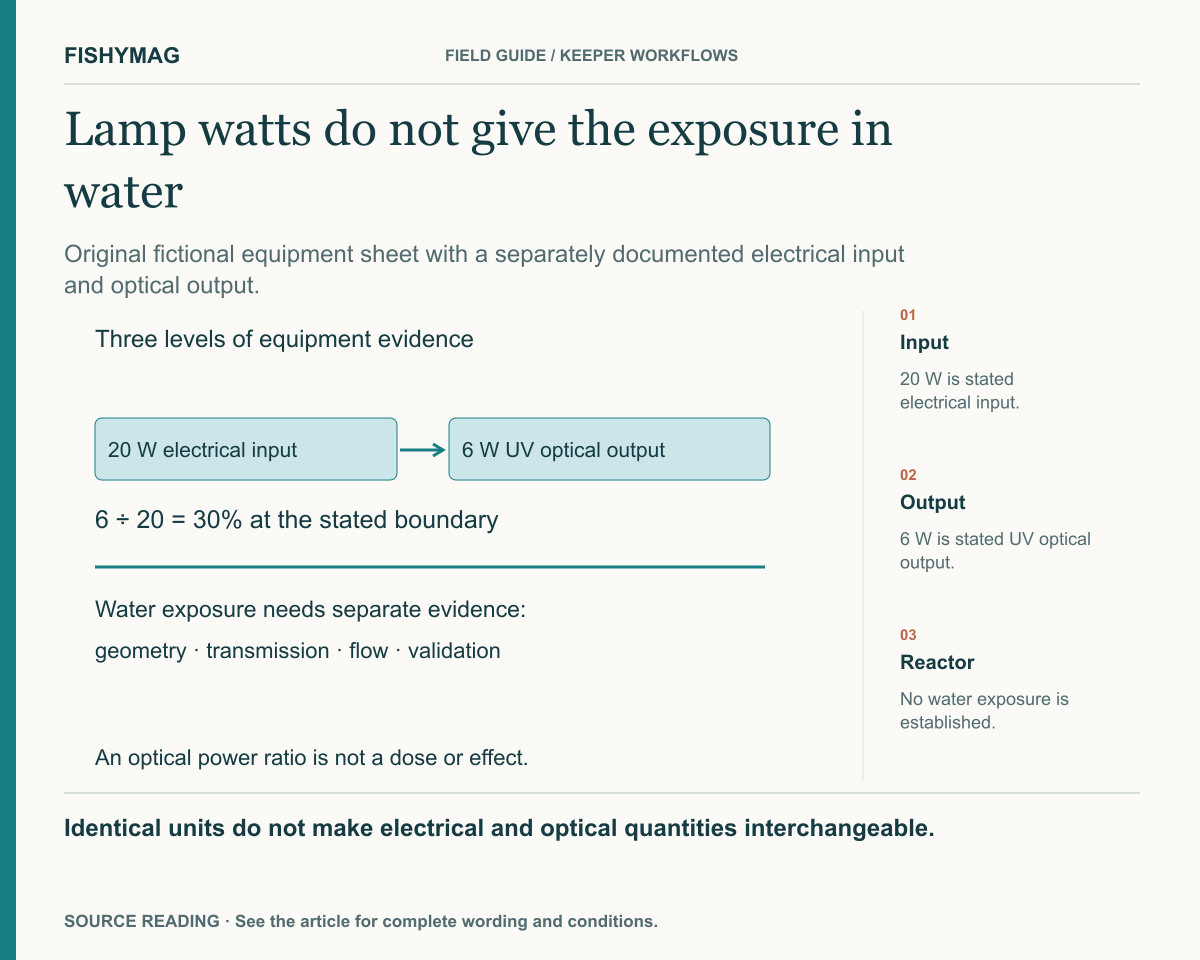
Figure data and explanation
Original fictional equipment sheet with a separately documented electrical input and optical output.
- Input
- 20 W is stated electrical input.
- Output
- 6 W is stated UV optical output.
- Reactor
- No water exposure is established.
Identical units do not make electrical and optical quantities interchangeable.
Find the measurement boundary beside each watt value
The Signify TUV PL-L family leaflet separates lamp power and UV-C radiation. Its code 210641 entry is 18 W lamp consumption and 5.5 W UV-C radiation. It is a real lamp specification and is not the fictional 20 W and 6 W device used below. A lamp figure also cannot stand in for electrical consumption at the wall if ballast and other loads are excluded.
Complete the fictional spec hierarchy
The 20 W input and 6 W output in this record refer to the same stated device and operating condition.
| Field | Fictional value | Meaning |
|---|---|---|
| Electrical input | 20 W | Power entering the stated device boundary |
| UV optical output | 6 W | Optical power in the specified band |
| Ratio | 6 ÷ 20 = 30% | Not a water dose or treatment percentage |
| Delivered exposure in reactor | No applicable validation result | Unresolved |
Request the actual performance document
Two lamps with the same UV-C power can sit in different sleeves and housings, with different water transmission and flow paths. A useful follow-up asks for validated reactor performance and the lamp, sleeve, water and hydraulic conditions represented. Do not interpret a marketing wattage or an optical ratio as efficacy.
Use your own details
Aquarium UV watts: electrical input or optical output? worksheet
Download the editable text file, fill it in on your device and keep it with the relevant record. This blank worksheet records your information; it does not verify entries or approve treatment.
- Exact lamp and reactor identifiers
- Electrical boundary: lamp or whole device
- Optical band and stated output
- Test and lifetime conditions
- Optical-to-electrical ratio, if bases match
- Water and reactor configuration
- Delivered exposure evidence
Put it into practice
Your checklist
- Compare electrical and optical figures at matching boundaries.
- Preserve the band and test conditions.
- Keep water exposure in its own row.
Sources and scope
This article distinguishes manufacturer statements from FishyMag’s own workflows and arithmetic examples. Linked formulation records retain their own evidence dates; publishing this article does not refresh those records.
- Signify TUV PL-L family leaflet, 2020-05-12; reviewed November 9, 2026 ↗
- EPA UV Disinfection Guidance Manual, Chapters 3 and 5; reviewed November 9, 2026 ↗
AI-assisted writing and development. Not hands-on product testing or veterinary review. How we publish →
FishyMag reports what manufacturers say, quoted and linked. It does not diagnose illness or recommend a treatment, and it never infers that a product is safe from the absence of a warning — where no statement exists, it says so.
Formulations change. Always read the label on the bottle in your hand, and contact the manufacturer if your tank contains anything valuable or unusual.