Keeper workflows
Six turnovers do not prove complete mixing
Use nominal aquarium turnover for what it measures and identify where a mixing claim needs additional evidence.
By FishyMag · Published
Worked hydraulic example · Not a clinical review or treatment recommendation.
Quick answer
A 200 L compartment receiving 1,200 L/h has six nominal turnovers per hour and a volume-to-flow ratio of ten minutes. Those two numbers still cannot tell when water reaches every corner or how long individual parcels remain in the compartment.
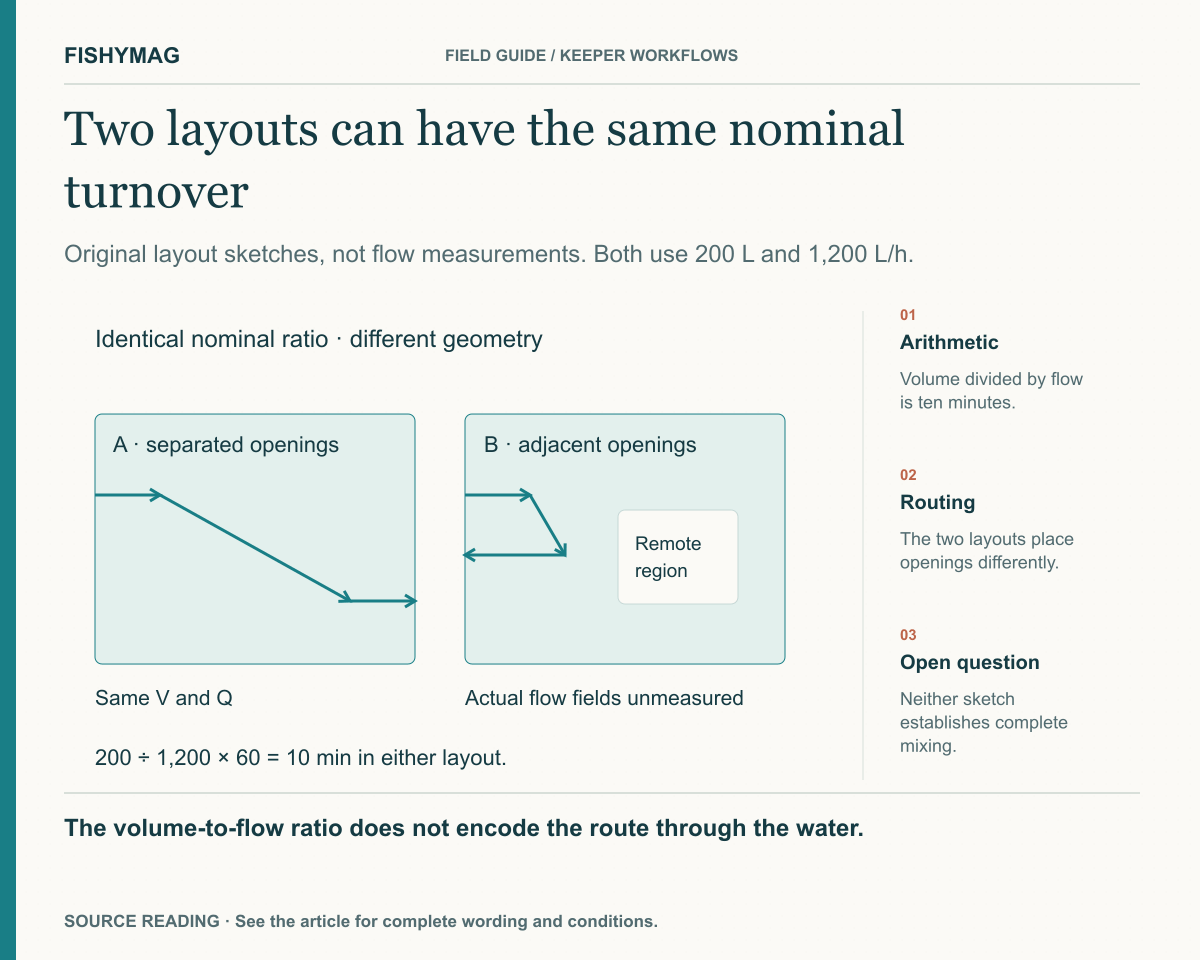
Figure data and explanation
Original layout sketches, not flow measurements. Both use 200 L and 1,200 L/h.
- Arithmetic
- Volume divided by flow is ten minutes.
- Routing
- The two layouts place openings differently.
- Open question
- Neither sketch establishes complete mixing.
The volume-to-flow ratio does not encode the route through the water.
Give the ten-minute number its proper name
The fictional record has 200 L of operating water and 1,200 L/h flowing across its boundary in a steady state. Divide the volume by flow to get one sixth of an hour. The reciprocal is six per hour. This is nominal hydraulic turnover, not a deadline by which each part of the aquarium has been reached.
Compare two arrangements with identical arithmetic
The first sketch separates inlet and outlet. The second puts them near each other with a remote region behind a partition. Arrows show only schematic routing possibilities, not predictions.
| Question | Arrangement A | Arrangement B |
|---|---|---|
| Volume and boundary flow | 200 L; 1,200 L/h | 200 L; 1,200 L/h |
| V/Q | 10 minutes | 10 minutes |
| Inlet/outlet arrangement | Opposite regions | Near each other |
| Time for all regions to be reached | Unmeasured | Unmeasured |
| Residence-time distribution | Not provided | Not provided |
Look for measurements that answer the actual mixing question
Davidson and Summerfelt examined inlet and drain configurations, velocity and oxygen profiles in large aquaculture tanks. Their methods illustrate the additional evidence used to describe a flow field. Their reported mixing cannot be assigned to either fictional aquarium. If a report offers only a pump rating or V/Q, record the nominal ratio and leave the spatial claim open. Even a well-mixed model is an assumption unless the evidence supports it.
Use your own details
Six turnovers do not prove complete mixing worksheet
Download the editable text file, fill it in on your device and keep it with the relevant record. This blank worksheet records your information; it does not verify entries or approve treatment.
- Compartment and operating volume
- Boundary flow and timestamp
- Nominal Q/V and V/Q
- Inlet and outlet geometry
- Baffles, screens or other routing
- Spatial observations or residence-time evidence
- Unresolved mixing or coverage claim
Put it into practice
Your checklist
- Use an operating volume and actual boundary flow.
- Record the routing geometry beside the turnover value.
- Require separate evidence for spatial or passage-time claims.
Sources and scope
This article distinguishes manufacturer statements from FishyMag’s own workflows and arithmetic examples. Linked formulation records retain their own evidence dates; publishing this article does not refresh those records.
- Davidson and Summerfelt, Cornell-type dual-drain tank measurements (2004); reviewed November 9, 2026 ↗
- US EPA EPANET 2.2 manual, network components and hydraulic equations; reviewed November 9, 2026 ↗
AI-assisted writing and development. Not hands-on product testing or veterinary review. How we publish →
FishyMag reports what manufacturers say, quoted and linked. It does not diagnose illness or recommend a treatment, and it never infers that a product is safe from the absence of a warning — where no statement exists, it says so.
Formulations change. Always read the label on the bottle in your hand, and contact the manufacturer if your tank contains anything valuable or unusual.