Keeper workflows
Trace the water paths in aquarium top-off
Read automatic top-off as a water-path and elevation problem, and identify the evidence missing from a fictional sump connection.
By FishyMag · Published
Worked hydraulic example · Not a clinical review or treatment recommendation.
Quick answer
The reservoir-to-sump delivery path is documented. The outlet’s position relative to the water levels and a second hose’s termination are missing. Those gaps prevent the record from establishing separation or predicting reverse flow.
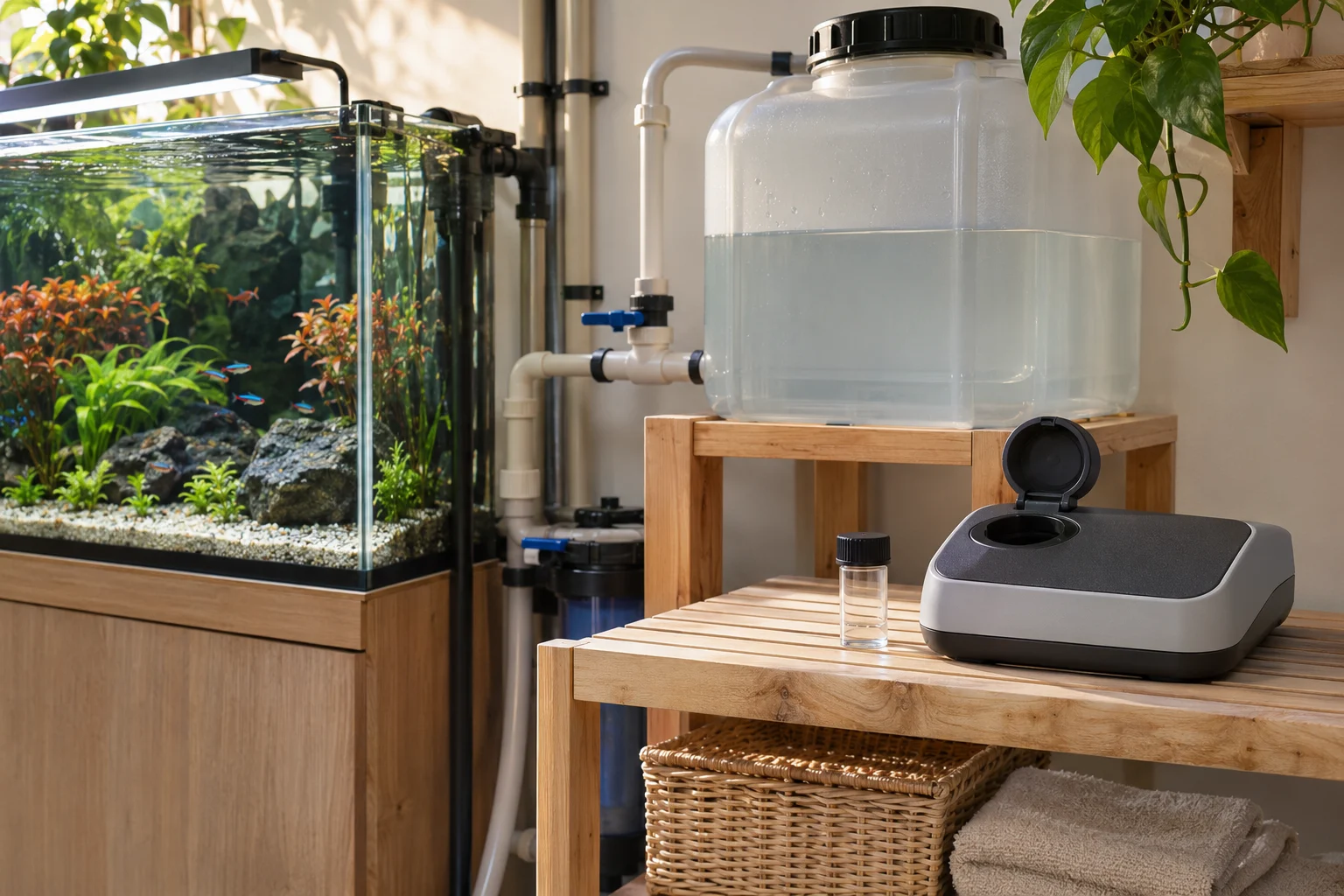
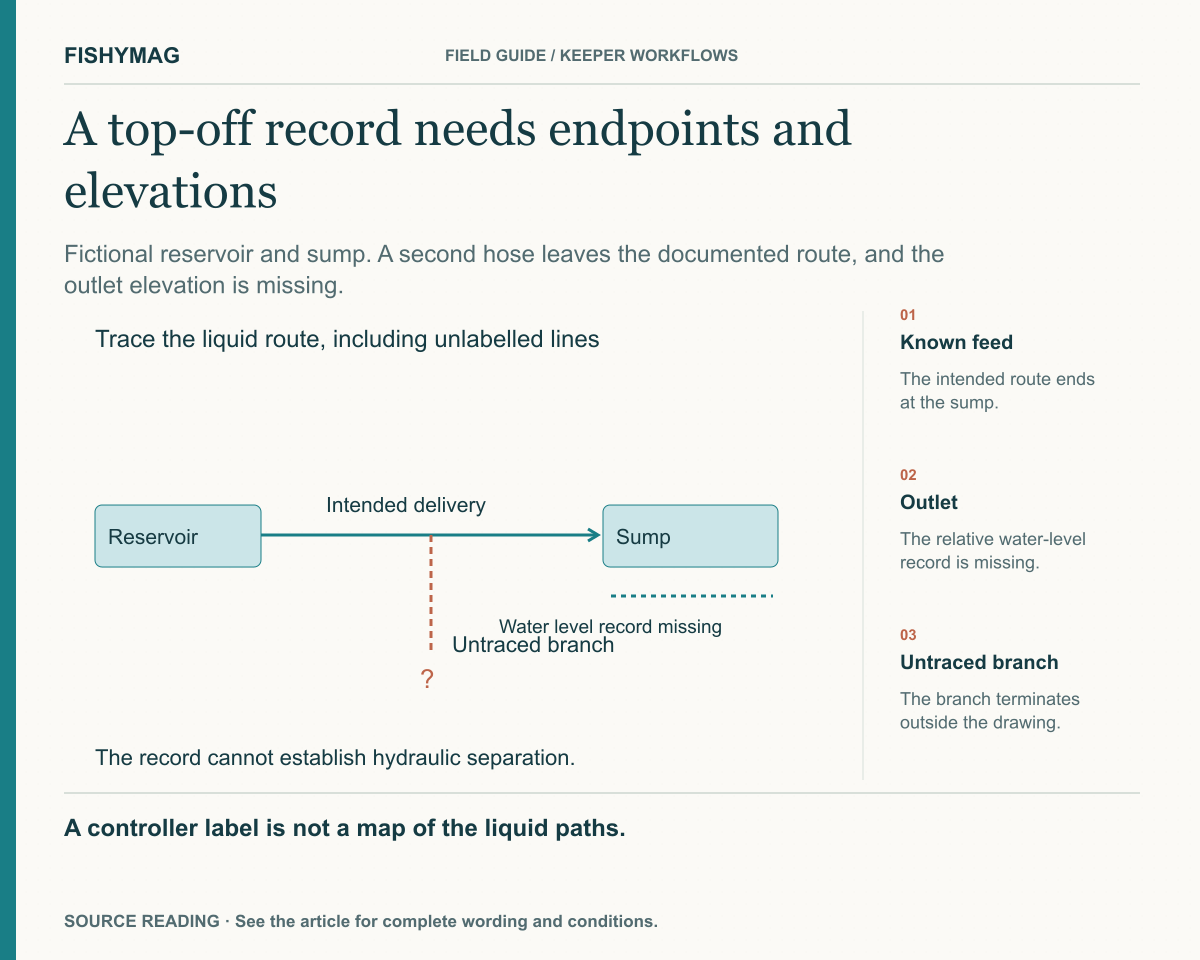
Figure data and explanation
Fictional reservoir and sump. A second hose leaves the documented route, and the outlet elevation is missing.
- Known feed
- The intended route ends at the sump.
- Outlet
- The relative water-level record is missing.
- Untraced branch
- The branch terminates outside the drawing.
A controller label is not a map of the liquid paths.
Draw the delivery line to its termination
The fictional keeper’s packet shows a reservoir and a pump with one delivery hose leading to a sump. A second line branches from the hose and leaves the frame. No height reference appears on the installation photo. The TUNZE Osmolator 3155 manual distinguishes outlet position and the relative reservoir and receiving-water levels when discussing unintended water movement. It is evidence for what to document, not proof this case matches its configuration.
Separate what is traced from what is guessed
Controller state and hose geometry answer different questions. A control record saying the pump is off does not identify the hose end or establish how water moves after that event.
| Path question | Packet evidence | Finding |
|---|---|---|
| Reservoir to sump | Both endpoints shown for main feed | Intended delivery documented |
| Outlet and water surfaces | No common level reference | Siphon and reverse-flow behaviour unresolved |
| Additional branch | Leaves image at tee | Destination and role unresolved |
| Any potable connection | No source documentation | Do not assume this packet covers it |
Ask for a drawing that resolves the missing route
The next useful record is a labelled drawing or complete set of existing photos showing both water elevations, where the feed ends, and where the second line ends. Match its components to the actual manual. If the added record confirms a closed spare line, the unknown branch narrows; the outlet-elevation question may still remain. The audit does not require altering a live hose or running a siphon trial.
Use your own details
Trace the water paths in aquarium top-off worksheet
Download the editable text file, fill it in on your device and keep it with the relevant record. This blank worksheet records your information; it does not verify entries or approve treatment.
- Controller, pump and manual revision
- Reservoir maximum water elevation
- Sump operating and stopped levels
- Actual outlet elevation and end condition
- All branches and their destinations
- Evidence for reverse-flow or siphon protection
- Unresolved crossings to show in handover
Put it into practice
Your checklist
- Trace the outlet and every branch to its end.
- Put water levels and outlet on a common elevation reference.
- Keep intended delivery separate from backflow evidence.
Sources and scope
This article distinguishes manufacturer statements from FishyMag’s own workflows and arithmetic examples. Linked formulation records retain their own evidence dates; publishing this article does not refresh those records.
- TUNZE Osmolator 3155 manual, feed-hose positioning; reviewed November 9, 2026 ↗
- Red Sea REEFER series manual v19A, water management system; reviewed November 9, 2026 ↗
AI-assisted writing and development. Not hands-on product testing or veterinary review. How we publish →
FishyMag reports what manufacturers say, quoted and linked. It does not diagnose illness or recommend a treatment, and it never infers that a product is safe from the absence of a warning — where no statement exists, it says so.
Formulations change. Always read the label on the bottle in your hand, and contact the manufacturer if your tank contains anything valuable or unusual.