Keeper workflows
An aquarium substitute needs its own evidence packet
Evaluate a seller’s substitute offer without transferring the requested item’s formulation record, compatibility claims or label conditions.
By FishyMag · Published
Worked evidence example · Not a clinical review or treatment recommendation.
Quick answer
A seller’s “equivalent” description documents an offer, not an evidence bridge. In the fictional case, S2 is offered instead of R1 with no applicable manufacturer mapping. Record the two identities separately. R1’s formulation record cannot clear S2, and a shared use claim or active-ingredient name cannot establish compatibility.

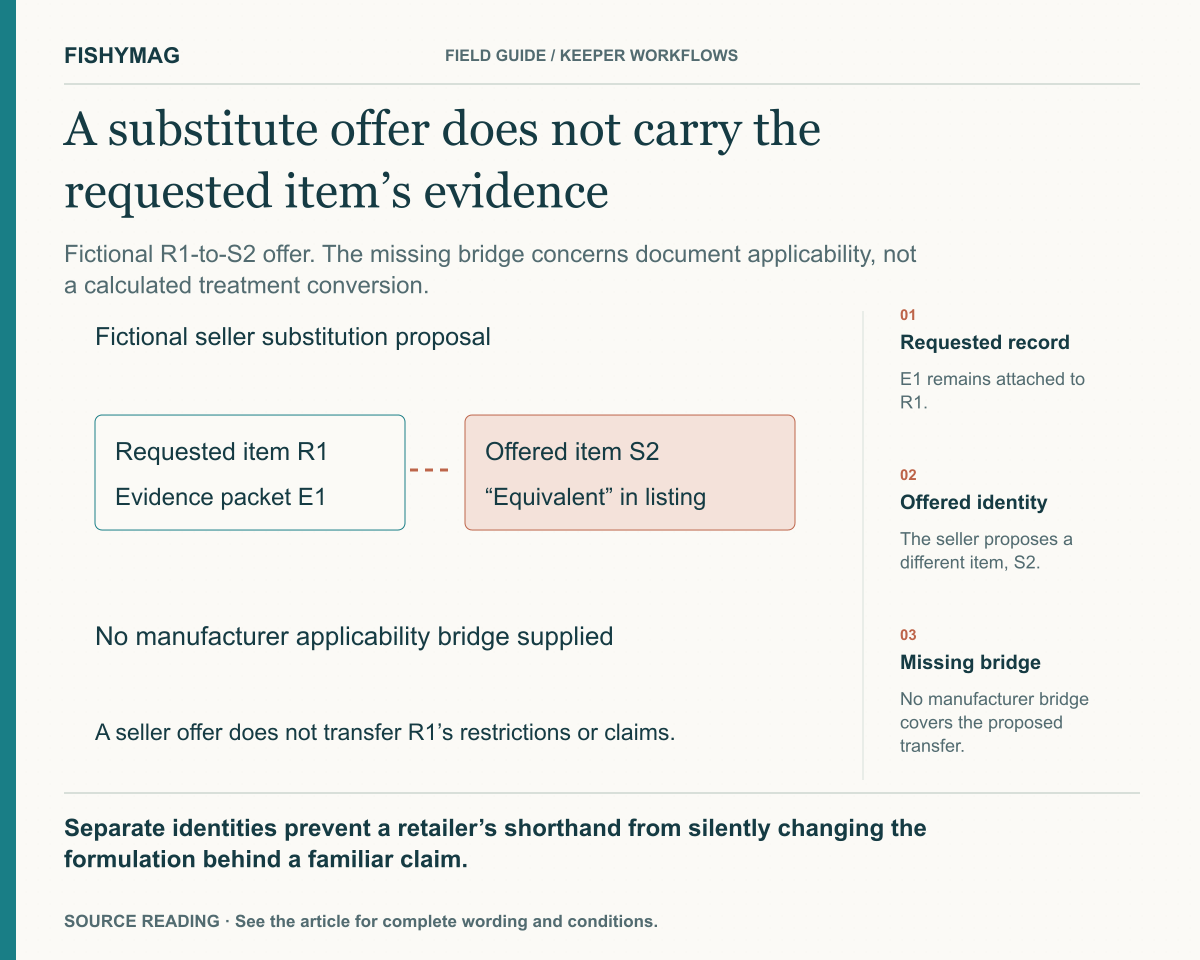
Figure data and explanation
Fictional R1-to-S2 offer. The missing bridge concerns document applicability, not a calculated treatment conversion.
- Requested record
- E1 remains attached to R1.
- Offered identity
- The seller proposes a different item, S2.
- Missing bridge
- No manufacturer bridge covers the proposed transfer.
Separate identities prevent a retailer’s shorthand from silently changing the formulation behind a familiar claim.
Keep the requested record attached to the requested item
FishyMag’s existing US Algae Clean Out record provides a practical anchor for why a named formulation matters. Its manufacturer evidence is dated August 16, 2026; this article does not claim a fresh manufacturer-page verification or change that record. A shopping listing that offers a different item cannot move the record’s claims to the offered bottle. Any optional retailer link on the existing record refers to that identified product, not a recommendation to select a treatment.
Complete the substitution review
R1, S2 and E1 below are fictional. The seller has supplied an “equivalent alternative” description, a photograph of S2 and no manufacturer statement connecting the two formulations or their claim conditions.
| Claim or question | Evidence supplied | Finding |
|---|---|---|
| What was requested? | R1 with evidence packet E1 | Original requested identity retained |
| What is offered? | S2 in seller listing | Different offered identity retained |
| Does the seller call it equivalent? | Yes, in the offer text | Seller claim attributed, not adopted |
| Does R1 evidence cover S2? | No applicable bridge supplied | Not established |
| Does an ingredient-name match clear compatibility? | Even a match would not establish safety | No compatibility inference issued |
Ask for S2 evidence before trying to bridge the records
Request S2’s exact manufacturer label and revision, market, strength basis and relevant restrictions, then ask what explicit evidence supports the proposed relationship to R1. Do not turn a similar pack size or a shared treatment category into a dose conversion, a combination recommendation or a safety finding. An ingredient concern may raise a warning, but absence of a flagged ingredient does not establish compatibility. The completed result is an unresolved substitution-evidence claim. It is not a diagnosis, treatment ranking or accusation that S2 is counterfeit. Preserve the offer and original item separately so a later reviewer can see what changed.
Use your own details
An aquarium substitute needs its own evidence packet worksheet
Download the editable text file, fill it in on your device and keep it with the relevant record. This blank worksheet records your information; it does not verify entries or approve treatment.
- Requested item R1, market and revision
- Offered item S2, market and revision
- Exact seller substitution wording and date
- R1 source packet and conditions
- S2 manufacturer source packet, or missing fields
- Explicit applicability or equivalence statement, if supplied
- Completed evidence-continuity finding
- Precise request naming both received and requested identities
Put it into practice
Your checklist
- Keep requested and offered identities separate.
- Attribute the seller’s equivalence wording to its source.
- Require applicable S2 evidence before making or transferring a claim.
Sources and scope
This article distinguishes manufacturer statements from FishyMag’s own workflows and arithmetic examples. Linked formulation records retain their own evidence dates; publishing this article does not refresh those records.
- Existing FishyMag US Algae Clean Out record; manufacturer evidence dated August 16, 2026, not freshly reverified here; reviewed November 9, 2026 ↗
- FishyMag evidence methodology; reviewed November 8, 2026 ↗
- FishyMag bottle identity worksheet; reviewed November 8, 2026 ↗
- FishyMag formulation evidence comparison; reviewed November 8, 2026 ↗
- FishyMag manufacturer question brief; reviewed November 8, 2026 ↗
AI-assisted writing and development. Not hands-on product testing or veterinary review. How we publish →
Read the formulation evidence
These links provide context, not product recommendations.
FishyMag reports what manufacturers say, quoted and linked. It does not diagnose illness or recommend a treatment, and it never infers that a product is safe from the absence of a warning — where no statement exists, it says so.
Formulations change. Always read the label on the bottle in your hand, and contact the manufacturer if your tank contains anything valuable or unusual.