Keeper workflows
An aquarium supply outside its documented storage conditions
Interpret a documented aquarium-supply storage excursion without inventing an acceptable time-temperature allowance from a general SDS statement.
By FishyMag · Published
Worked evidence example · Not a clinical review or treatment recommendation.
Quick answer
A temperature record establishes exposure only to the extent its link to the item is documented. It does not supply a stability allowance. The cited Fritz Algae Clean Out SDS advises avoiding extreme heat and cold but does not establish a 42 °C, two-hour allowance. The fictional S8 record therefore cannot establish remaining suitability or degradation from those facts alone.
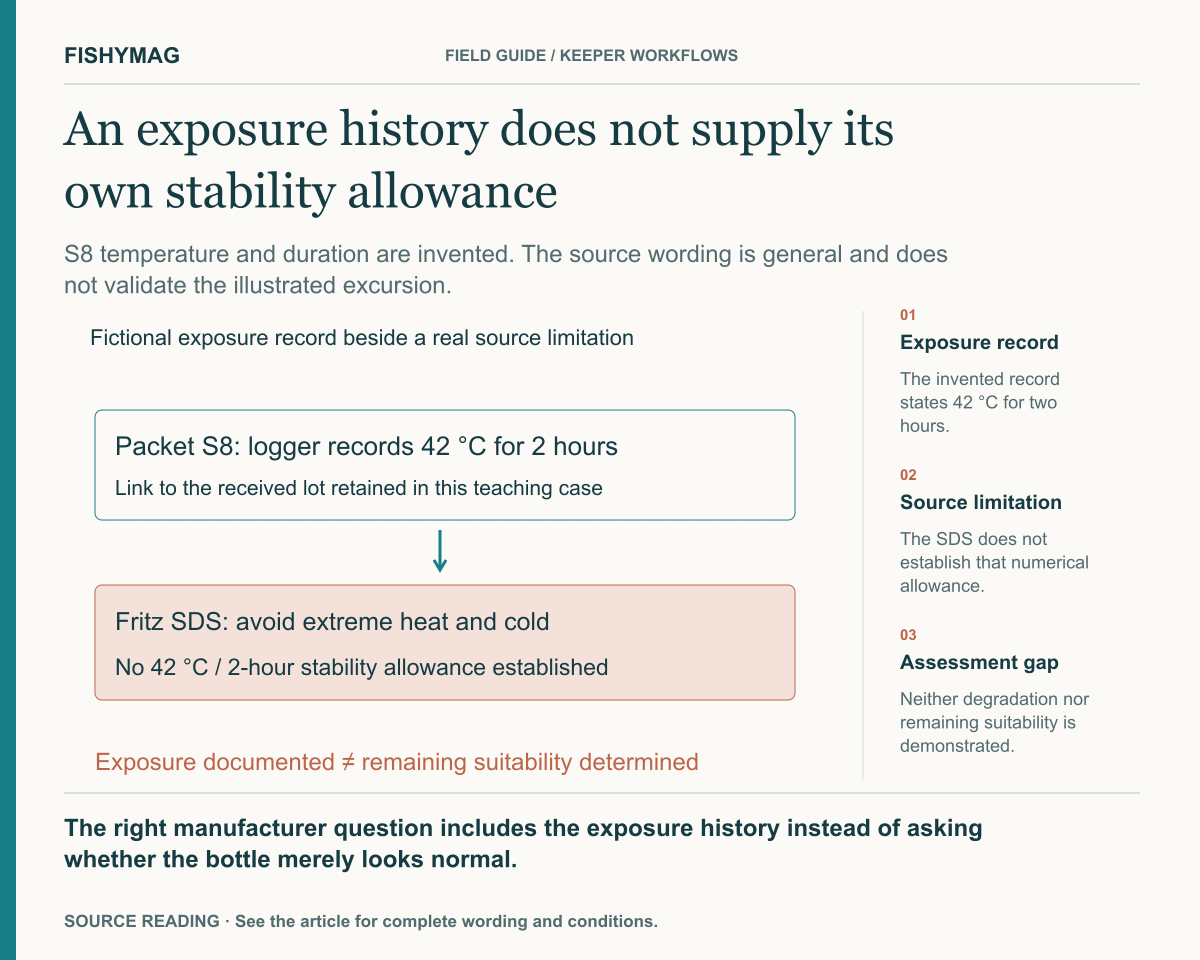
Figure data and explanation
S8 temperature and duration are invented. The source wording is general and does not validate the illustrated excursion.
- Exposure record
- The invented record states 42 °C for two hours.
- Source limitation
- The SDS does not establish that numerical allowance.
- Assessment gap
- Neither degradation nor remaining suitability is demonstrated.
The right manufacturer question includes the exposure history instead of asking whether the bottle merely looks normal.
Preserve the exposure record without upgrading it
The S8 teaching packet declares a logger record of 42 °C for two hours, with a documented connection to the received pack. Those are invented case facts, not data from FishyMag shipping or storage tests. In a real packet, a vehicle-weather report, cabinet air sensor and liquid temperature are different observations. Record what the device actually measured and how its location relates to the pack.
Compare the record with the statement actually available
The manufacturer-hosted Fritz SDS revised July 11, 2017 supplies general storage and stability wording. It is not a time-temperature stability study for the numerical S8 excursion. The case does not establish that this historical document is the only applicable current instruction.
| Question | Available evidence | Completed finding |
|---|---|---|
| What exposure is in the teaching record? | 42 °C for two hours, with declared pack link | Retained as a case exposure fact |
| Does the cited SDS give this exact allowance? | General extreme-temperature caution | No exact allowance established |
| Was degradation demonstrated? | No applicable analytical or manufacturer assessment | Not demonstrated |
| Was remaining suitability demonstrated? | No product-specific clearance for this excursion | Not demonstrated |
| Does an unchanged appearance settle it? | Appearance is not an applicable stability assessment | No clearance inferred |
Ask about the actual excursion and lot
Provide the responsible manufacturer with the pack identity, document revision, complete exposure record, logger location and any gaps. Ask whether applicable evidence addresses this exact history and whether additional information is needed. Do not interpolate an allowance from a different product, invent a chemical ageing equation or convert a general “stable under recommended conditions” statement into approval of an excursion outside those conditions. The useful conclusion is a documented exposure paired with an unanswered product-specific stability question, rather than either an invented clearance or a claim that the contents definitely degraded.
Use your own details
An aquarium supply outside its documented storage conditions worksheet
Download the editable text file, fill it in on your device and keep it with the relevant record. This blank worksheet records your information; it does not verify entries or approve treatment.
- Received product, market, lot and expiry
- Exposure start and end with clock basis
- Logger identity, location and evidence linking it to the pack
- Original time-temperature record and gaps
- Applicable label and storage-document revision
- Specific allowance actually stated, or explicit absence
- Completed exposure finding without chemical clearance
- Manufacturer question including the entire exposure history
Put it into practice
Your checklist
- Keep the logger-to-pack link and complete time history.
- Look for an explicit applicable allowance rather than a general stability phrase.
- Request a lot- and exposure-specific assessment without inferring it from appearance.
Sources and scope
This article distinguishes manufacturer statements from FishyMag’s own workflows and arithmetic examples. Linked formulation records retain their own evidence dates; publishing this article does not refresh those records.
- Fritz Algae Clean Out SDS, July 11, 2017, storage and stability sections; reviewed November 9, 2026 ↗
- FishyMag evidence methodology; reviewed November 8, 2026 ↗
- FishyMag bottle identity worksheet; reviewed November 8, 2026 ↗
- FishyMag manufacturer question brief; reviewed November 8, 2026 ↗
AI-assisted writing and development. Not hands-on product testing or veterinary review. How we publish →
FishyMag reports what manufacturers say, quoted and linked. It does not diagnose illness or recommend a treatment, and it never infers that a product is safe from the absence of a warning — where no statement exists, it says so.
Formulations change. Always read the label on the bottle in your hand, and contact the manufacturer if your tank contains anything valuable or unusual.