Keeper workflows
Does every condition in an aquarium recall notice match?
Complete a recall-scope matrix for three fictional aquarium packs while preserving unreadable identifiers and the notice’s separate action instructions.
By FishyMag · Published
Worked evidence example · Not a clinical review or treatment recommendation.
Quick answer
Check every scope condition in the original notice. In this fictional example, item AX-20 with lot L42 in Market M matches the stated scope; lot L44 does not match its lot range; an unreadable lot remains unresolved. A brand match alone cannot complete the review, and being outside one notice is not a safety clearance.
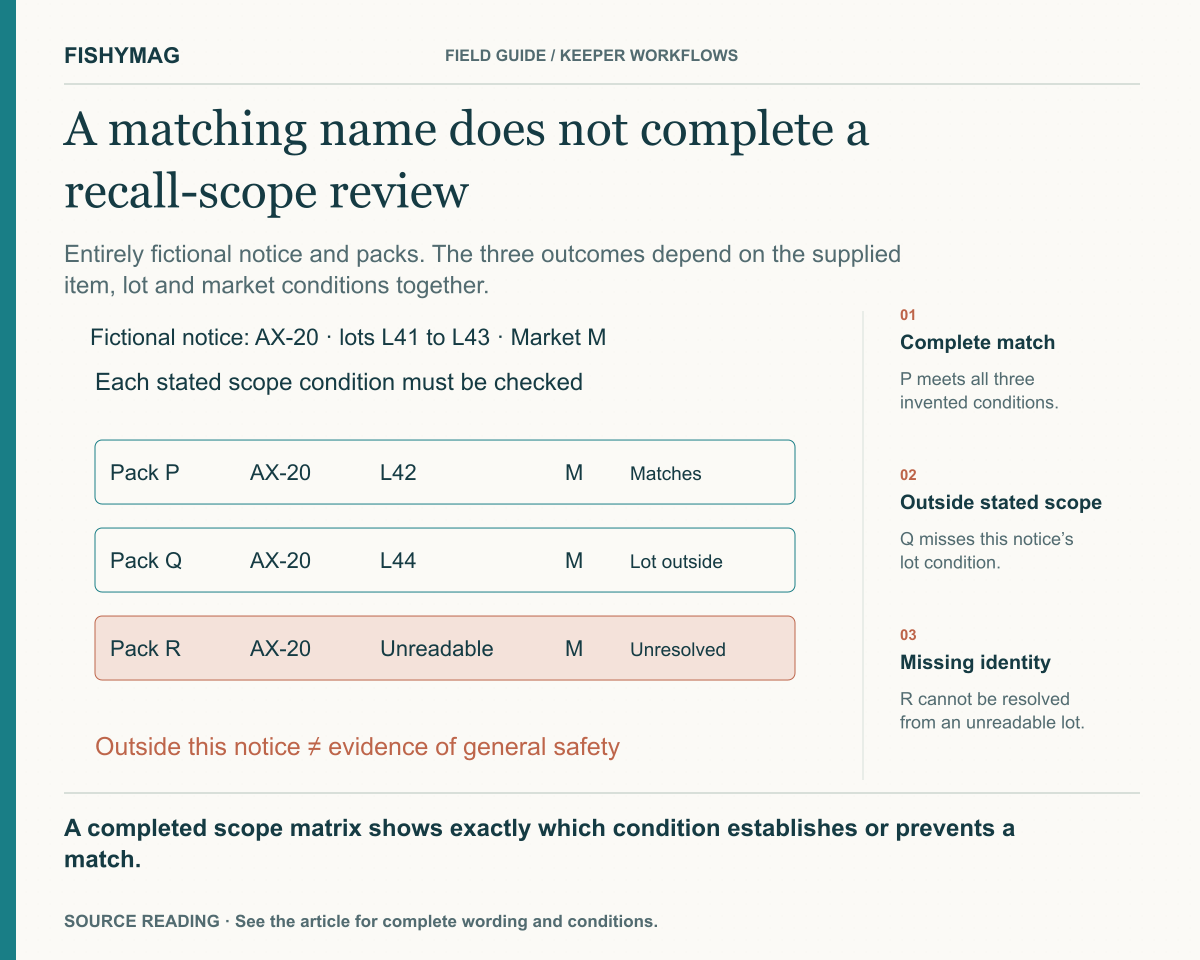
Figure data and explanation
Entirely fictional notice and packs. The three outcomes depend on the supplied item, lot and market conditions together.
- Complete match
- P meets all three invented conditions.
- Outside stated scope
- Q misses this notice’s lot condition.
- Missing identity
- R cannot be resolved from an unreadable lot.
A completed scope matrix shows exactly which condition establishes or prevents a match.
Copy the notice’s scope before inspecting the pack
Real notices do not all use the same conditions. The CPSC’s April 21, 2011 Marineland heater notice, for example, identifies specific model numbers and notes that some products were sold in starter kits. Do not invent a lot requirement if the actual notice uses models, or overlook a component because it arrived inside a kit. That historical notice is a real source; the pack-and-lot example below is entirely fictional and does not announce a new recall.
Complete the three-pack review
The invented notice applies jointly to AX-20, lots L41 through L43, supplied in Market M. Its stated action must be read separately. All identifiers below belong to a teaching case, not an actual manufacturer, market authorization or recalled supply.
| Received pack | Item condition | Lot condition | Market condition | Completed scope finding |
|---|---|---|---|---|
| P | AX-20 matches | L42 is within L41 to L43 | M matches | All supplied scope conditions match |
| Q | AX-20 matches | L44 is outside the stated range | M matches | Does not match this notice’s lot condition |
| R | AX-20 matches | Lot cannot be read | M matches | Unresolved; do not infer a lot from the carton beside it |
Keep scope, action and general suitability separate
For P, preserve the exact notice and its applicable action rather than substituting advice from a seller review. For Q, the finding is limited to this notice; it does not establish general product suitability or rule out another notice. For R, ask the issuing organization how the actual pack can be identified when its lot is unreadable. Keep photographs, purchase details and any component identity together. If a real notice instructs immediate action, follow its official instruction and current contact route rather than treating this worksheet as a reason to postpone it. The CPSC notice’s original remedy text must not be presented as a guarantee that a historical contact number or remedy process remains unchanged today.
Use your own details
Does every condition in an aquarium recall notice match? worksheet
Download the editable text file, fill it in on your device and keep it with the relevant record. This blank worksheet records your information; it does not verify entries or approve treatment.
- Received item and original identifier record
- Issuer, document URL and retrieval date
- Document revision and market scope
- Exact item, lot and component conditions
- Pack evidence for each required condition
- Completed applicability finding
- Unresolved identity or revision link
- Precise follow-up request and retained original evidence
Put it into practice
Your checklist
- Use the original notice’s actual scope conditions.
- Preserve unreadable identifiers as unresolved.
- Keep notice applicability separate from its required action and broader suitability.
Sources and scope
This article distinguishes manufacturer statements from FishyMag’s own workflows and arithmetic examples. Linked formulation records retain their own evidence dates; publishing this article does not refresh those records.
- CPSC historical Marineland Stealth and Stealth Pro recall notice, April 21, 2011; reviewed November 9, 2026 ↗
- FishyMag evidence methodology; reviewed November 8, 2026 ↗
- FishyMag bottle identity worksheet; reviewed November 8, 2026 ↗
- FishyMag manufacturer question brief; reviewed November 8, 2026 ↗
AI-assisted writing and development. Not hands-on product testing or veterinary review. How we publish →
FishyMag reports what manufacturers say, quoted and linked. It does not diagnose illness or recommend a treatment, and it never infers that a product is safe from the absence of a warning — where no statement exists, it says so.
Formulations change. Always read the label on the bottle in your hand, and contact the manufacturer if your tank contains anything valuable or unusual.