Keeper workflows
Compare sump headroom with documented drain-down
Compare usable sump headroom with a documented drain-down interval without calling the result a flood test.
By FishyMag · Published
Worked hydraulic example · Not a clinical review or treatment recommendation.
Quick answer
The fictional rectangular chamber has 24 L of usable headroom. Subtracting the documented 18 to 22 L drain-down interval leaves 2 to 6 L of nominal headroom. The calculation is positive only for the stated paths and dimensions.
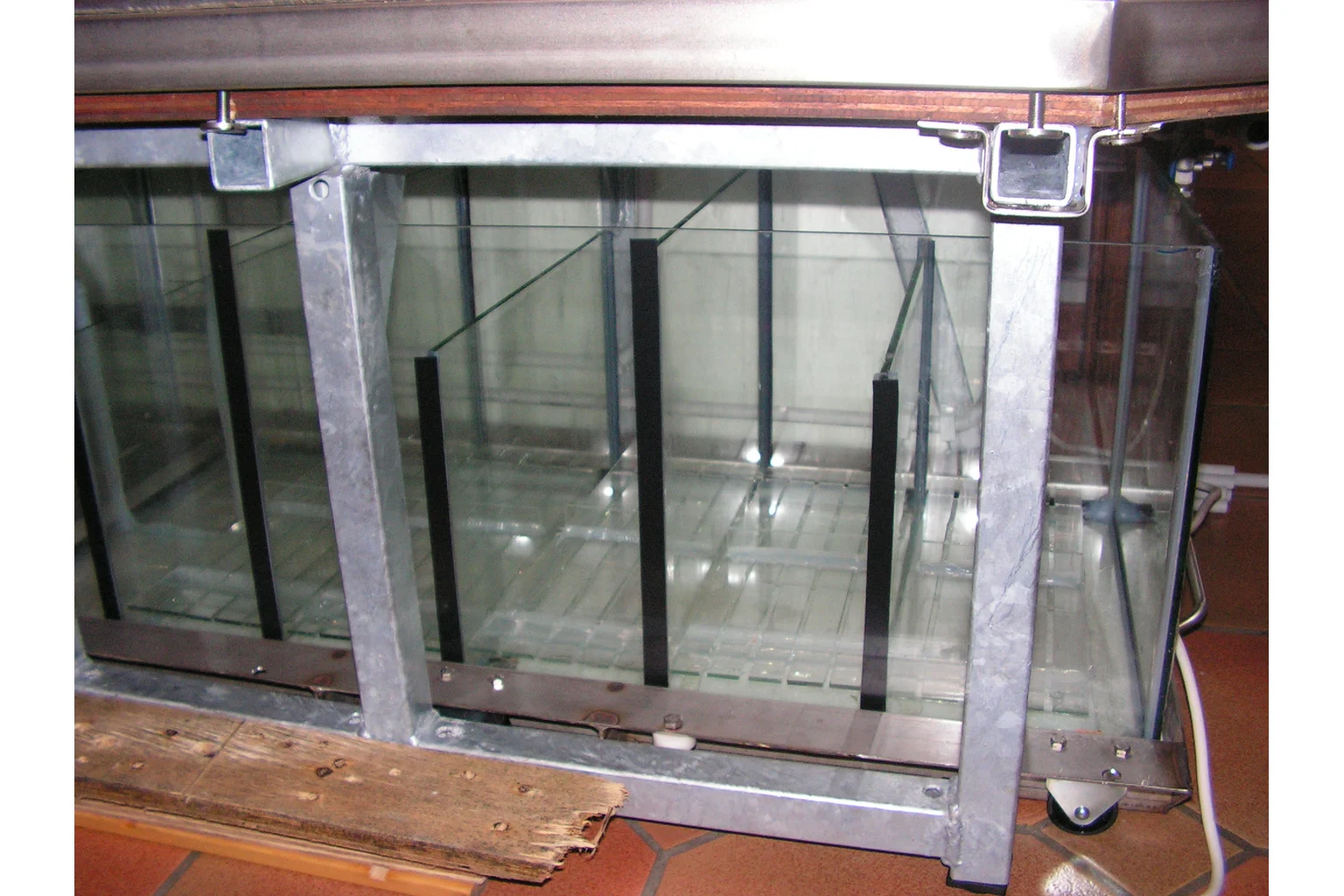
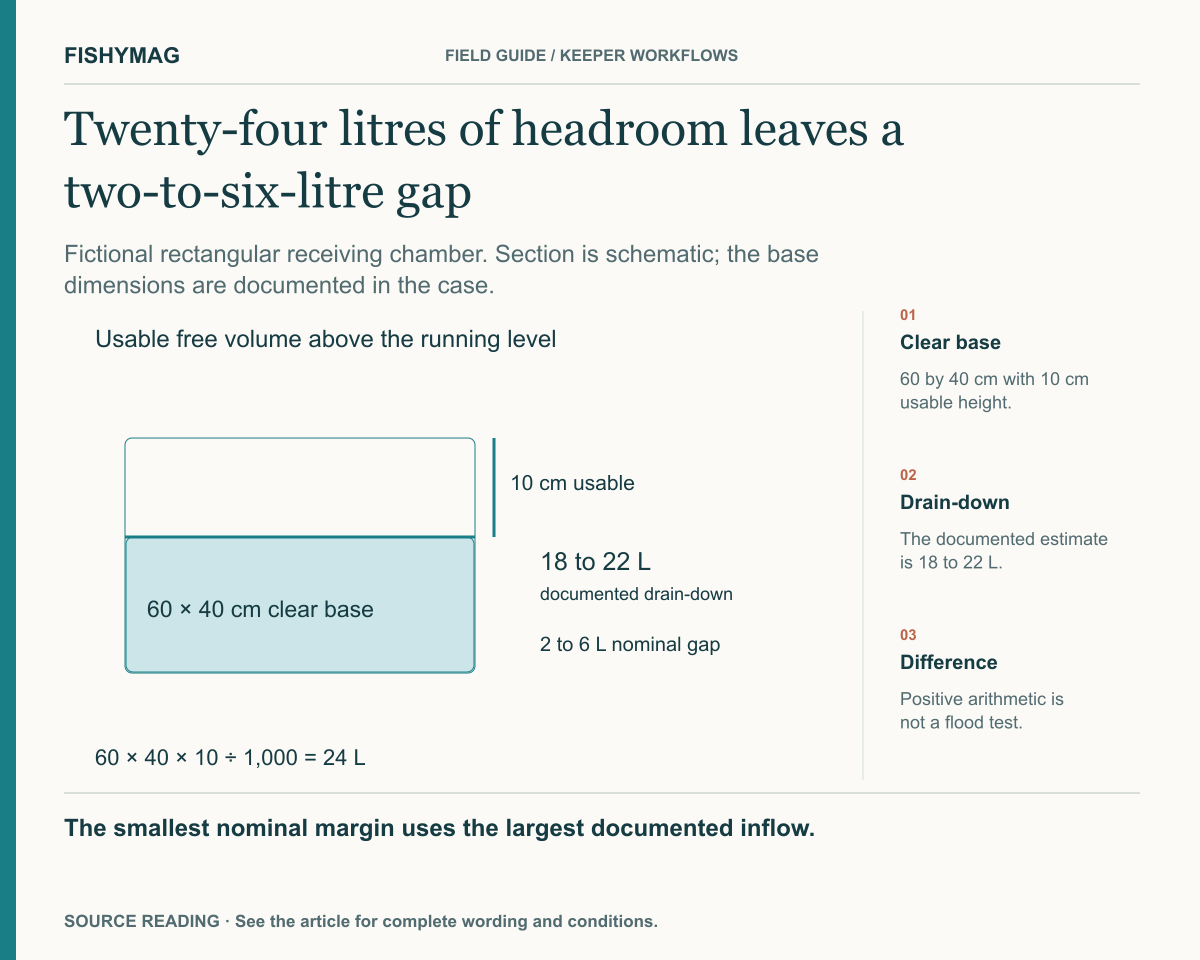
Figure data and explanation
Fictional rectangular receiving chamber. Section is schematic; the base dimensions are documented in the case.
- Clear base
- 60 by 40 cm with 10 cm usable height.
- Drain-down
- The documented estimate is 18 to 22 L.
- Difference
- Positive arithmetic is not a flood test.
The smallest nominal margin uses the largest documented inflow.
Measure the space water can actually reach on the drawing
The fictional engineering packet specifies one rectangular receiving chamber, 60 cm by 40 cm clear inside, with 10 cm of unobstructed vertical space from running level to the chosen upper limit. The receiving chamber alone is counted. Red Sea’s illustrated water management system distinguishes sump compartments and downpipes, a reason to read a real layout instead of assuming the whole cabinet provides one free volume.
Subtract the high end first for the smallest margin
Use 1,000 cubic centimetres per litre. The 18 to 22 L interval is a given fictional drain-down estimate from the system record; it is not computed from the pump output.
| Quantity | Calculation | Result |
|---|---|---|
| Usable free volume | 60 × 40 × 10 ÷ 1,000 | 24 L |
| Largest documented inflow | 24 − 22 | 2 L nominal difference |
| Smallest documented inflow | 24 − 18 | 6 L nominal difference |
| Uncounted extra drain line | Amount not documented | Earlier margin may not apply |
Mark omissions beside the number
Headroom behind a partition counts only if the water can reach it under the modelled condition. Equipment displaces volume; other returns, overflows and connected vessels may add water. If a revised drawing introduces an uncounted path, do not certify overflow prevention from the positive subtraction. This worksheet compares existing dimensions and estimates; it does not ask a keeper to stop a running system.
Use your own details
Compare sump headroom with documented drain-down worksheet
Download the editable text file, fill it in on your device and keep it with the relevant record. This blank worksheet records your information; it does not verify entries or approve treatment.
- Clear internal footprint and units
- Running water level and usable upper limit
- Accessible chambers and restrictions
- Usable volume and displacement assumptions
- Documented drain paths and interval
- Smallest and largest nominal difference
- Uncounted volumes or inaccessible headroom
Put it into practice
Your checklist
- Use clear and accessible volume at the stated level.
- Compare both ends of the drain-down interval.
- Keep omitted paths and displacement visible.
Sources and scope
This article distinguishes manufacturer statements from FishyMag’s own workflows and arithmetic examples. Linked formulation records retain their own evidence dates; publishing this article does not refresh those records.
- Red Sea REEFER series manual v19A, water management system; reviewed November 9, 2026 ↗
- US Bureau of Reclamation Water Measurement Manual, changing flow conditions; reviewed November 9, 2026 ↗
AI-assisted writing and development. Not hands-on product testing or veterinary review. How we publish →
FishyMag reports what manufacturers say, quoted and linked. It does not diagnose illness or recommend a treatment, and it never infers that a product is safe from the absence of a warning — where no statement exists, it says so.
Formulations change. Always read the label on the bottle in your hand, and contact the manufacturer if your tank contains anything valuable or unusual.