Evidence literacy
Read aquarium survival curves without losing the follow-up
Calculate a fictional Kaplan-Meier comparison with explicit risk sets, censoring marks and different follow-up endings.
By FishyMag · Published
Worked arithmetic example · Not a clinical review or treatment recommendation.
Quick answer
At day 4, the fictional unmodified Kaplan-Meier estimates are 62.5% for A and 66.7% for B. Both groups have two events, but A loses a censored unit before the second event, changing its risk set. Censored units are not confirmed survivors through later follow-up.

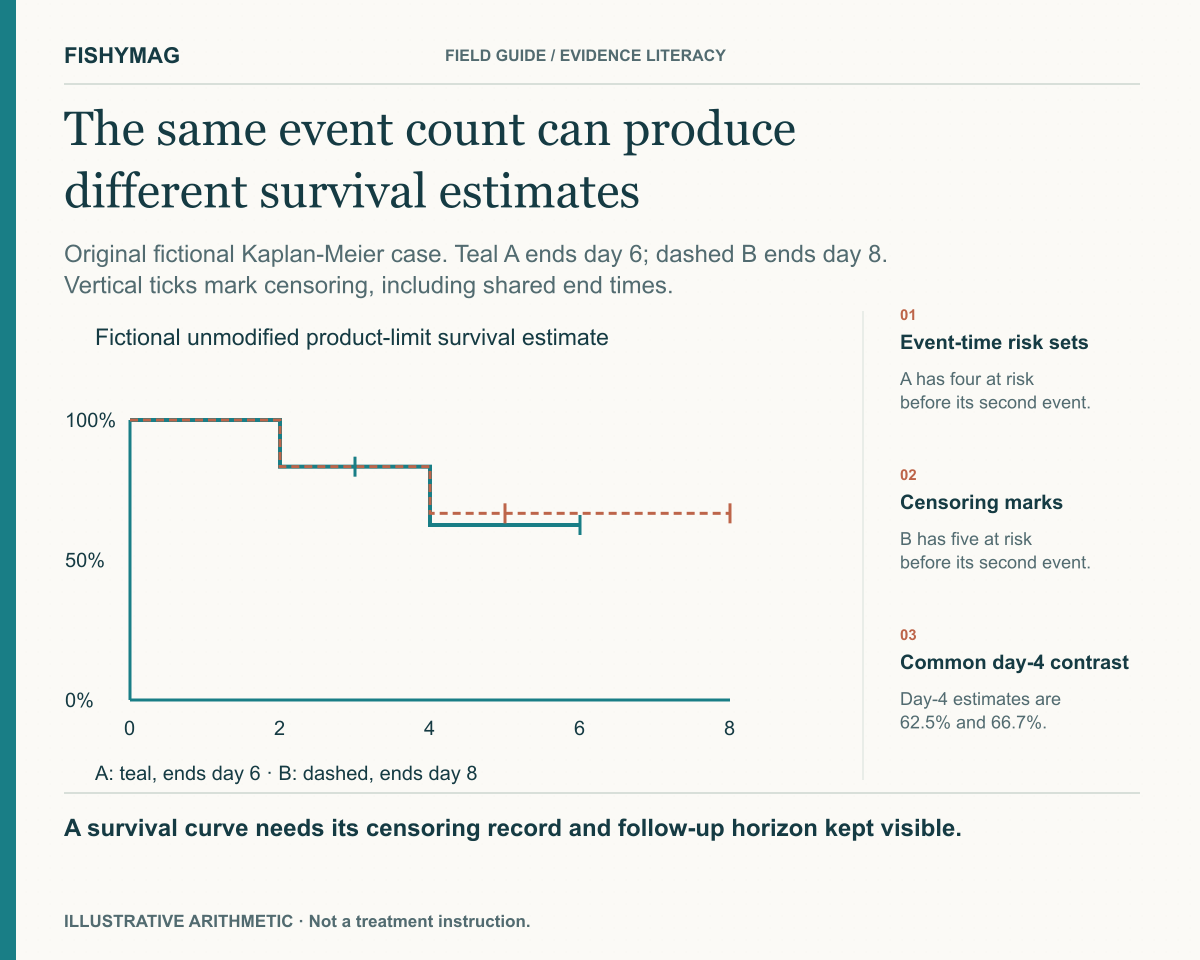
Figure data and explanation
Original fictional Kaplan-Meier case. Teal A ends day 6; dashed B ends day 8. Vertical ticks mark censoring, including shared end times.
- Event-time risk sets
- A has four at risk before its second event.
- Censoring marks
- B has five at risk before its second event.
- Common day-4 contrast
- Day-4 estimates are 62.5% and 66.7%.
A survival curve needs its censoring record and follow-up horizon kept visible.
Keep censoring in the risk-set calculation
This original fictional case starts with six independent units per group and one defined event endpoint. A has events on days 2 and 4, censoring on day 3, and administrative follow-up ending day 6 for its remaining three units. B has events on days 2 and 4, censoring on day 5, and administrative follow-up ending day 8 for its remaining three. The download identifies each event and censoring time.
Complete the day-4 product-limit calculation
The unmodified Kaplan-Meier estimate multiplies conditional survival at event times. Censoring removes a unit from later risk sets without adding an event. Interpretation also requires appropriate censoring assumptions, which a real paper must justify.
| Event time | A risk set and event | B risk set and event | Survival calculation |
|---|---|---|---|
| Day 2 | 6 at risk, 1 event | 6 at risk, 1 event | Both multiply by 5/6 |
| Day 3 | 1 unit censored | No record change | A risk set becomes 4 before day 4 |
| Day 4 | 4 at risk, 1 event | 5 at risk, 1 event | A × 3/4; B × 4/5 |
| Day-4 estimate | (5/6) × (3/4) = 62.5% | (5/6) × (4/5) = 66.7% | A − B ≈ −4.2 percentage points |
| Later coverage | Ends day 6 | Ends day 8 | Do not extend A to day 8 |
Preserve the common day and the unobserved history
Equal event counts do not force equal product-limit estimates when risk sets differ. The plotted censoring marks indicate when information ends, not a biological event or a guarantee of later survival. Multiple administrative censorings share the end marker in each group. The day-4 contrast is descriptive; no hazard ratio, significance test or compatibility claim is calculated. Ask for censoring reasons and analysis assumptions before interpreting a real curve, and compare groups at a horizon both actually support. The invented days here are not suggested monitoring durations.
Use your own details
Read aquarium survival curves without losing the follow-up worksheet
Download the editable text file, fill it in on your device and keep it with the relevant record. This blank worksheet records your information; it does not verify entries or approve treatment.
- Independent unit and event definition
- Event or censoring time for each unit
- Risk set immediately before each event
- Conditional survival factors
- Censoring assumptions and reason record
- Common comparison day
- Administrative end of each group
- Unobserved later outcomes and inferential limits
Worked example files
These files contain the article’s worked example. Read its source and scope notes, and keep your own current records before opening an example in a tool.
Put it into practice
Your checklist
- Reconstruct the risk set before every event.
- Keep censoring distinct from an event and from confirmed later survival.
- Compare at a supported common horizon.
Sources and scope
This article distinguishes manufacturer statements from FishyMag’s own workflows and arithmetic examples. Linked formulation records retain their own evidence dates; publishing this article does not refresh those records.
AI-assisted writing and development. Not hands-on product testing or veterinary review. How we publish →
FishyMag reports what manufacturers say, quoted and linked. It does not diagnose illness or recommend a treatment, and it never infers that a product is safe from the absence of a warning — where no statement exists, it says so.
Formulations change. Always read the label on the bottle in your hand, and contact the manufacturer if your tank contains anything valuable or unusual.