Evidence literacy
Many aquarium observations are not many independent replicates
Reconcile repeated fish observations to four independent tanks per condition and calculate a tank-level descriptive contrast.
By FishyMag · Published
Worked arithmetic example · Not a clinical review or treatment recommendation.
Quick answer
Four independent tanks per condition, ten fish per tank and six occasions produce 240 fish-observations per condition. Exposure is still independently assigned only four times per condition. The supplied tank-level visible-fish means average five in A and four in B, a descriptive difference of one visible fish per snapshot.
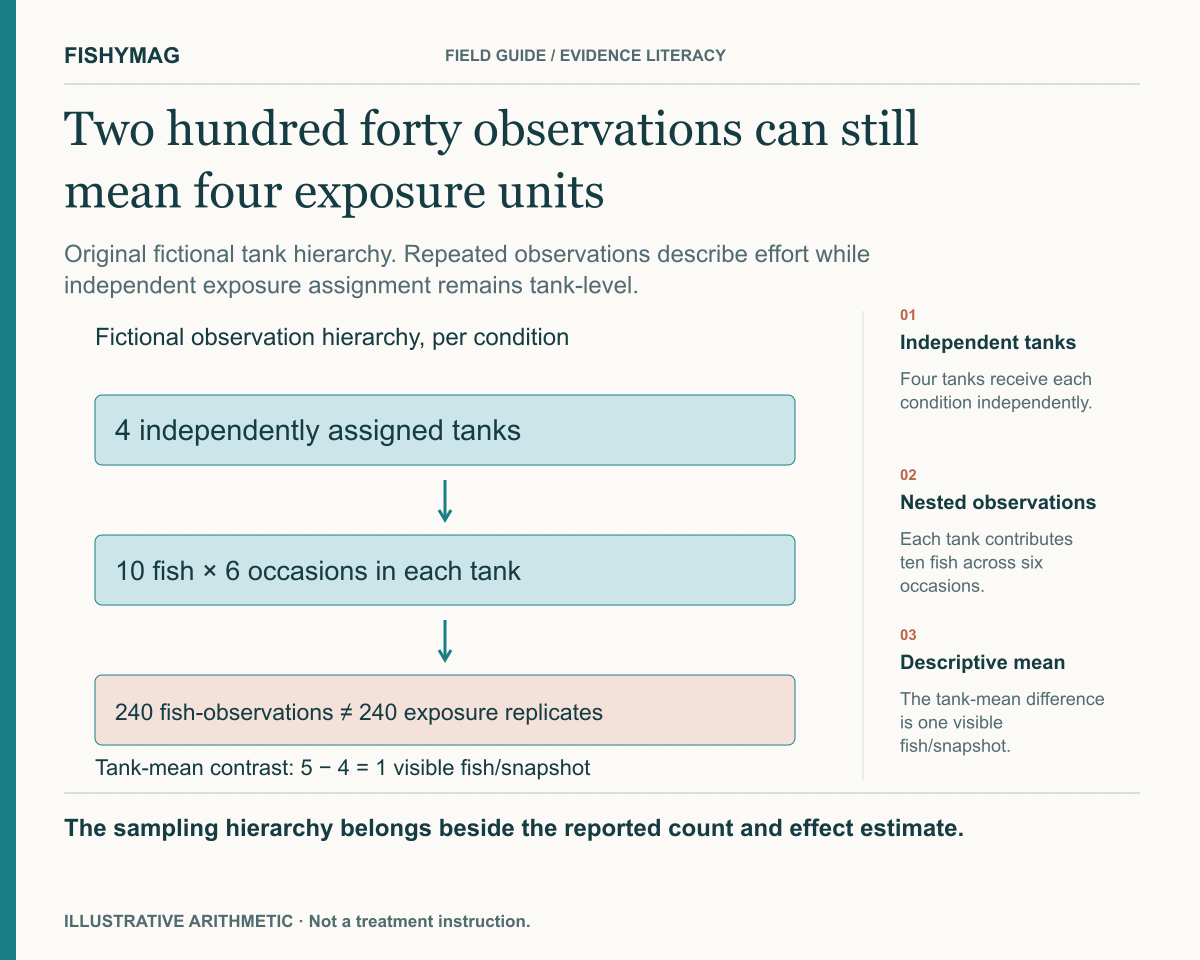
Figure data and explanation
Original fictional tank hierarchy. Repeated observations describe effort while independent exposure assignment remains tank-level.
- Independent tanks
- Four tanks receive each condition independently.
- Nested observations
- Each tank contributes ten fish across six occasions.
- Descriptive mean
- The tank-mean difference is one visible fish/snapshot.
The sampling hierarchy belongs beside the reported count and effect estimate.
Keep the measurement hierarchy visible
In this original fictional study, exposure is assigned independently to four hydraulically separate tanks in each condition. Each tank contains ten fish and is observed on six occasions. ARRIVE distinguishes experimental units from subsamples and repeated observations. Counting more records can describe observation effort without increasing the number of independent exposure assignments.
Complete the count and tank-level mean audit
The supplied endpoint is the mean count of visible fish per snapshot within each tank. It is not an adverse-event probability or a count of unique fish ever seen.
| Quantity | A | B |
|---|---|---|
| Independent exposure units | 4 tanks | 4 tanks |
| Fish-observations per condition | 4 × 10 × 6 = 240 | 4 × 10 × 6 = 240 |
| Tank-level means, fish visible/snapshot | 2, 4, 6, 8 | 1, 3, 5, 7 |
| Group mean of tank means | (2 + 4 + 6 + 8)/4 = 5 | (1 + 3 + 5 + 7)/4 = 4 |
| Descriptive A-minus-B contrast | 5 − 4 = 1 visible fish/snapshot | No significance test performed |
Do not let a large record count manufacture precision
The four-tank count is the corrected independent exposure replication under the case’s stated assumptions. A real inferential analysis must account for the dependence and hierarchy relevant to the data; this article does not prescribe a model from incomplete records. Treating 240 observations as 240 independent assignments would replace the study’s design with a different one. Ask for tank identifiers, repeated-observation times, raw endpoint definitions and the authors’ actual analysis. The descriptive difference remains calculable, but no confidence interval, causal conclusion or compatibility finding has been established by the record count.
Use your own details
Many aquarium observations are not many independent replicates worksheet
Download the editable text file, fill it in on your device and keep it with the relevant record. This blank worksheet records your information; it does not verify entries or approve treatment.
- Exposure-assignment unit
- Tanks independently assigned per condition
- Fish nested within each tank
- Observation occasions per fish or tank
- Tank-level endpoint definition
- Tank means used in descriptive comparison
- Group means and units
- Dependence-aware analysis still required
Put it into practice
Your checklist
- Separate exposure units, nested animals and repeated occasions.
- Calculate descriptive summaries at a clearly named level.
- Request a dependence-aware analysis instead of counting records as replicates.
Sources and scope
This article distinguishes manufacturer statements from FishyMag’s own workflows and arithmetic examples. Linked formulation records retain their own evidence dates; publishing this article does not refresh those records.
- Percie du Sert etal., ARRIVE2.0 explanationandelaboration,2020; reviewed November 9, 2026 ↗
- NIST handbook: confidence limits and their repeated-sampling meaning; reviewed November 9, 2026 ↗
AI-assisted writing and development. Not hands-on product testing or veterinary review. How we publish →
FishyMag reports what manufacturers say, quoted and linked. It does not diagnose illness or recommend a treatment, and it never infers that a product is safe from the absence of a warning — where no statement exists, it says so.
Formulations change. Always read the label on the bottle in your hand, and contact the manufacturer if your tank contains anything valuable or unusual.