Evidence literacy
How much worse did the aquarium study allow?
Show how a fictional non-inferiority criterion changes with its margin, without treating either margin as acceptable for aquarium animals.
By FishyMag · Published
Worked arithmetic example · Not a clinical review or treatment recommendation.
Quick answer
A fictional adverse-outcome estimate of +3 percentage points has a one-sided 95% upper bound of +9. That upper bound is below a stipulated +10-point margin but not below +5. The numerical result depends on the margin, and neither margin is justified here as biologically acceptable.

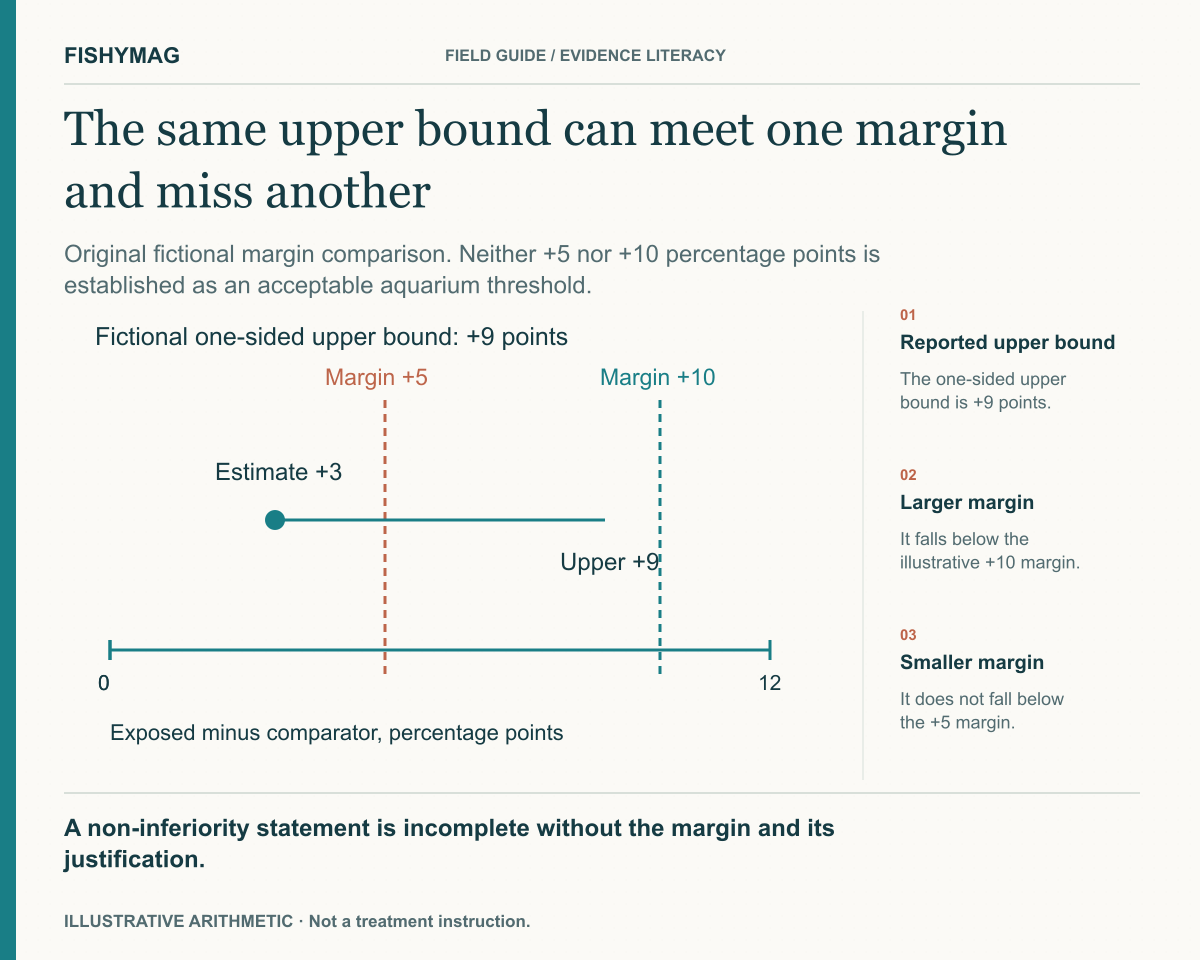
Figure data and explanation
Original fictional margin comparison. Neither +5 nor +10 percentage points is established as an acceptable aquarium threshold.
- Reported upper bound
- The one-sided upper bound is +9 points.
- Larger margin
- It falls below the illustrative +10 margin.
- Smaller margin
- It does not fall below the +5 margin.
A non-inferiority statement is incomplete without the margin and its justification.
State which direction is worse
The original fictional report defines its day-14 adverse-outcome difference as exposed minus comparator. Positive values therefore mean more adverse outcomes. It supplies an estimate of +3 points and a one-sided 95% upper confidence bound of +9. These are stipulated report outputs. FDA’s non-inferiority guidance emphasizes the role and justification of a margin; no human clinical margin is imported into this aquarium reading exercise.
Complete the two margin branches
For this numerical exercise, the criterion requires the upper bound to be below the chosen positive margin. The two margins illustrate different questions rather than two post hoc ways to approve the same result.
| Branch | Stipulated tolerated difference | Upper bound | Numerical finding |
|---|---|---|---|
| Illustrative margin +10 | Ten additional event percentage points | +9 | Criterion met: 9 < 10 |
| Illustrative margin +5 | Five additional event percentage points | +9 | Criterion not met: 9 > 5 |
| Point estimate | +3 points | Not the upper bound | Estimate alone cannot settle either branch |
| Margin justification | Not supplied for either value | Biological question unresolved | No acceptance decision follows |
| Shared scope | Specified endpoint through day 14 | Other endpoints unmeasured | No whole-aquarium compatibility finding |
Keep the margin rationale beside the result
A summary that says “not worse” without naming the margin hides the amount of extra adverse outcome the criterion would permit. Meeting the +10 criterion is not evidence that the groups are identical or that ten extra points is acceptable. Failing the +5 criterion also does not prove the true difference exceeds five points. Recover the original prespecified rationale, analysis method, endpoint and population before interpreting a real report. A numerical margin can be checked exactly while its biological or ethical acceptability remains unsupported. This article supplies no recommended margin for aquarium animals and no treatment clearance.
Use your own details
How much worse did the aquarium study allow? worksheet
Download the editable text file, fill it in on your device and keep it with the relevant record. This blank worksheet records your information; it does not verify entries or approve treatment.
- Specified adverse endpoint and horizon
- Direction of worse outcomes
- Point estimate and one-sided upper limit
- Margin fixed before result review
- Extra events allowed by that margin
- Scientific justification and applicable population
- Numerical comparison with upper limit
- Acceptance claims not established
Put it into practice
Your checklist
- Name the direction in which the endpoint is worse.
- Compare the one-sided bound with the prespecified margin.
- Report the margin’s justification status with the numerical result.
Sources and scope
This article distinguishes manufacturer statements from FishyMag’s own workflows and arithmetic examples. Linked formulation records retain their own evidence dates; publishing this article does not refresh those records.
AI-assisted writing and development. Not hands-on product testing or veterinary review. How we publish →
FishyMag reports what manufacturers say, quoted and linked. It does not diagnose illness or recommend a treatment, and it never infers that a product is safe from the absence of a warning — where no statement exists, it says so.
Formulations change. Always read the label on the bottle in your hand, and contact the manufacturer if your tank contains anything valuable or unusual.