Evidence literacy
“No observed effect” does not mean no aquarium effects
Reconcile a fictional no-observed-effect classification with a nonzero observed difference in adverse outcomes.
By FishyMag · Published
Worked arithmetic example · Not a clinical review or treatment recommendation.
Quick answer
At the fictional 0.20 mg/L level, 3/20 units have the event versus 1/20 comparators: 15% versus 5%, a ten-point observed difference. The packet stipulates that this level is not statistically significant in its documented analysis. That classification can coexist with the nonzero observed difference and does not prove no effect.

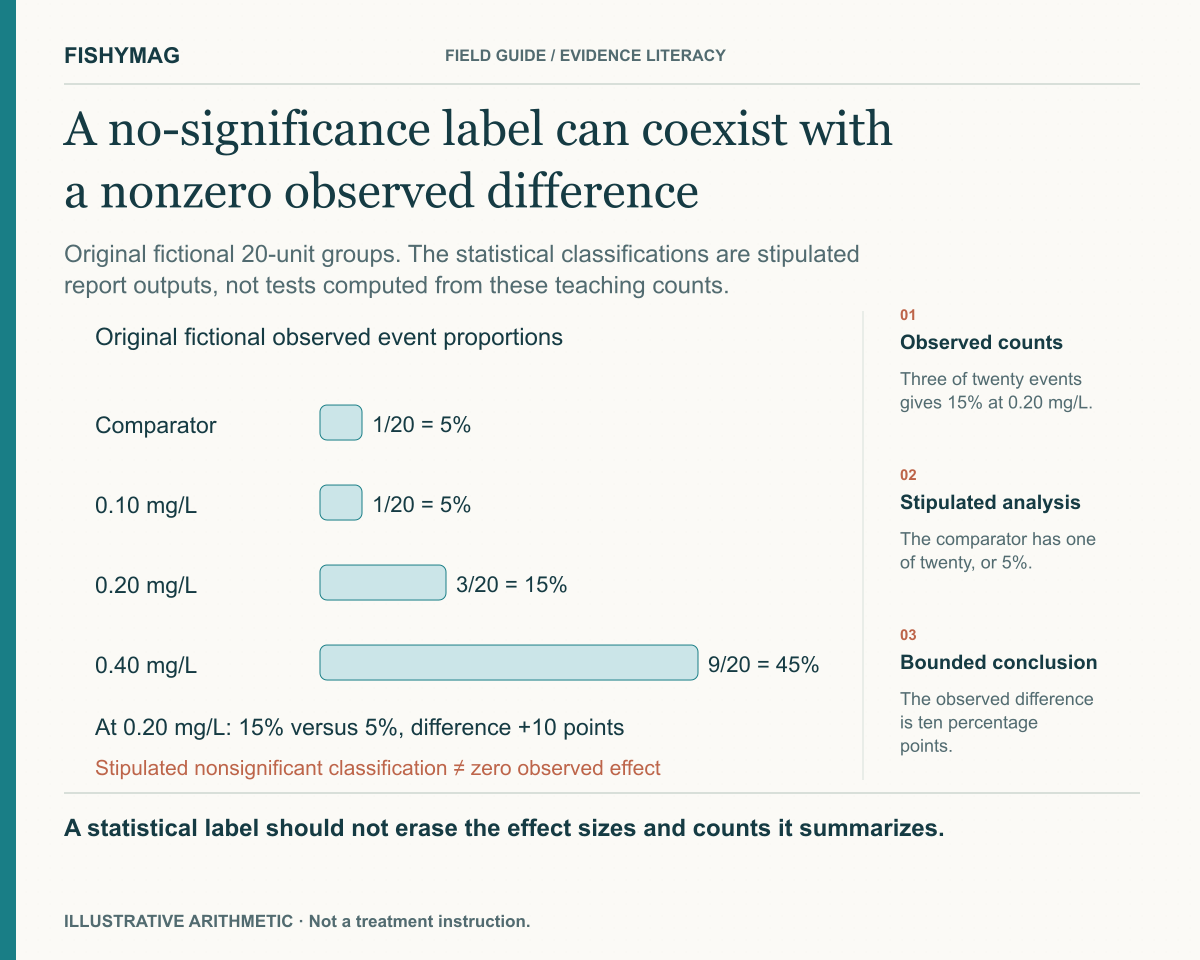
Figure data and explanation
Original fictional 20-unit groups. The statistical classifications are stipulated report outputs, not tests computed from these teaching counts.
- Observed counts
- Three of twenty events gives 15% at 0.20 mg/L.
- Stipulated analysis
- The comparator has one of twenty, or 5%.
- Bounded conclusion
- The observed difference is ten percentage points.
A statistical label should not erase the effect sizes and counts it summarizes.
Keep a statistical classification separate from the observations
OECD’s statistical guidance cautions that a NOEC classification does not establish identical exposed and control conditions or an exact toxicity threshold. In this original fictional record, there are 20 independent units per level for the same day-14 adverse endpoint. The packet stipulates a documented analysis classifying 0.20 mg/L as the highest tested level without a statistically significant effect and 0.40 mg/L as significant. This article does not invent which statistical test produced that classification.
Read the count beside the classification
These teaching values are not results for a chemical product, and no biological acceptance cutoff is supplied.
| Group or level | Events / units | Observed proportion | Stipulated classification |
|---|---|---|---|
| Comparator | 1/20 | 5% | Reference group |
| 0.10 mg/L | 1/20 | 5% | Nonsignificant in the fictional analysis |
| 0.20 mg/L | 3/20 | 15% | Highest tested nonsignificant level |
| 0.40 mg/L | 9/20 | 45% | Significant in the fictional analysis |
| 0.20 minus comparator | 15% − 5% | +10 percentage points | Observed difference is not zero |
Correct no effect to the actual reported finding
A defensible sentence says the analysis did not detect a statistically significant effect at 0.20 mg/L under its documented procedure, while the observed proportions were 15% and 5%. It should retain the sample size, endpoint and horizon. No-significance is a test result, not a measurement of an exactly zero population difference or a permission to expose livestock. Ask for the test specification, effect estimate and uncertainty, including how multiple comparisons were handled. Do not calculate retrospective power from these counts to explain the stipulation or infer an acceptable operating concentration between tested levels.
Use your own details
“No observed effect” does not mean no aquarium effects worksheet
Download the editable text file, fill it in on your device and keep it with the relevant record. This blank worksheet records your information; it does not verify entries or approve treatment.
- Endpoint and observation horizon
- Independent units per tested level
- Observed event counts
- Statistical analysis and decision rule
- Highest tested nonsignificant concentration
- Lowest tested significant concentration
- Observed effect at the classified level
- Uncertainty and biological claims not established
Put it into practice
Your checklist
- Report observed counts beside the statistical classification.
- Keep the tested-level classification distinct from an exact no-effect threshold.
- Request the analysis and uncertainty before accepting a no-effects headline.
Sources and scope
This article distinguishes manufacturer statements from FishyMag’s own workflows and arithmetic examples. Linked formulation records retain their own evidence dates; publishing this article does not refresh those records.
AI-assisted writing and development. Not hands-on product testing or veterinary review. How we publish →
FishyMag reports what manufacturers say, quoted and linked. It does not diagnose illness or recommend a treatment, and it never infers that a product is safe from the absence of a warning — where no statement exists, it says so.
Formulations change. Always read the label on the bottle in your hand, and contact the manufacturer if your tank contains anything valuable or unusual.