Evidence literacy
Missing aquarium outcomes can change the comparison
Calculate transparent missing-outcome assignment bounds in a fictional aquarium study without treating missing units as event-free.
By FishyMag · Published
Worked arithmetic example · Not a clinical review or treatment recommendation.
Quick answer
The fictional complete-case rates are 4/32 = 12.5% and 2/36 = 5.56%. On the original 40-unit denominators, assigning all missing outcomes across their possible binary states gives A 10% to 30% and B 5% to 15%. The A-minus-B difference can range from −5 to +25 percentage points.

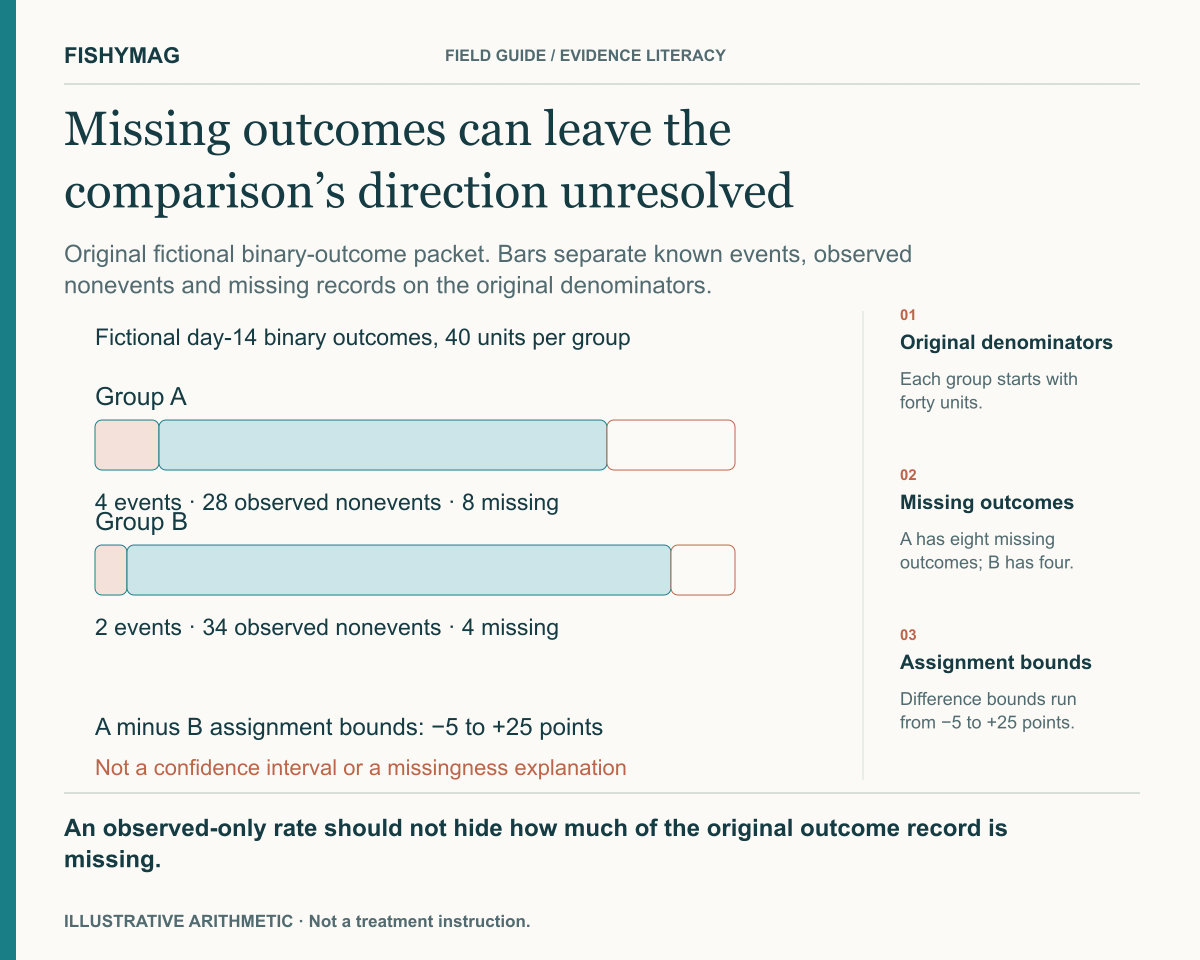
Figure data and explanation
Original fictional binary-outcome packet. Bars separate known events, observed nonevents and missing records on the original denominators.
- Original denominators
- Each group starts with forty units.
- Missing outcomes
- A has eight missing outcomes; B has four.
- Assignment bounds
- Difference bounds run from −5 to +25 points.
An observed-only rate should not hide how much of the original outcome record is missing.
Reconcile the original group size before calculating rates
This original fictional day-14 packet starts with 40 independent units in each group. A has 32 observed outcomes, including four events, and eight missing outcomes. B has 36 observed outcomes, including two events, and four missing outcomes. Cochrane advises making missing-data assumptions explicit. The arithmetic here explores all possible assignments of the missing binary results; it does not assert why records are missing.
Complete both denominator views
The complete-case rates describe observed records only. The assignment bounds use the original denominators and make no claim that either extreme actually occurred.
| Quantity | A | B |
|---|---|---|
| Complete-case event rate | 4/32 = 12.50% | 2/36 = 5.56% |
| Original-denominator minimum | 4/40 = 10% | 2/40 = 5% |
| Original-denominator maximum | (4 + 8)/40 = 30% | (2 + 4)/40 = 15% |
| Lowest A-minus-B difference | 10% − 15% = −5 points | A missing nonevents; B missing events |
| Highest A-minus-B difference | 30% − 5% = +25 points | A missing events; B missing nonevents |
Name what the bounds do and do not represent
The interval from −5 to +25 points is a logical assignment range for these missing binary outcomes. It is not a confidence interval and does not account for sampling uncertainty. The direction of the complete-case comparison can change under possible missing-outcome assignments, but that observation does not establish any particular missingness mechanism. Ask for missing-record recovery, reasons and timing, and an appropriate sensitivity analysis from the investigators. Do not substitute zero for missing adverse events or impute them all as harmful by default. Preserve the original and observed denominators in any summary before discussing a compatibility claim.
Use your own details
Missing aquarium outcomes can change the comparison worksheet
Download the editable text file, fill it in on your device and keep it with the relevant record. This blank worksheet records your information; it does not verify entries or approve treatment.
- Endpoint and fixed follow-up horizon
- Original assigned denominators
- Observed events and nonevents
- Missing binary outcomes per group
- Complete-case rates and denominator
- All-missing-nonevent and all-missing-event bounds
- Cross-group difference bounds
- Missingness mechanism and uncertainty not inferred
Put it into practice
Your checklist
- Show original, observed and missing counts together.
- Label extreme assignments as bounds rather than actual outcomes.
- Keep missing-data assumptions separate from sampling uncertainty.
Sources and scope
This article distinguishes manufacturer statements from FishyMag’s own workflows and arithmetic examples. Linked formulation records retain their own evidence dates; publishing this article does not refresh those records.
- Cochrane Handbook, chapter 10: analysis, missing data and heterogeneity; reviewed November 9, 2026 ↗
AI-assisted writing and development. Not hands-on product testing or veterinary review. How we publish →
FishyMag reports what manufacturers say, quoted and linked. It does not diagnose illness or recommend a treatment, and it never infers that a product is safe from the absence of a warning — where no statement exists, it says so.
Formulations change. Always read the label on the bottle in your hand, and contact the manufacturer if your tank contains anything valuable or unusual.