Evidence literacy
What an aquarium study’s confidence interval actually says
Read a stipulated confidence interval spanning fewer and more adverse events without turning confidence into a probability of aquarium safety.
By FishyMag · Published
Worked arithmetic example · Not a clinical review or treatment recommendation.
Quick answer
The fictional estimate is four percentage points more adverse events in the exposed group, with a reported 95% interval from three points fewer to eleven points more. The interval spans both directions. It does not mean a 95% probability of safety or establish no important difference.

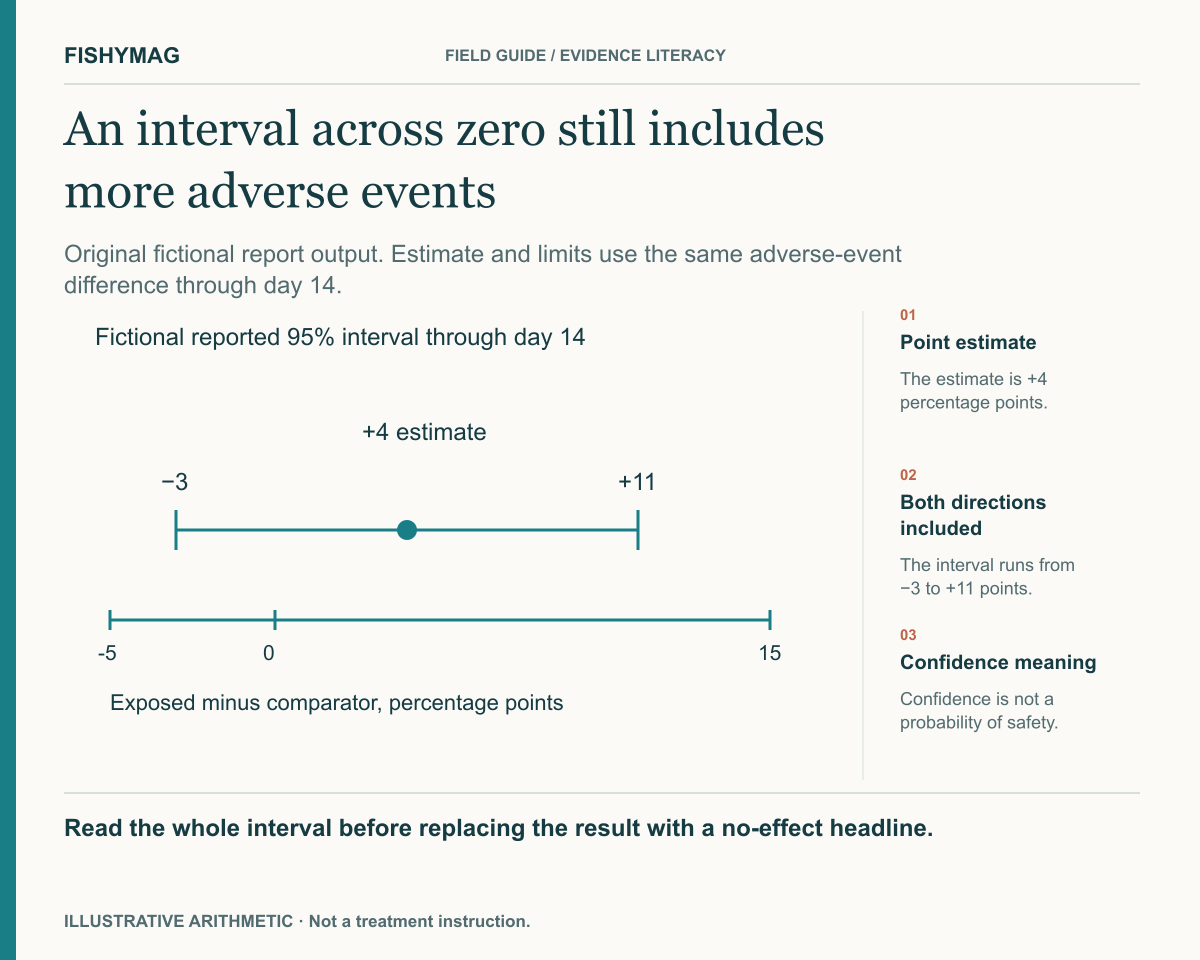
Figure data and explanation
Original fictional report output. Estimate and limits use the same adverse-event difference through day 14.
- Point estimate
- The estimate is +4 percentage points.
- Both directions included
- The interval runs from −3 to +11 points.
- Confidence meaning
- Confidence is not a probability of safety.
Read the whole interval before replacing the result with a no-effect headline.
Read the sign before interpreting the interval
This original fictional report defines its effect as exposed minus comparator for the specified adverse event through day 14. It supplies an estimate of +4 percentage points and a 95% confidence interval of −3 to +11 points. The interval is stipulated as a report output; FishyMag has not reconstructed it from missing raw data. A positive value means more events in the exposed group, not improvement.
Translate each part of the reported result
NIST explains that a frequentist confidence level concerns the interval-generating method across repeated samples under its assumptions. It is not a posterior probability assigned to this realized interval or to a safety claim.
| Reported element | Bounded reading | Unsupported upgrade |
|---|---|---|
| Estimate +4 points | Observed estimate favours more exposed-group events | Exact true difference is four points |
| Lower endpoint −3 points | Interval includes fewer exposed-group events | The exposure is protective |
| Upper endpoint +11 points | Interval includes more exposed-group events | Eleven points is an acceptable margin |
| Zero inside interval | No-difference value lies inside this interval | Groups proven equivalent |
| 95% confidence level | Property of the stated method under its model | 95% probability the aquarium product is safe |
Keep uncertainty separate from an acceptance decision
The interval contains values on both sides of zero, including a materially positive direction whose importance has not been justified in this case. A real paper’s endpoint definition, method, independent unit and horizon must remain with the interval. If an abstract says “no effect,” request the actual estimate and limits. If it says “compatible,” ask for the evidence and acceptance criterion supporting that broader proposition. The interval alone supplies neither a biological margin nor a manufacturer position. It remains useful as a bounded description of uncertainty in the specified comparison.
Use your own details
What an aquarium study’s confidence interval actually says worksheet
Download the editable text file, fill it in on your device and keep it with the relevant record. This blank worksheet records your information; it does not verify entries or approve treatment.
- Event and comparison direction
- Common observation horizon
- Point estimate and unit
- Interval endpoints and confidence level
- Interval method and assumptions
- Whether zero lies inside
- Range of directions represented
- Importance and compatibility claims requiring other evidence
Put it into practice
Your checklist
- Keep the exposed-minus-comparator direction visible.
- Translate both interval endpoints, not just whether zero is inside.
- Separate confidence-method coverage from a probability of safety.
Sources and scope
This article distinguishes manufacturer statements from FishyMag’s own workflows and arithmetic examples. Linked formulation records retain their own evidence dates; publishing this article does not refresh those records.
AI-assisted writing and development. Not hands-on product testing or veterinary review. How we publish →
FishyMag reports what manufacturers say, quoted and linked. It does not diagnose illness or recommend a treatment, and it never infers that a product is safe from the absence of a warning — where no statement exists, it says so.
Formulations change. Always read the label on the bottle in your hand, and contact the manufacturer if your tank contains anything valuable or unusual.