Evidence literacy
Three times the risk, or ten extra events per hundred?
Express one fictional aquarium outcome comparison on absolute and relative scales without confusing percentage points with percent increase.
By FishyMag · Published
Worked arithmetic example · Not a clinical review or treatment recommendation.
Quick answer
The fictional exposed group has 6/40 events, or 15%, versus 2/40, or 5%, in the comparator. That is a 10-percentage-point difference, a risk ratio of three and a 200% relative increase over the comparator. All describe the same day-14 comparison.

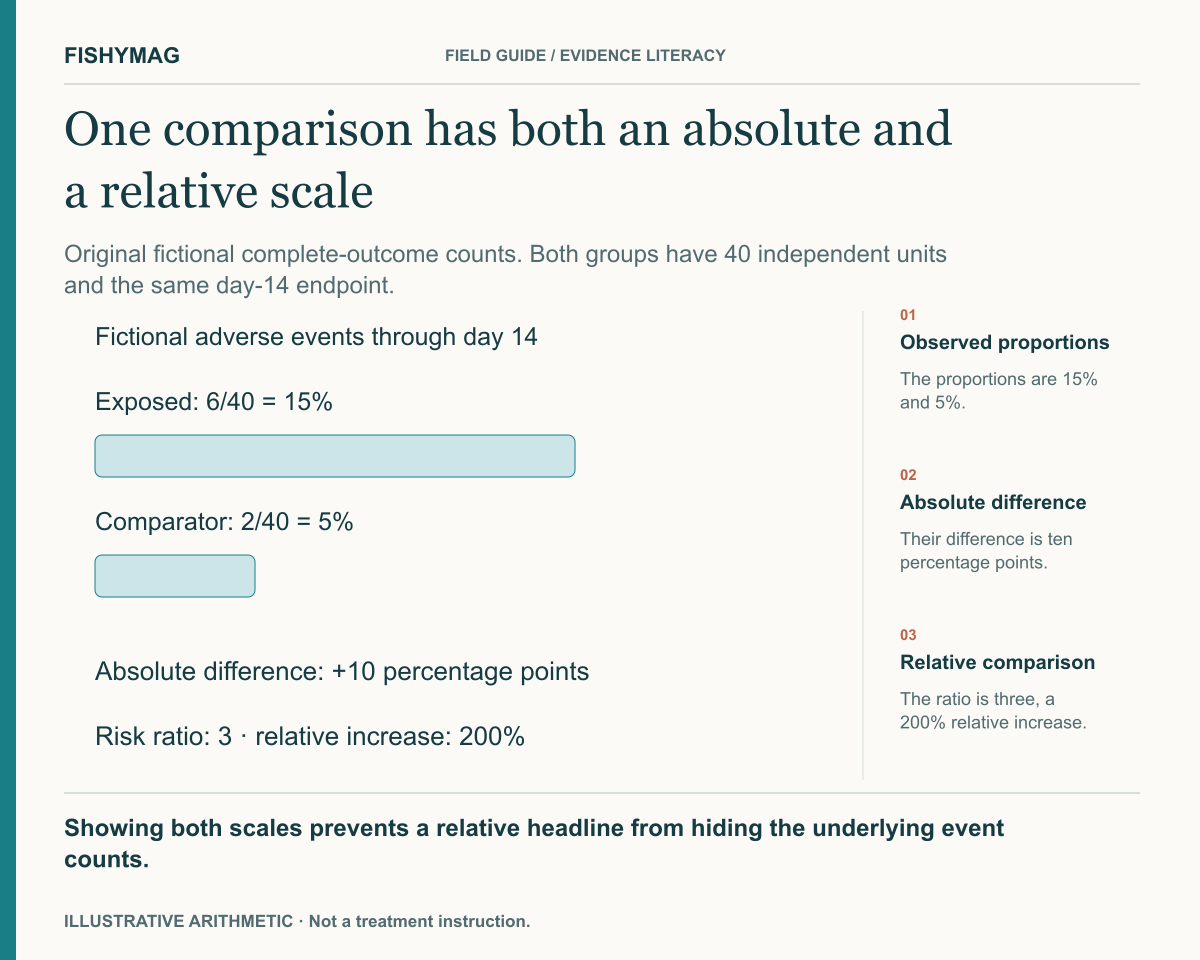
Figure data and explanation
Original fictional complete-outcome counts. Both groups have 40 independent units and the same day-14 endpoint.
- Observed proportions
- The proportions are 15% and 5%.
- Absolute difference
- Their difference is ten percentage points.
- Relative comparison
- The ratio is three, a 200% relative increase.
Showing both scales prevents a relative headline from hiding the underlying event counts.
Start with both denominators
In this original fictional study, each group contains 40 independent units with complete follow-up through day 14. The endpoint is the same predefined adverse event in both groups. Six exposed units and two comparator units have the event. The calculations below describe those counts. They do not add randomization, a causal model or a confidence interval that the case has not supplied.
Calculate the three scales explicitly
Cochrane distinguishes absolute and relative effect measures. Here the comparator risk is nonzero, so the risk ratio and relative increase can both be calculated.
| Quantity | Calculation | Result |
|---|---|---|
| Exposed proportion | 6/40 × 100 | 15% |
| Comparator proportion | 2/40 × 100 | 5% |
| Absolute difference | 15% − 5% | +10 percentage points |
| Risk ratio | 0.15/0.05 | 3 |
| Relative increase | (0.15 − 0.05)/0.05 × 100 | 200% |
| Observed excess count | 6 − 2 | 4 events among equal groups of 40 |
Use matched sentences rather than a dramatic isolated ratio
Write: “Through day 14, the specified event occurred in 15% of exposed units and 5% of comparators, an observed difference of 10 percentage points; the exposed proportion was three times the comparator proportion.” A relative increase of 200% is not a 200-percentage-point difference. “Ten extra per hundred” is a rescaling of the observed absolute difference, not a prediction for the next hundred aquarium animals. To interpret a real study, retain its assignment design, endpoint, horizon and uncertainty. These descriptive scales alone do not establish cause, a biological acceptance threshold or formulation compatibility.
Use your own details
Three times the risk, or ten extra events per hundred? worksheet
Download the editable text file, fill it in on your device and keep it with the relevant record. This blank worksheet records your information; it does not verify entries or approve treatment.
- Event definition and common horizon
- Independent units and complete outcomes
- Exposed event count and denominator
- Comparator event count and denominator
- Absolute difference with percentage-point unit
- Risk ratio and comparator direction
- Relative change with named baseline
- Design and uncertainty not supplied by arithmetic
Put it into practice
Your checklist
- Show both risks and denominators before a ratio.
- Use percentage points for a difference between percentages.
- Keep descriptive rescaling separate from prediction or causation.
Sources and scope
This article distinguishes manufacturer statements from FishyMag’s own workflows and arithmetic examples. Linked formulation records retain their own evidence dates; publishing this article does not refresh those records.
- Cochrane Handbook, chapter 10: analysis, missing data and heterogeneity; reviewed November 9, 2026 ↗
- Percie du Sert etal., ARRIVE2.0 explanationandelaboration,2020; reviewed November 9, 2026 ↗
AI-assisted writing and development. Not hands-on product testing or veterinary review. How we publish →
FishyMag reports what manufacturers say, quoted and linked. It does not diagnose illness or recommend a treatment, and it never infers that a product is safe from the absence of a warning — where no statement exists, it says so.
Formulations change. Always read the label on the bottle in your hand, and contact the manufacturer if your tank contains anything valuable or unusual.