Keeper workflows
Two aquarium papers, one experiment?
Link aquarium study reports to their actual cohorts before counting independent experiments.
By FishyMag · Published
Original evidence audit · Not a clinical review or treatment recommendation.
Quick answer
Papers A and B in the worked case describe the same cohort, T1. Paper C documents T2 separately. The dossier therefore contains three reports on two cohorts; the extra behaviour outcome is useful but is not an extra replication.
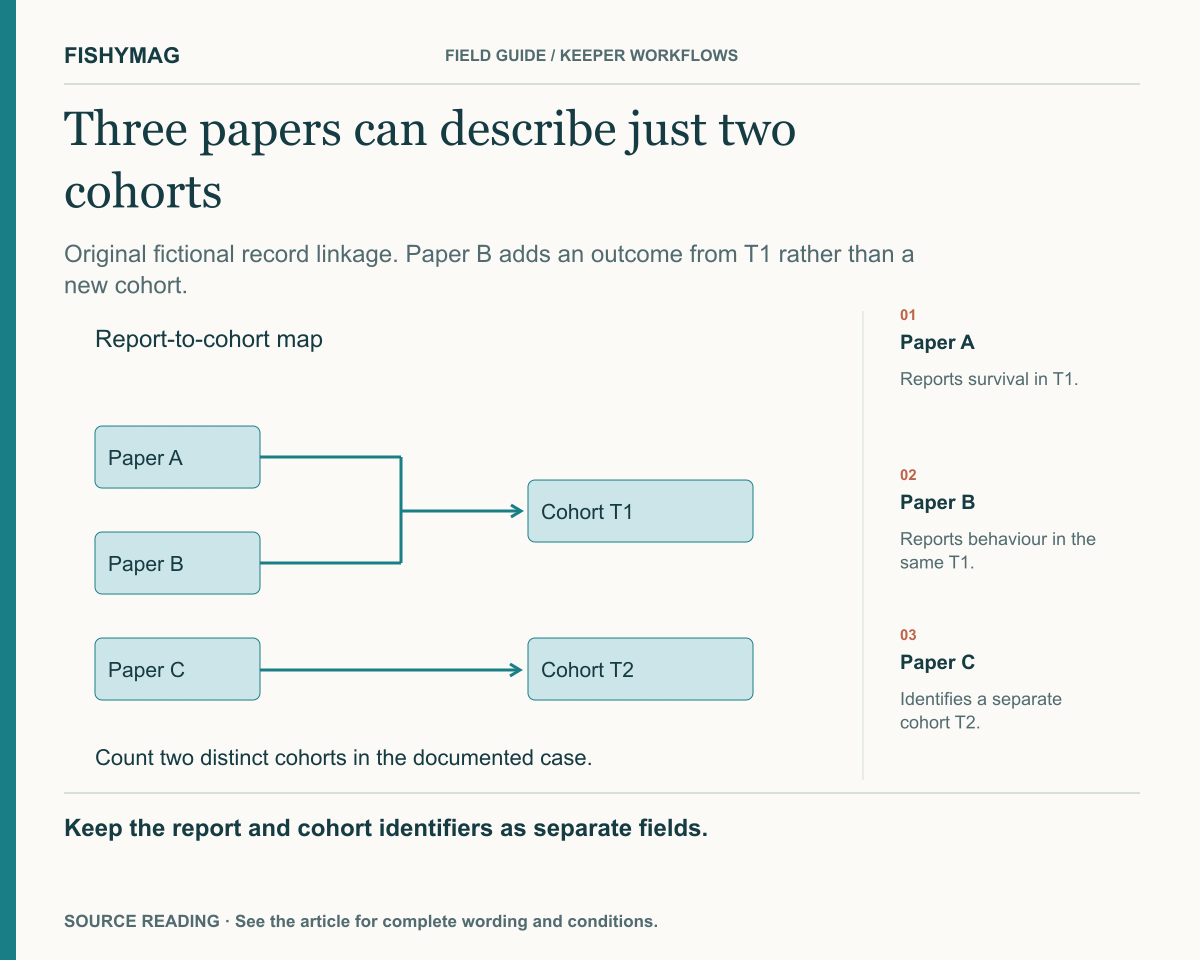
Figure data and explanation
Original fictional record linkage. Paper B adds an outcome from T1 rather than a new cohort.
- Paper A
- Reports survival in T1.
- Paper B
- Reports behaviour in the same T1.
- Paper C
- Identifies a separate cohort T2.
Keep the report and cohort identifiers as separate fields.
Count the animals and tanks behind the papers
Fictional paper A reports survival for T1 at facility F during March 2025. Paper B names T1, the same twelve tanks, allocation and dates, explicitly citing A, and adds behaviour observations. Paper C documents a separate T2 cohort at the same facility in June with its own allocation. Cochrane’s reporting guidance recommends linking records to the underlying study before synthesis.
Write one linked row for each reported outcome
Do not discard B just because it shares a cohort. Preserve its distinct measurements while recording dependence.
| Paper | Cohort evidence | Treatment of report |
|---|---|---|
| A | T1, March, same twelve tanks as B | Keep survival record linked to T1 |
| B | T1, matching dates and allocation; cites A | Keep behaviour linked to T1 |
| C | T2, June, separately documented allocation | Separate cohort |
| Alternative B | Facility and tank count only; dates and IDs missing | Possible overlap; linkage unresolved |
Do not resolve a missing link using a familiar author name
Shared authors, a facility or similar tank counts can raise a linkage question. They do not prove reuse. When decisive details are absent, preserve a possible-overlap note so the two papers cannot be added as independent evidence by default. The completed case shows two cohorts, not how many independent experimental units each design provides.
Use your own details
Two aquarium papers, one experiment? worksheet
Download the editable text file, fill it in on your device and keep it with the relevant record. This blank worksheet records your information; it does not verify entries or approve treatment.
- Report ID and location of cohort statement
- Facility and dates
- Cohort or protocol ID
- Tank allocation and sample counts
- Explicit reference to related report
- Shared and separate outcomes
- Link confirmed, separate or unresolved
Put it into practice
Your checklist
- Compare cohort IDs, dates and allocation records.
- Keep all useful outcomes without counting the cohort twice.
- Mark possible overlap when identifiers are missing.
Sources and scope
This article distinguishes manufacturer statements from FishyMag’s own workflows and arithmetic examples. Linked formulation records retain their own evidence dates; publishing this article does not refresh those records.
- Cochrane Handbook Chapter 5, extracting from multiple reports; reviewed November 9, 2026 ↗
- Cochrane Handbook Chapter 4, searching and selecting studies; reviewed November 9, 2026 ↗
- Percie du Sert etal., ARRIVE2.0 explanationandelaboration,2020; reviewed November 9, 2026 ↗
AI-assisted writing and development. Not hands-on product testing or veterinary review. How we publish →
FishyMag reports what manufacturers say, quoted and linked. It does not diagnose illness or recommend a treatment, and it never infers that a product is safe from the absence of a warning — where no statement exists, it says so.
Formulations change. Always read the label on the bottle in your hand, and contact the manufacturer if your tank contains anything valuable or unusual.