Keeper workflows
Does that standard cover your aquarium claim?
Read a test standard’s scope and exclusions before transferring an equipment result to different conditions or livestock.
By FishyMag · Published
Original source audit · Not a clinical review or treatment recommendation.
Quick answer
The fictional standard defines a specific equipment test. A matching report can document that test, but the standard alone cannot. It does not establish performance under undocumented conditions or any livestock compatibility finding.
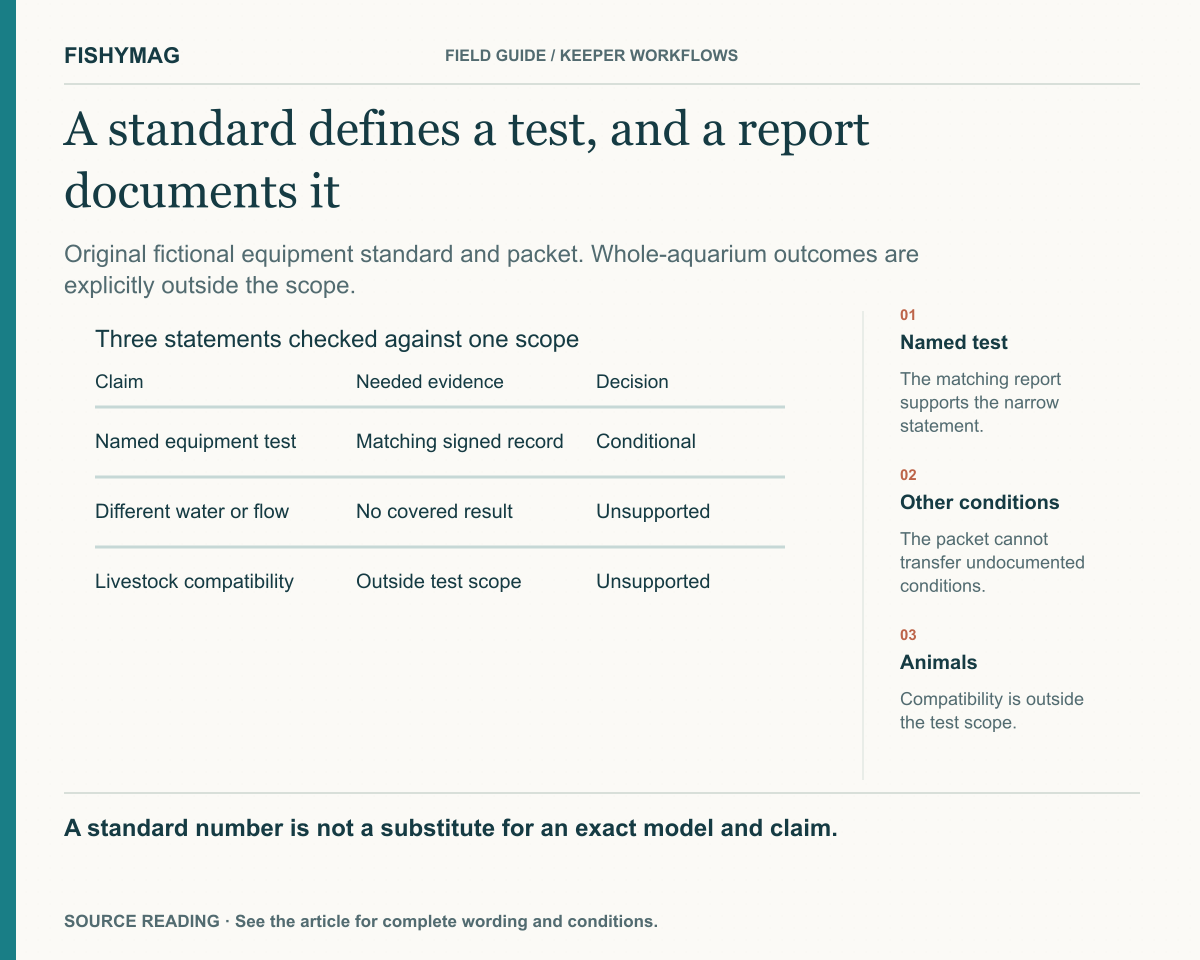
Figure data and explanation
Original fictional equipment standard and packet. Whole-aquarium outcomes are explicitly outside the scope.
- Named test
- The matching report supports the narrow statement.
- Other conditions
- The packet cannot transfer undocumented conditions.
- Animals
- Compatibility is outside the test scope.
A standard number is not a substitute for an exact model and claim.
Distinguish the standard from the test record
NSF describes NSF/ANSI 42 as a drinking-water equipment standard with specific claims that vary by product. Its directory ties claims to listings. Our fictional standard DEMO-S1 instead covers a defined bench particle-retention test and explicitly excludes whole-aquarium outcomes. It is not an industry standard.
Evaluate the three proposed statements
Packet A supplies the fictional standard only. Packet B also has a matching dated test report for the exact equipment and test method.
| Statement | Decision | Reason |
|---|---|---|
| The exact unit underwent the named test | Supported in B only | Matching test report required |
| The measured performance applies at different undocumented flow and water | Unsupported | Conditions outside the evidence |
| The standard establishes livestock compatibility | Unsupported | Biological endpoints excluded |
Record scope and actual claim side by side
A certificate, listing, test report and standard may each answer a different question. Preserve the exact model, edition and claim. Do not treat a logo or number as covering every reduction claim in the standard, or assign a bench result to an aquarium use without evidence.
Use your own details
Does that standard cover your aquarium claim? worksheet
Download the editable text file, fill it in on your device and keep it with the relevant record. This blank worksheet records your information; it does not verify entries or approve treatment.
- Exact standard and edition
- Defined method, scope and exclusions
- Exact equipment model and test report
- Test conditions and endpoint
- Certificate or listing claim, if applicable
- Difference from the proposed conditions
- Unsupported biological claim
Put it into practice
Your checklist
- Read the scope and exclusions of the exact edition.
- Verify the exact unit and claimed test in the report.
- Keep other conditions and biological claims outside the evidence.
Sources and scope
This article distinguishes manufacturer statements from FishyMag’s own workflows and arithmetic examples. Linked formulation records retain their own evidence dates; publishing this article does not refresh those records.
- NSF scope summary for NSF/ANSI 42, 53 and 401; reviewed November 9, 2026 ↗
- NSF drinking-water treatment units certification directory; reviewed November 9, 2026 ↗
- OECD weight-of-evidence guidance for chemical assessment; reviewed November 9, 2026 ↗
AI-assisted writing and development. Not hands-on product testing or veterinary review. How we publish →
FishyMag reports what manufacturers say, quoted and linked. It does not diagnose illness or recommend a treatment, and it never infers that a product is safe from the absence of a warning — where no statement exists, it says so.
Formulations change. Always read the label on the bottle in your hand, and contact the manufacturer if your tank contains anything valuable or unusual.