Keeper workflows
Does that solubility value apply to aquarium water?
Normalise published praziquantel solubility units while keeping crystal form, medium and temperature attached.
By FishyMag · Published
Worked formulation evidence example · Not a clinical review or treatment recommendation.
Quick answer
The published numbers can be converted to mg/L. Neither cited result measures solubility in the fictional 24 °C reef water. Equal units do not resolve differences in solid form, water matrix or experimental conditions.
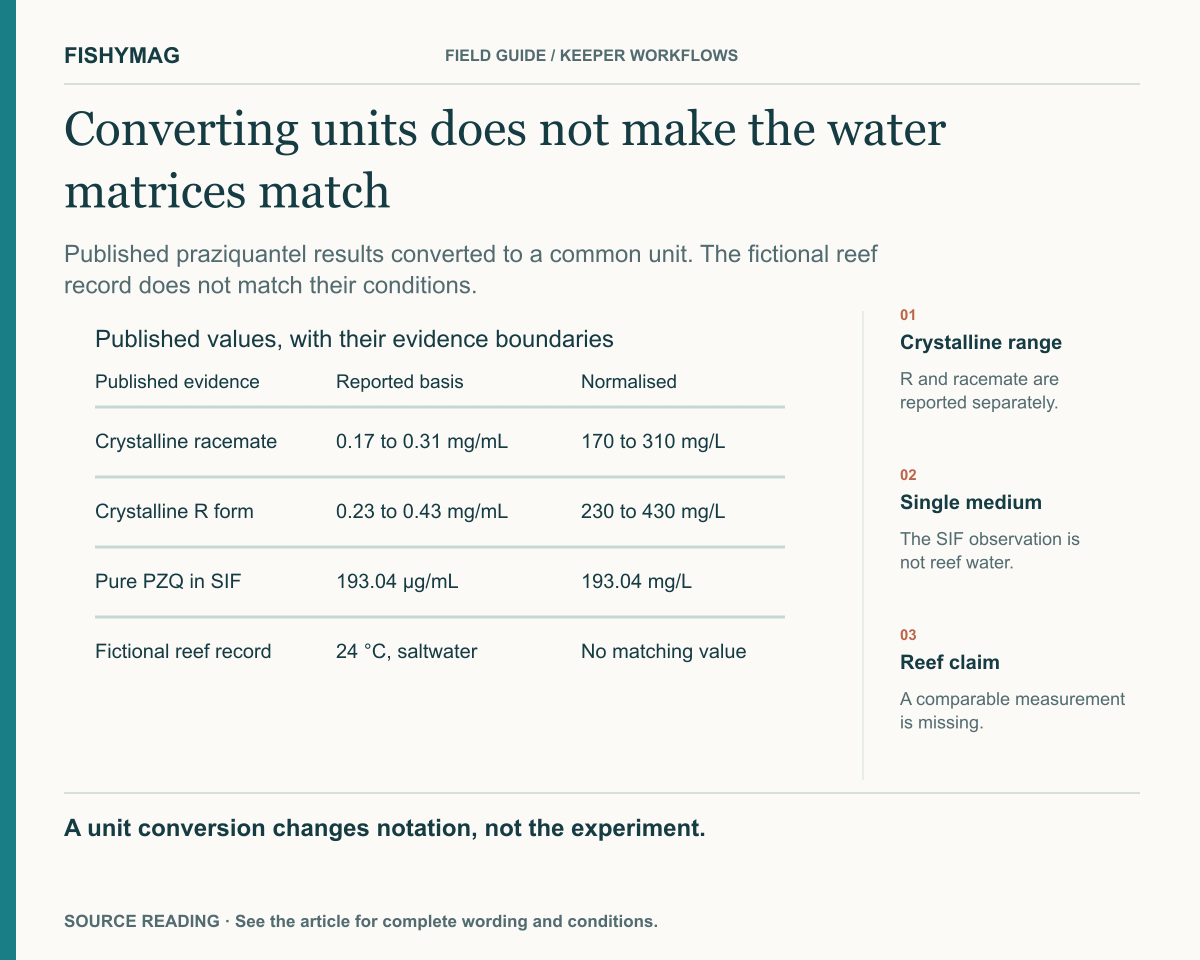
Figure data and explanation
Published praziquantel results converted to a common unit. The fictional reef record does not match their conditions.
- Crystalline range
- R and racemate are reported separately.
- Single medium
- The SIF observation is not reef water.
- Reef claim
- A comparable measurement is missing.
A unit conversion changes notation, not the experiment.
Record the form and medium before comparing values
A primary release study reports crystalline racemic praziquantel at 0.17 to 0.31 mg/mL and crystalline R material at 0.23 to 0.43 mg/mL across its tested media at 37 °C. These are ranges across media, not uncertainty intervals. Mureșan-Pop and colleagues report 193.04 µg/mL for pure PZQ in simulated intestinal fluid at their 37 °C, 24-hour solubility endpoint.
Convert units without combining unlike test records
A milligram per millilitre is 1,000 mg/L; one microgram per millilitre is one mg/L. SIF here means simulated intestinal fluid.
| Result | Normalised value | Why it does not answer the fictional reef question |
|---|---|---|
| Crystalline racemate, range across tested media | 170 to 310 mg/L | Different temperature and no matched reef matrix |
| Crystalline R form, range across tested media | 230 to 430 mg/L | Different tested form and conditions |
| Pure PZQ in SIF | 193.04 mg/L | Simulated intestinal fluid and 37 °C |
| Fictional reef water | 24 °C, saltwater, unknown lot solid form | No matched equilibrium result |
Keep the exact claim narrow
The 193.04 mg/L number answers the reported SIF question. It does not establish what an unknown solid form does in a cooler reef matrix. Even agreement in numerical values would not make the media interchangeable. Request the solid-form record and a measurement under the relevant water conditions if the property matters.
Use your own details
Does that solubility value apply to aquarium water? worksheet
Download the editable text file, fill it in on your device and keep it with the relevant record. This blank worksheet records your information; it does not verify entries or approve treatment.
- Exact compound and solid form
- Test medium and temperature
- Observation period and endpoint
- Original value and concentration unit
- Converted value on same analyte basis
- Aquarium matrix and missing evidence
- Applicability decision
Put it into practice
Your checklist
- Match the analyte basis and convert only units.
- Retain the original medium, solid form and temperature.
- Do not transfer a condition-specific solubility to an untested aquarium.
Sources and scope
This article distinguishes manufacturer statements from FishyMag’s own workflows and arithmetic examples. Linked formulation records retain their own evidence dates; publishing this article does not refresh those records.
- Experimental comparison of racemic and enantiopure praziquantel in different media; reviewed November 9, 2026 ↗
- Mureșan-Pop and colleagues, praziquantel cocrystal solubility, 2024; reviewed November 9, 2026 ↗
- EMA-hosted arpraziquantel risk management plan; reviewed November 9, 2026 ↗
AI-assisted writing and development. Not hands-on product testing or veterinary review. How we publish →
FishyMag reports what manufacturers say, quoted and linked. It does not diagnose illness or recommend a treatment, and it never infers that a product is safe from the absence of a warning — where no statement exists, it says so.
Formulations change. Always read the label on the bottle in your hand, and contact the manufacturer if your tank contains anything valuable or unusual.