Keeper workflows
Before and together are different aquarium exposures
Distinguish administration order from measured exposure overlap in three aquarium study records.
By FishyMag · Published
Original evidence audit · Not a clinical review or treatment recommendation.
Quick answer
Record S documents sequential administration but leaves overlap unresolved. Record J verifies A and B during the same interval. Record N supports non-overlap within the scope of its measurements. The three records answer different questions.

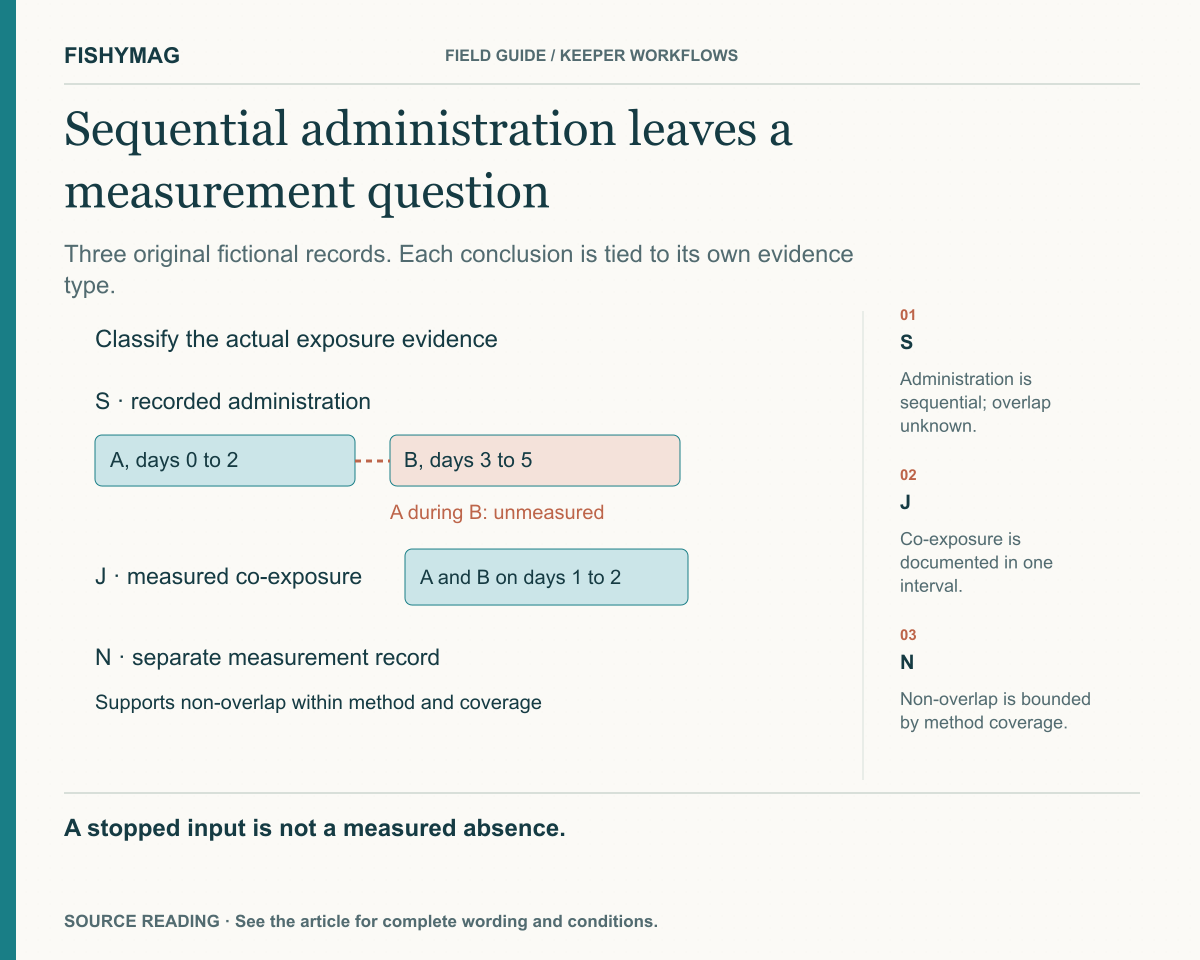
Figure data and explanation
Three original fictional records. Each conclusion is tied to its own evidence type.
- S
- Administration is sequential; overlap unknown.
- J
- Co-exposure is documented in one interval.
- N
- Non-overlap is bounded by method coverage.
A stopped input is not a measured absence.
Put administration and measurement on different lines
Fictional study S records A on days 0 through 2 and B on days 3 through 5. It has no water result for A at the transition. J verifies both targets during days 1 and 2. N documents non-overlap within the time resolution, matrix and reporting capability stated in its analytical record. These are study chronology examples, not a schedule to follow.
Classify the records by what they establish
A record of application order can be accurate without resolving persistence.
| Study | Direct record | Classification |
|---|---|---|
| S | A administered first and B later; no A result at changeover | Sequential administration, overlap unresolved |
| J | Both named targets verified in same documented interval | Co-exposure within that interval |
| N | Applicable measurement series covers its non-overlap claim | Non-overlap within stated method and coverage |
Describe the uncertainty at the transition
The next question for S is whether an applicable record measures A when B is present, including the sampling times, fraction and reporting limit. Even N does not prove absolute chemical absence everywhere or rule out unmeasured products. Preserve that limit when summarising the study. Chronology is evidence about timing, not proof of compatibility.
Use your own details
Before and together are different aquarium exposures worksheet
Download the editable text file, fill it in on your device and keep it with the relevant record. This blank worksheet records your information; it does not verify entries or approve treatment.
- Record and exact formulations
- Administration start and stop events
- Measured analytes and methods
- Sampling times and location
- Reporting limits and gaps
- Evidence of co-exposure or non-overlap
- Scope of the conclusion
Put it into practice
Your checklist
- Separate administration history from measured presence.
- Record where the analytical windows do and do not overlap.
- Preserve reporting limits and unmeasured products.
Sources and scope
This article distinguishes manufacturer statements from FishyMag’s own workflows and arithmetic examples. Linked formulation records retain their own evidence dates; publishing this article does not refresh those records.
- EFSA guidance on combined exposure to multiple chemicals, 2019; reviewed November 9, 2026 ↗
- OECD weight-of-evidence guidance for chemical assessment; reviewed November 9, 2026 ↗
- FishyMag evidence methodology; reviewed November 8, 2026 ↗
AI-assisted writing and development. Not hands-on product testing or veterinary review. How we publish →
FishyMag reports what manufacturers say, quoted and linked. It does not diagnose illness or recommend a treatment, and it never infers that a product is safe from the absence of a warning — where no statement exists, it says so.
Formulations change. Always read the label on the bottle in your hand, and contact the manufacturer if your tank contains anything valuable or unusual.