Keeper workflows
Is that aquarium approval claim official?
Follow a seller’s approval claim to its cited official record and distinguish a wrong identity from a narrower claim.
By FishyMag · Published
Original source audit · Not a clinical review or treatment recommendation.
Quick answer
The cited number in case A leads to a different product, so it does not substantiate the seller’s statement. In case B a matching record is located, but its use is narrower than the seller’s claim. Neither result establishes that no other authorization exists.
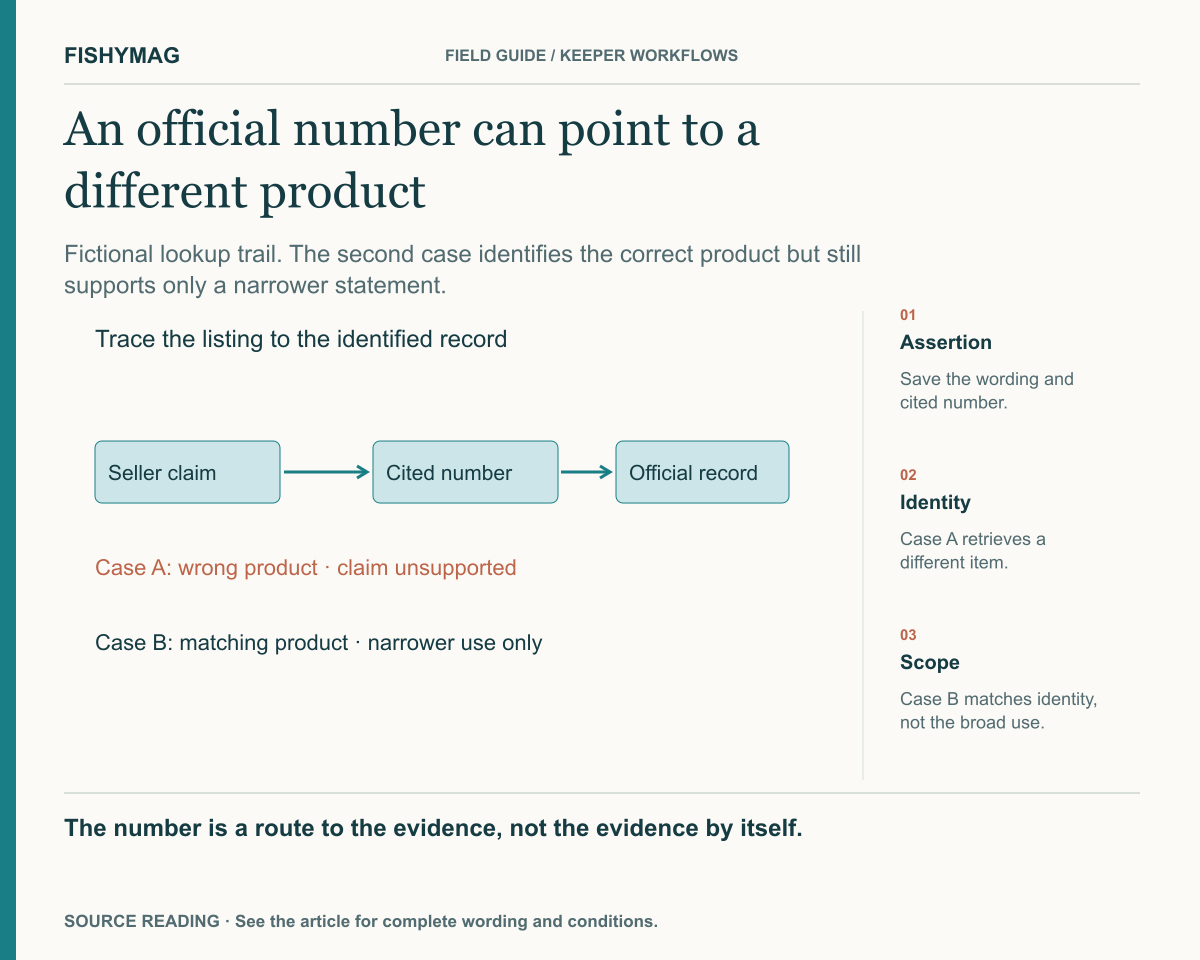
Figure data and explanation
Fictional lookup trail. The second case identifies the correct product but still supports only a narrower statement.
- Assertion
- Save the wording and cited number.
- Identity
- Case A retrieves a different item.
- Scope
- Case B matches identity, not the broad use.
The number is a route to the evidence, not the evidence by itself.
Record the claim before opening the lookup
The invented seller describes item A as officially approved for every display. It cites fictional identifier DEMO-11. Within the teaching packet the official record for DEMO-11 names item B and a narrower use. EPA’s real PPLS illustrates searching by an exact registration number and date; neither identifier in the worked case is a real registration.
Complete both verification branches
A correct identifier can still be used to support an overly broad statement. Check identity and use separately.
| Check | Case A | Case B |
|---|---|---|
| Seller statement | All displays for item A | Same broad wording |
| Located record | DEMO-11 for item B | DEMO-24 for item A |
| Identity match | No | Yes in the fictional packet |
| Use match | No basis for claim about A | Supports only the described equipment-water use |
| Bounded wording | Located record does not substantiate the claim | A matching record supports the narrower documentary wording only |
Avoid replacing an unsupported positive with an unsupported negative
Record what was looked up, when, and which identity and use checks failed. This says what the located document supports. It does not say no applicable record exists elsewhere. A correct source for a narrow use also does not justify a whole-aquarium compatibility claim.
Use your own details
Is that aquarium approval claim official? worksheet
Download the editable text file, fill it in on your device and keep it with the relevant record. This blank worksheet records your information; it does not verify entries or approve treatment.
- Seller wording and retrieval date
- Exact cited number
- Official lookup and dated document
- Product and formulation match
- Stated use and scope match
- What the located record supports
- Other authorization not assessed
Put it into practice
Your checklist
- Save the exact seller wording and identifier.
- Match the official record by item and use separately.
- Report the limits of the lookup without declaring absence of authorization.
Sources and scope
This article distinguishes manufacturer statements from FishyMag’s own workflows and arithmetic examples. Linked formulation records retain their own evidence dates; publishing this article does not refresh those records.
- EPA Pesticide Product Label System search documentation; reviewed November 9, 2026 ↗
- EPA pesticide labeling terminology and questions; reviewed November 9, 2026 ↗
- FishyMag evidence methodology; reviewed November 8, 2026 ↗
AI-assisted writing and development. Not hands-on product testing or veterinary review. How we publish →
FishyMag reports what manufacturers say, quoted and linked. It does not diagnose illness or recommend a treatment, and it never infers that a product is safe from the absence of a warning — where no statement exists, it says so.
Formulations change. Always read the label on the bottle in your hand, and contact the manufacturer if your tank contains anything valuable or unusual.