Keeper workflows
What paired readings say about aquarium RO rejection
Calculate constituent-specific RO rejection from a fictional paired result and retain a qualified permeate result as a bound.
By FishyMag · Published
Worked arithmetic example · Not a clinical review or treatment recommendation.
Quick answer
For the fictional matched chloride pair, 100 mg/L feed and 4 mg/L permeate give 96% rejection by concentration. A separate permeate report of <1 mg/L supports a conditional bound above 99%, not an exact 100%. Neither result describes every contaminant or the final delivered batch.
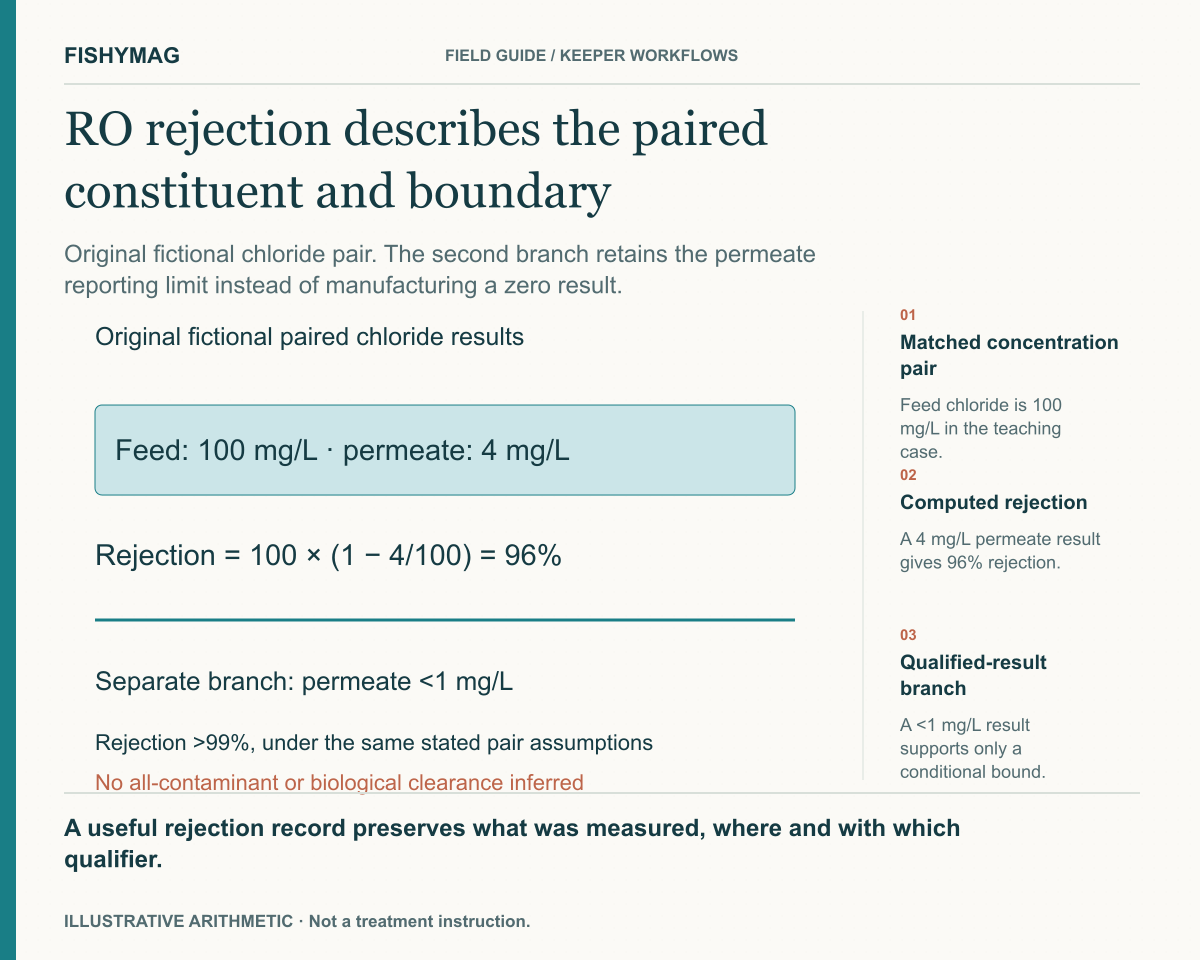
Figure data and explanation
Original fictional chloride pair. The second branch retains the permeate reporting limit instead of manufacturing a zero result.
- Matched concentration pair
- Feed chloride is 100 mg/L in the teaching case.
- Computed rejection
- A 4 mg/L permeate result gives 96% rejection.
- Qualified-result branch
- A <1 mg/L result supports only a conditional bound.
A useful rejection record preserves what was measured, where and with which qualifier.
Pair the same constituent across the membrane boundary
The original fictional packet has chloride measured in matched feed and membrane-permeate samples during the same documented collection window. Both results use mg/L on a comparable basis. The feed result is 100 mg/L and permeate is 4 mg/L. DuPont’s August 2026 technical manual defines rejection by reduction in solute concentration. These teaching chloride results are not DuPont test data or an assay of a real aquarium supply.
Complete the measured and qualified branches
The calculation treats the supplied feed value as exact for the arithmetic illustration. A real comparison must retain its sampling and measurement uncertainty.
| Case | Calculation | Bounded finding |
|---|---|---|
| Quantified pair | 100 × (1 − 4/100) | 96% chloride rejection by concentration |
| Passage for that pair | 4/100 × 100 | 4% concentration passage |
| Separate permeate report <1 mg/L | 100 × (1 − Cp/100), with 0 ≤ Cp < 1 | Rejection greater than 99%, at most 100%, under the stated assumptions |
| Replacing <1 with zero | Would yield exactly 100% | Not authorized by the report |
| Other contaminants or final stored water | No corresponding assay | Unresolved, not cleared |
Keep the product specification and the measured pair separate
The TW30-1812-50HR sheet reports a conditional salt-rejection specification using a stated bicarbonate challenge, not the fictional chloride pair above. It cannot be used to declare this example a pass or failure against that product claim. Nor does rejection by concentration directly state the fraction of incoming constituent mass removed from every system output; water recovery is a separate quantity. Record the operating boundary and any downstream DI, storage or delivery stages before reusing the result in a batch summary. No product ranking, aquarium use limit or contaminant-absence statement follows.
Use your own details
What paired readings say about aquarium RO rejection worksheet
Download the editable text file, fill it in on your device and keep it with the relevant record. This blank worksheet records your information; it does not verify entries or approve treatment.
- Exact constituent and analytical method
- Feed and permeate sample identities
- Matched collection window and operating configuration
- Same concentration unit and reporting basis
- Feed result and uncertainty
- Permeate result including qualifier and limit
- Rejection formula or bound
- Final delivery and other constituents not measured
Put it into practice
Your checklist
- Match constituent, basis and collection window before taking a ratio.
- Retain a qualified result as a bound rather than substituting zero.
- Keep membrane rejection distinct from final-batch quality and water recovery.
Sources and scope
This article distinguishes manufacturer statements from FishyMag’s own workflows and arithmetic examples. Linked formulation records retain their own evidence dates; publishing this article does not refresh those records.
- DuPont FilmTec RO/NF technical manual, version 20, August 2026; reviewed November 9, 2026 ↗
- DuPont TW30-1812-50HR product data sheet, revision 5, January 2021; reviewed November 9, 2026 ↗
AI-assisted writing and development. Not hands-on product testing or veterinary review. How we publish →
FishyMag reports what manufacturers say, quoted and linked. It does not diagnose illness or recommend a treatment, and it never infers that a product is safe from the absence of a warning — where no statement exists, it says so.
Formulations change. Always read the label on the bottle in your hand, and contact the manufacturer if your tank contains anything valuable or unusual.