Keeper workflows
Product and reject water: calculate RO recovery
Calculate RO water recovery and product-to-reject ratio from a fictional matched window, then expose the missing-flush denominator.
By FishyMag · Published
Worked arithmetic example · Not a clinical review or treatment recommendation.
Quick answer
For the fictional complete two-stream window, 18 L product and 54 L reject mean 25% recovery and a 1:3 product-to-reject ratio. If an additional flush stream occurred but was not measured, 72 L is no longer the established whole-window feed denominator. Its recovery remains unresolved.
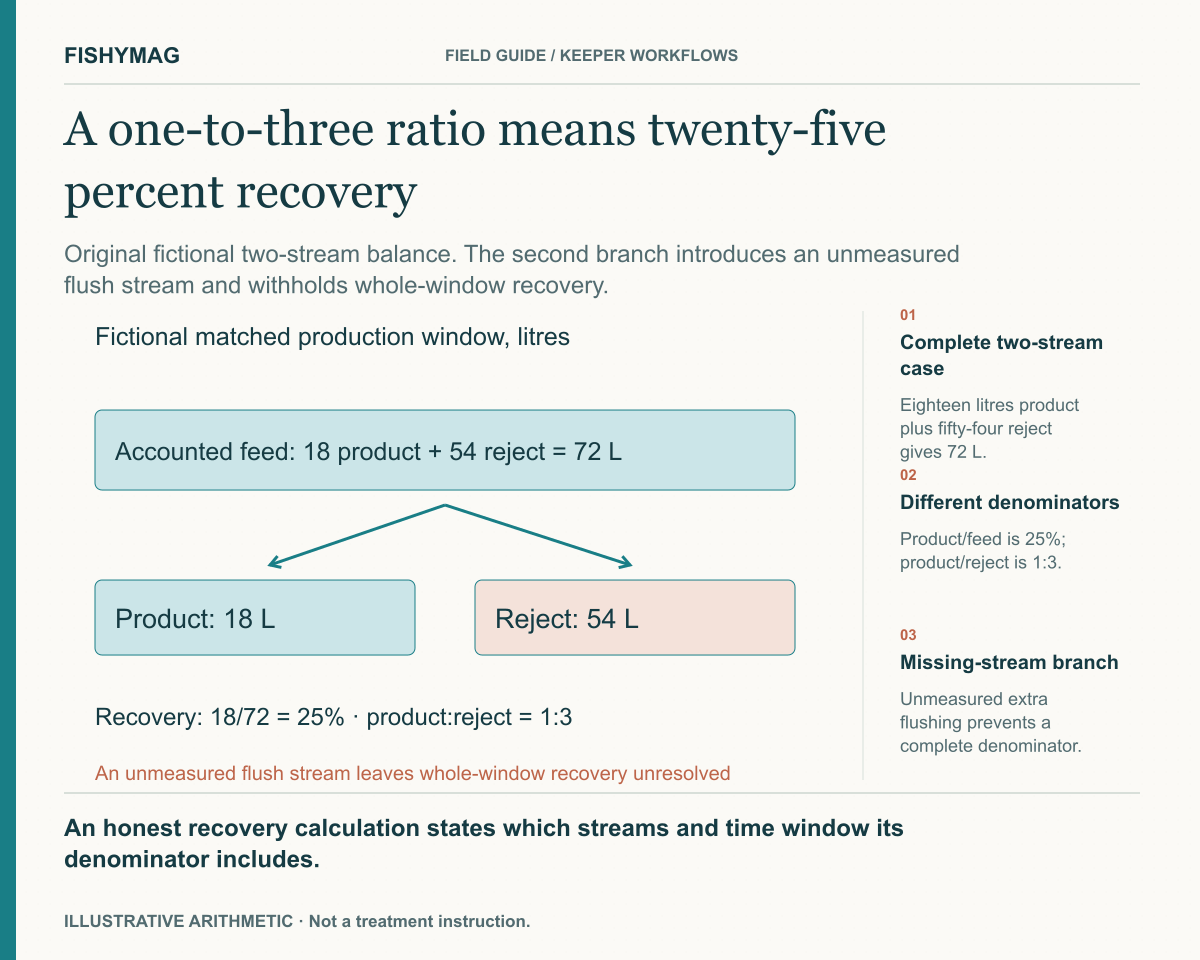
Figure data and explanation
Original fictional two-stream balance. The second branch introduces an unmeasured flush stream and withholds whole-window recovery.
- Complete two-stream case
- Eighteen litres product plus fifty-four reject gives 72 L.
- Different denominators
- Product/feed is 25%; product/reject is 1:3.
- Missing-stream branch
- Unmeasured extra flushing prevents a complete denominator.
An honest recovery calculation states which streams and time window its denominator includes.
Use one window and one system boundary
DuPont and EPA define recovery as permeate divided by feed. The original fictional record initially describes a complete two-stream production window with no storage change or other inflow or outflow: 18 L product and 54 L reject. Under those explicit assumptions, the accounted incoming volume is 72 L. This is a record reconciliation, not an instruction to collect, reroute or reuse reject water.
Keep recovery separate from the product-to-reject ratio
Both quantities use the same observations but different denominators. Neither is a contaminant-rejection percentage.
| Quantity | Calculation | Finding |
|---|---|---|
| Accounted incoming water | 18 + 54 | 72 L under complete two-stream assumptions |
| Recovery | 18/(18 + 54) × 100 | 25% |
| Product-to-reject ratio | 18:54 | 1:3 |
| Incorrect recovery shortcut | 18/54 × 100 | 33.3% compares product with reject, not feed |
| Second packet: unmeasured flush stream | Additional water output, amount unknown | Whole-window feed not established from 72 L |
| Whole-window recovery in second packet | 18 / unknown complete feed | Unresolved, not assumed 25% |
Leave the missing stream visible
If the flush water is already included in a measured reject total, adding it again would double count. If it is outside that total, omitting it understates accounted water use. Ask which is true in the actual record, including any tank accumulation, bypass or mismatch between collection windows. Do not assign a convenient volume to the missing stream or transfer a component recovery rating to the entire installation. The completed example establishes 25% only for its first, explicitly closed two-stream case. It makes no efficiency ranking, operating recommendation or water-quality claim.
Use your own details
Product and reject water: calculate RO recovery worksheet
Download the editable text file, fill it in on your device and keep it with the relevant record. This blank worksheet records your information; it does not verify entries or approve treatment.
- Production-window start and end
- System boundary and storage change
- Product volume in that window
- Reject volume in the same window
- Flush, bypass and other streams
- Feed volume or complete reconciled balance
- Recovery numerator and denominator
- Product-to-reject ratio and unresolved losses
Put it into practice
Your checklist
- Use matched-window product and reject records.
- Keep permeate/feed recovery distinct from product/reject ratio.
- Resolve whether flushing is included before claiming whole-window recovery.
Sources and scope
This article distinguishes manufacturer statements from FishyMag’s own workflows and arithmetic examples. Linked formulation records retain their own evidence dates; publishing this article does not refresh those records.
- DuPont FilmTec RO/NF technical manual, version 20, August 2026; reviewed November 9, 2026 ↗
- EPA WaterSense at Work, Water Purification, March 2024; reviewed November 9, 2026 ↗
AI-assisted writing and development. Not hands-on product testing or veterinary review. How we publish →
FishyMag reports what manufacturers say, quoted and linked. It does not diagnose illness or recommend a treatment, and it never infers that a product is safe from the absence of a warning — where no statement exists, it says so.
Formulations change. Always read the label on the bottle in your hand, and contact the manufacturer if your tank contains anything valuable or unusual.