Keeper workflows
Why aquarium RO output differs from the rating
Read a fictional RO output-to-rating ratio alongside a real manufacturer’s conditional specification without diagnosing membrane failure.
By FishyMag · Published
Worked arithmetic example · Not a clinical review or treatment recommendation.
Quick answer
The fictional production record is 120 L/day against an illustrative 200 L/day rating, or 60%. Because their documented conditions differ, that ratio alone is not a membrane-failure finding. A condition-adjusted expectation has not been calculated from a validated applicable method.
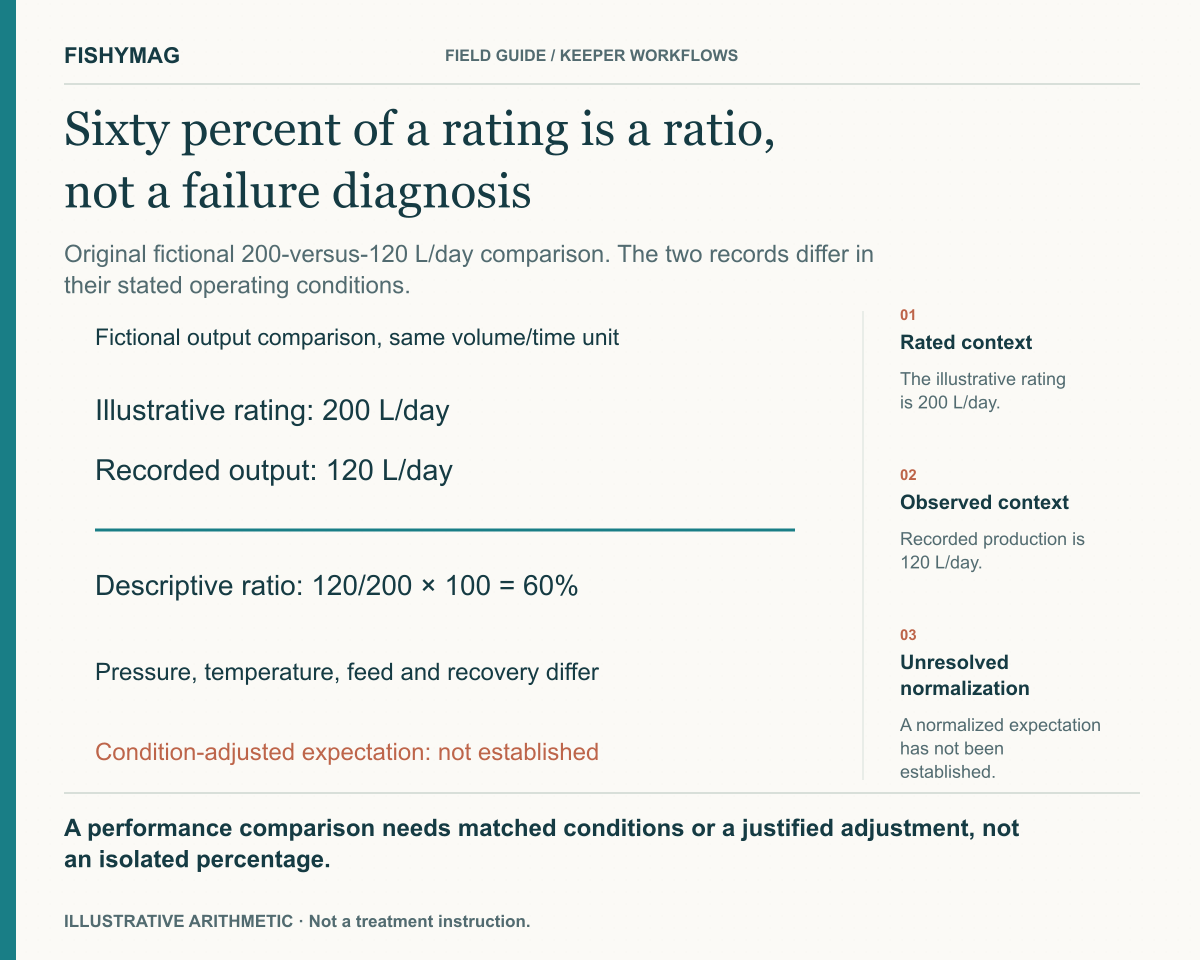
Figure data and explanation
Original fictional 200-versus-120 L/day comparison. The two records differ in their stated operating conditions.
- Rated context
- The illustrative rating is 200 L/day.
- Observed context
- Recorded production is 120 L/day.
- Unresolved normalization
- A normalized expectation has not been established.
A performance comparison needs matched conditions or a justified adjustment, not an isolated percentage.
Read the conditions printed with a real rating
The DuPont TW30-1812-50HR sheet, revision 5 January 2021, gives typical 50 GPD or 7.9 L/h at stated test conditions: 50 psig, 25 °C, 500 ppm NaHCO3, pH 8.0 and 15% recovery. It also states individual permeate-flow variation. Those conditions belong to that exact component document. The separate original fictional case below uses a 200 L/day rating to make the comparison arithmetic transparent; it is not a conversion of DuPont’s rating.
Complete the condition comparison before interpreting 60%
The invented record deliberately differs from its rating. These values are observations in the teaching packet, not recommended operating settings.
| Field | Fictional rating record | Fictional production record | Comparison |
|---|---|---|---|
| Output | 200 L/day | 120 L/day | 120/200 × 100 = 60% |
| Feed pressure | 4.0 bar | 3.0 bar | Different |
| Feed temperature | 25 °C | 18 °C | Different |
| Feed composition | Specified test solution | Different documented source profile | Different |
| Recovery | 15% | 20% | Different |
| Condition-adjusted expectation | Requires applicable normalization | Not supplied | Not established |
Do not replace missing normalization with a guessed multiplier
The manufacturer’s technical manual discusses operating-condition dependence. This article has not extracted and validated a normalization calculation for the fictional system, so it does not invent one or read precise correction factors from a different model’s graph. Keep the descriptive output ratio, exact unit and collection window, then request the installed system’s applicable performance assessment and required inputs. A lower unadjusted ratio can motivate review without establishing the cause. No pressure adjustment, membrane replacement recommendation or procedure for altering equipment follows from this record.
Use your own details
Why aquarium RO output differs from the rating worksheet
Download the editable text file, fill it in on your device and keep it with the relevant record. This blank worksheet records your information; it does not verify entries or approve treatment.
- Exact installed membrane and system identity
- Rating document and revision
- Rated output and unit
- Rating pressure, temperature, feed and recovery
- Observed matched-window production
- Observed operating conditions and missing values
- Applicable normalization method and its inputs
- Descriptive ratio versus failure conclusion
Put it into practice
Your checklist
- Retain every condition attached to the exact rating.
- Keep the observed-to-rated ratio descriptive.
- Require an applicable normalization before interpreting a condition-adjusted shortfall.
Sources and scope
This article distinguishes manufacturer statements from FishyMag’s own workflows and arithmetic examples. Linked formulation records retain their own evidence dates; publishing this article does not refresh those records.
- DuPont TW30-1812-50HR product data sheet, revision 5, January 2021; reviewed November 9, 2026 ↗
- DuPont FilmTec RO/NF technical manual, version 20, August 2026; reviewed November 9, 2026 ↗
AI-assisted writing and development. Not hands-on product testing or veterinary review. How we publish →
FishyMag reports what manufacturers say, quoted and linked. It does not diagnose illness or recommend a treatment, and it never infers that a product is safe from the absence of a warning — where no statement exists, it says so.
Formulations change. Always read the label on the bottle in your hand, and contact the manufacturer if your tank contains anything valuable or unusual.