Keeper workflows
An RO membrane rating is not a whole-system result
Trace a membrane specification through a fictional five-stage aquarium water train and identify what a final-outlet assay adds.
By FishyMag · Published
Worked arithmetic example · Not a clinical review or treatment recommendation.
Quick answer
The fictional membrane claim has component scope. It does not measure water after the DI stage, storage vessel and delivery line. A later batch-linked final-outlet assay can answer its specified constituent question at that outlet and time, while leaving each stage’s separate contribution unresolved.
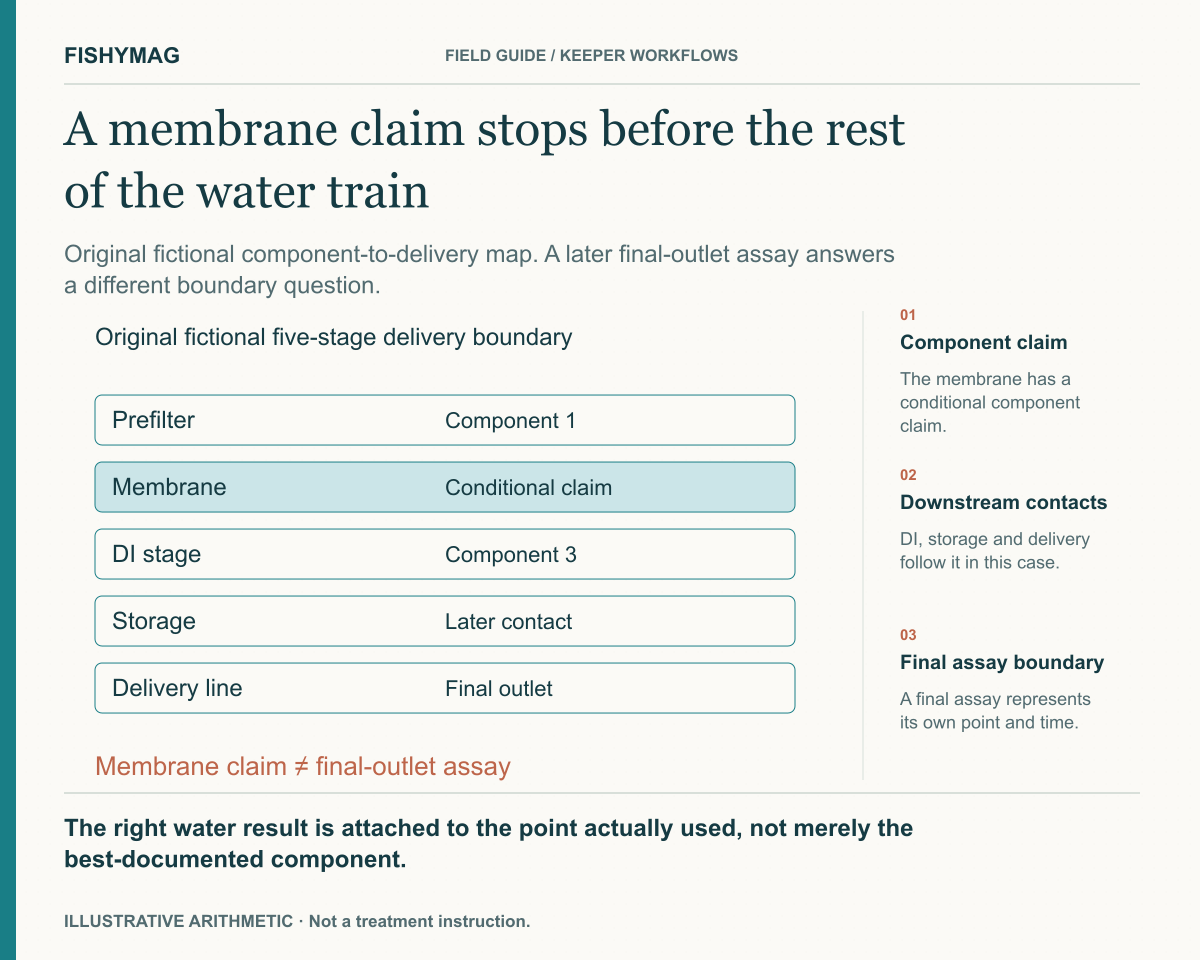
Figure data and explanation
Original fictional component-to-delivery map. A later final-outlet assay answers a different boundary question.
- Component claim
- The membrane has a conditional component claim.
- Downstream contacts
- DI, storage and delivery follow it in this case.
- Final assay boundary
- A final assay represents its own point and time.
The right water result is attached to the point actually used, not merely the best-documented component.
Put the sample point on the same diagram as the claim
This original fictional train contains a prefilter, membrane, DI stage, storage vessel and delivery line. A component document states a conditional rejection claim for constituent X at the membrane, but the packet contains no assay at the final delivery outlet. EPA describes sequential purification technologies, and Aquatic Life documents a DI component downstream of a membrane. Neither turns a membrane-only specification into a measurement after every later contact.
Complete the two evidence packets
Packet B adds one expressly fictional assay: final-delivery batch B17, X reported <2 µg/L using a stated applicable method. That qualifier is preserved.
| Evidence item | Packet A: component document only | Packet B: final-outlet assay added |
|---|---|---|
| Membrane claim | Assessable only within its conditions | Same component scope |
| DI stage performance for X | No constituent-specific result | Not isolated by a final assay |
| Storage and delivery contact | Present in the train, unassayed | Included before the final collection point |
| Final-delivery X result | Not measured | B17 at that outlet and collection time: <2 µg/L |
| X exactly absent | Not established | Still not established by <2 |
| Which stage caused the result? | Unresolved | Unresolved without stage-specific evidence |
Use the added assay without over-crediting a component
A final-outlet result is valuable because it represents a different boundary from the membrane document. Its relevance still depends on batch linkage, collection time, fraction, method and reporting capability. It is not automatically a certificate for all later batches or all untested constituents. Conversely, a low final value cannot be attributed solely to the membrane when other stages and incoming conditions differ. A practical summary names the sample point and result, then separately records the component claims. No installation change, laboratory collection protocol or livestock-clearance decision is supplied here.
Use your own details
An RO membrane rating is not a whole-system result worksheet
Download the editable text file, fill it in on your device and keep it with the relevant record. This blank worksheet records your information; it does not verify entries or approve treatment.
- Complete feed-to-delivery stage list
- Exact component identity and document revision
- Constituent named in each claim
- Claim test conditions and boundary
- Final collection point and batch identity
- Final result with qualifier and reporting basis
- Downstream contact and storage coverage
- Attribution to individual stages not demonstrated
Put it into practice
Your checklist
- Map every downstream stage after the component claim.
- Attach the final assay to a specific batch, outlet and time.
- Keep final quality evidence separate from attribution to one component.
Sources and scope
This article distinguishes manufacturer statements from FishyMag’s own workflows and arithmetic examples. Linked formulation records retain their own evidence dates; publishing this article does not refresh those records.
- DuPont TW30-1812-50HR product data sheet, revision 5, January 2021; reviewed November 9, 2026 ↗
- EPA WaterSense at Work, Water Purification, March 2024; reviewed November 9, 2026 ↗
- Aquatic Life Classic DI manual, models 540722/540235, file 021224; reviewed November 9, 2026 ↗
AI-assisted writing and development. Not hands-on product testing or veterinary review. How we publish →
FishyMag reports what manufacturers say, quoted and linked. It does not diagnose illness or recommend a treatment, and it never infers that a product is safe from the absence of a warning — where no statement exists, it says so.
Formulations change. Always read the label on the bottle in your hand, and contact the manufacturer if your tank contains anything valuable or unusual.