Keeper workflows
What does an aquarium resin actually select?
Read a resin selectivity claim against a named free ion, a specific complex and a total-element report.
By FishyMag · Published
Worked filtration evidence example · Not a clinical review or treatment recommendation.
Quick answer
The fictional selectivity record tests free Cu²⁺ in its stated matrix. It does not test the named copper complex or identify the forms in a total-copper result. Keep those requests separate, even if all three use the word copper.
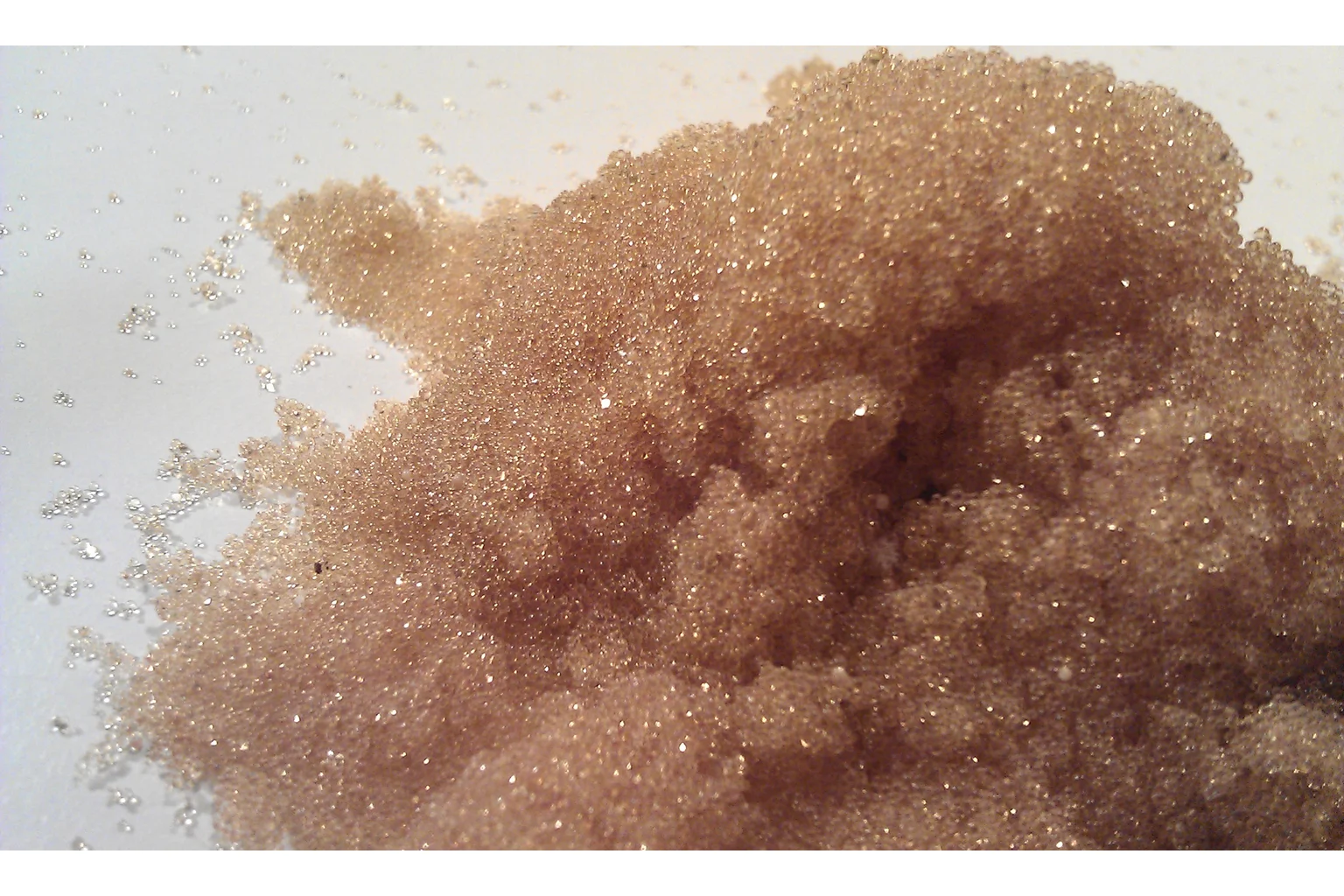
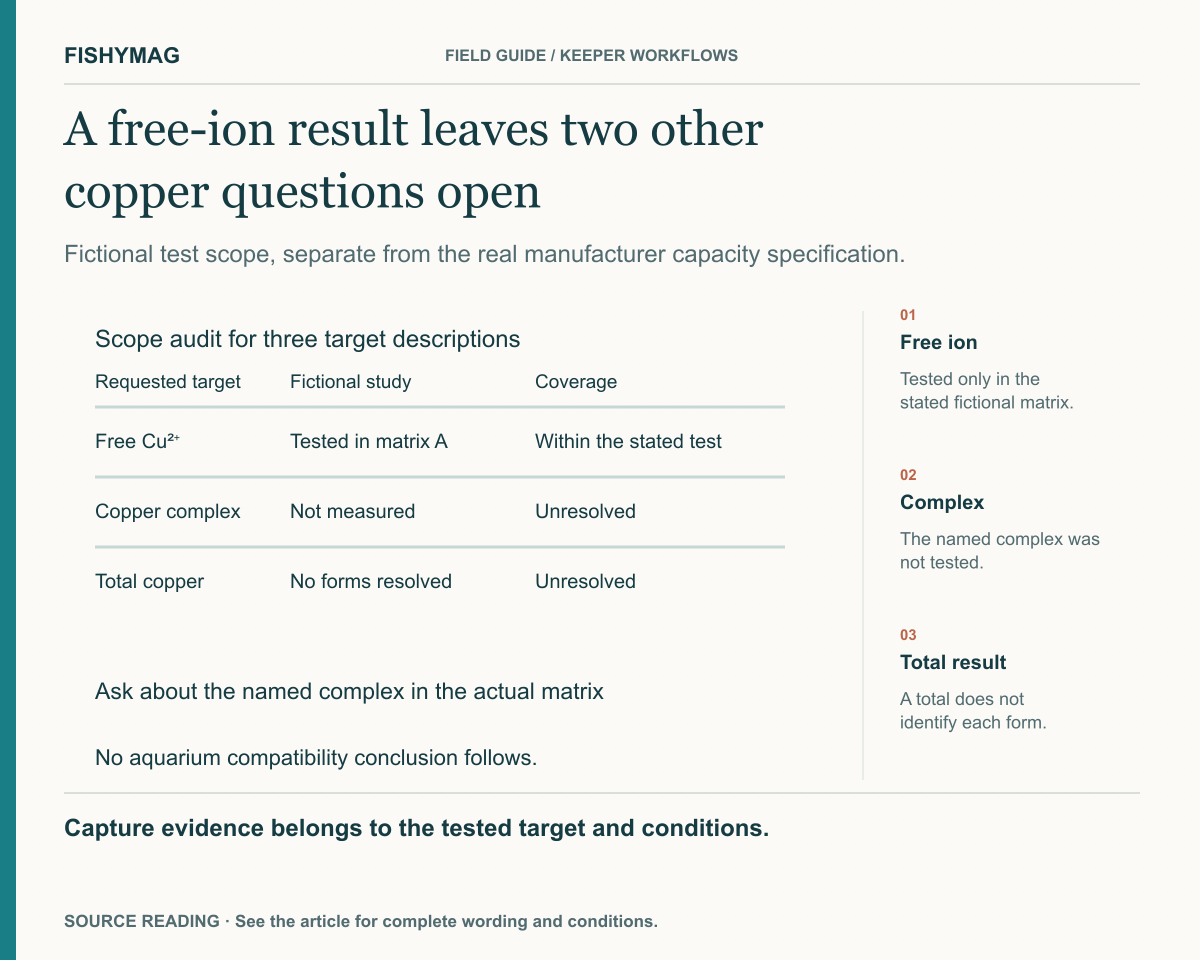
Figure data and explanation
Fictional test scope, separate from the real manufacturer capacity specification.
- Free ion
- Tested only in the stated fictional matrix.
- Complex
- The named complex was not tested.
- Total result
- A total does not identify each form.
Capture evidence belongs to the tested target and conditions.
A capacity line is not a list of every form captured
The Purolite S930Plus sheet names an iminodiacetic resin supplied in sodium form and lists a minimum copper capacity of 50 g/L. This is a real industrial resin document. The separate fictional test packet covers free Cu²⁺ in matrix A; it is not a Purolite test, and its scope does not follow from the capacity line.
Keep three requests distinct
The term “copper” may describe a specified ion, a complex, or an analytical total that says nothing by itself about the mixture of forms.
| Request | Matching evidence | Finding |
|---|---|---|
| Free Cu²⁺ in matrix A | Fictional test measured it | Covered under those conditions |
| Specified copper-ligand complex in matrix B | No test of that complex in B | Unresolved |
| Total copper with uncharacterised forms | No form-specific comparison | Cannot infer capture for all copper in the result |
Send the next question to the right evidence
A useful question to prepare is: “For the exact resin in its supplied ionic form, what result is available for this named copper complex at our documented pH and ionic composition, and how was the measured fraction defined?” A missing answer does not imply capture or failure. Keep the original capacity basis, target form and exposure conditions attached to any reply.
Use your own details
What does an aquarium resin actually select? worksheet
Download the editable text file, fill it in on your device and keep it with the relevant record. This blank worksheet records your information; it does not verify entries or approve treatment.
- Exact resin and ionic form
- Functional group and document version
- Named free ion or complex
- Matrix, pH and competing constituents
- Measurement and reporting basis
- Tested species versus unresolved forms
- Exact follow-up question
Put it into practice
Your checklist
- Match the exact resin and supplied ionic form.
- Identify the tested chemical species and matrix.
- Ask a form-specific question before generalising a capacity figure.
Sources and scope
This article distinguishes manufacturer statements from FishyMag’s own workflows and arithmetic examples. Linked formulation records retain their own evidence dates; publishing this article does not refresh those records.
- Purolite S930Plus technical sheet, November 26, 2025; reviewed November 9, 2026 ↗
- Experimental copper detection with two chelating polymers in the presence of EDTA; reviewed November 9, 2026 ↗
AI-assisted writing and development. Not hands-on product testing or veterinary review. How we publish →
FishyMag reports what manufacturers say, quoted and linked. It does not diagnose illness or recommend a treatment, and it never infers that a product is safe from the absence of a warning — where no statement exists, it says so.
Formulations change. Always read the label on the bottle in your hand, and contact the manufacturer if your tank contains anything valuable or unusual.