Keeper workflows
Does the mixing vessel's documentation cover its use?
Assess a fictional replacement-water vessel assembly without extending a shell-only use claim to unidentified seals and fittings.
By FishyMag · Published
Original evidence-and-batch case · Not a clinical review or treatment recommendation.
Quick answer
The fictional vessel dossier documents an intended-use match for the shell, but not for every water-contact component. The seal composition and some fitting conditions are missing. The assembly is partially documented. That is neither approval nor evidence that it leaches or is unsuitable.
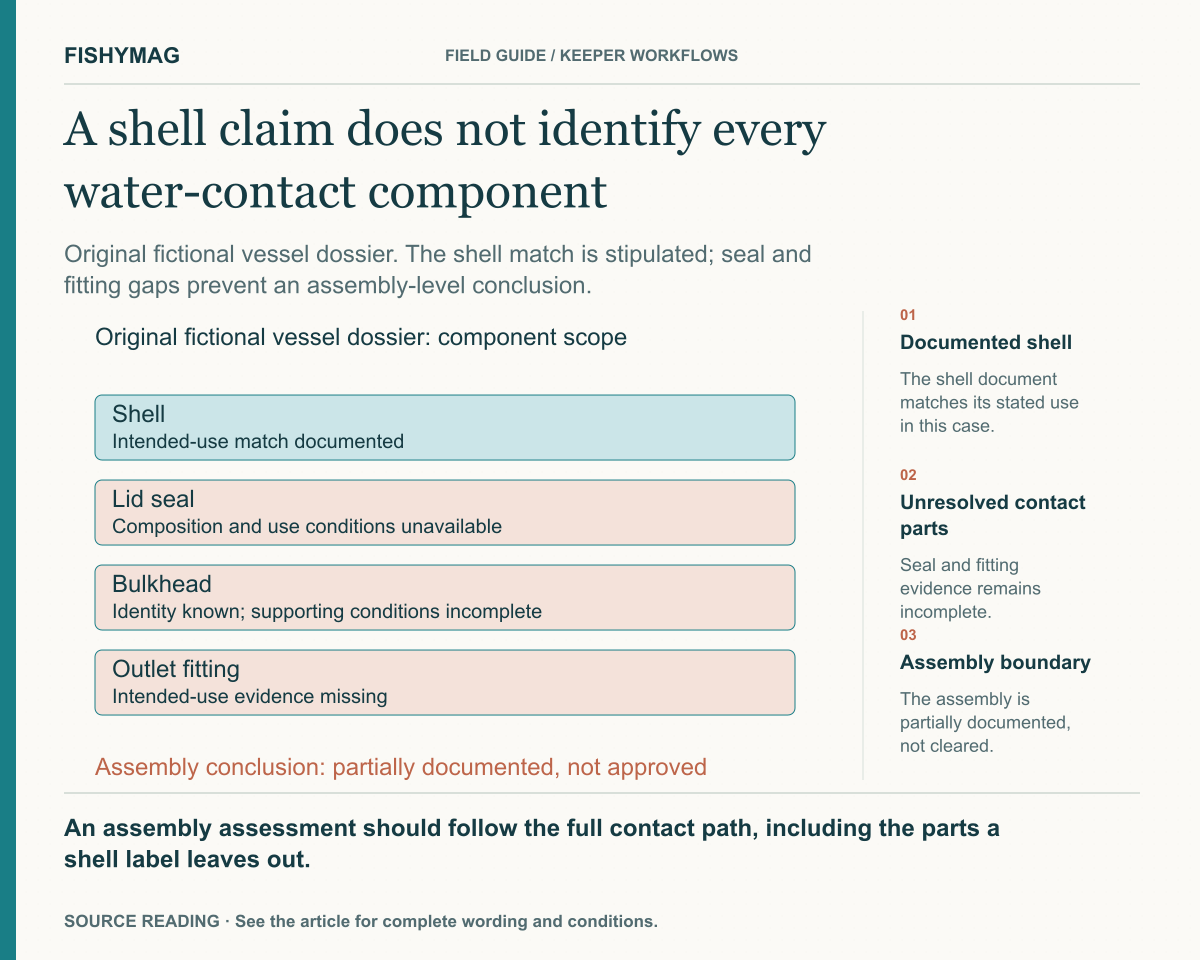
Figure data and explanation
Original fictional vessel dossier. The shell match is stipulated; seal and fitting gaps prevent an assembly-level conclusion.
- Documented shell
- The shell document matches its stated use in this case.
- Unresolved contact parts
- Seal and fitting evidence remains incomplete.
- Assembly boundary
- The assembly is partially documented, not cleared.
An assembly assessment should follow the full contact path, including the parts a shell label leaves out.
Separate the vessel from its water-contact assembly
This original fictional dossier contains a shell, lid seal, bulkhead and outlet fitting. The shell’s supplied document matches the intended liquid and contact conditions in the case. Other component records are incomplete. Norwesco’s real bolted-fitting page illustrates why components need separate identities: it lists fitting bodies, bolts and different gasket options. This article does not evaluate a particular Norwesco installation or infer the composition of an unidentified seal.
Complete the assembly evidence map
The shell match is stipulated as an invented dossier fact. It does not establish that a different component, replacement gasket or installed modification shares the same scope.
| Component | Fictional evidence supplied | Completed finding |
|---|---|---|
| Shell | Exact identity and intended liquid/contact conditions match | That component’s stated use documented |
| Lid seal | Composition and use conditions unavailable | Applicability unresolved |
| Bulkhead | Body identity recorded; complete contact conditions missing | Partially documented |
| Outlet fitting | Identity present; intended-use evidence absent | Applicability unresolved |
| Whole assembly | One component matched; other contact paths incomplete | Partially documented, not approved |
| Leaching or biological outcome | No assay or relevant outcome test supplied | Neither contamination nor compatibility inferred |
Ask for the missing component record, not a generic material label
Request the installed seal and fitting specifications, their relevant contact conditions and any manufacturer assembly-level statement. “Plastic,” “stainless” or a shell-only use description cannot identify every gasket, adhesive or altered connection. Conversely, missing documentation is not proof that a component releases a harmful amount of anything. Preserve the distinction between identification, intended-use coverage, measured release and biological compatibility. The output is a completed evidence-gap list, not a vessel modification guide, a food-contact legal determination or permission to use a batch with livestock.
Use your own details
Does the mixing vessel's documentation cover its use? worksheet
Download the editable text file, fill it in on your device and keep it with the relevant record. This blank worksheet records your information; it does not verify entries or approve treatment.
- Exact vessel and assembly identity
- Water-contact shell material and use document
- Lid and seal identity with conditions
- Bulkhead body, bolts and gasket specification
- Outlet fitting and downstream contact materials
- Temperature, duration and liquid covered by documents
- Unsupported installed modifications
- Assembly-level evidence gaps and bounded conclusion
Put it into practice
Your checklist
- List every water-contact component in the actual assembly.
- Keep a shell-only use statement within its component scope.
- Report missing documentation without inventing contamination or approval.
Sources and scope
This article distinguishes manufacturer statements from FishyMag’s own workflows and arithmetic examples. Linked formulation records retain their own evidence dates; publishing this article does not refresh those records.
- Norwesco bolted fittings: separately specified fitting and gasket materials; reviewed November 9, 2026 ↗
- FishyMag evidence methodology; reviewed November 8, 2026 ↗
AI-assisted writing and development. Not hands-on product testing or veterinary review. How we publish →
FishyMag reports what manufacturers say, quoted and linked. It does not diagnose illness or recommend a treatment, and it never infers that a product is safe from the absence of a warning — where no statement exists, it says so.
Formulations change. Always read the label on the bottle in your hand, and contact the manufacturer if your tank contains anything valuable or unusual.