Keeper workflows
Separate product evidence is not combination evidence
Map four exposure cells and show exactly what a limited combination report would add.
By FishyMag · Published
Original evidence audit · Not a clinical review or treatment recommendation.
Quick answer
The fictional dossier covers neither product, A alone and B alone. It has no record for A with B. An added combination report on short-term feeding would fill that one endpoint cell while leaving other endpoints and an interaction assessment unresolved.
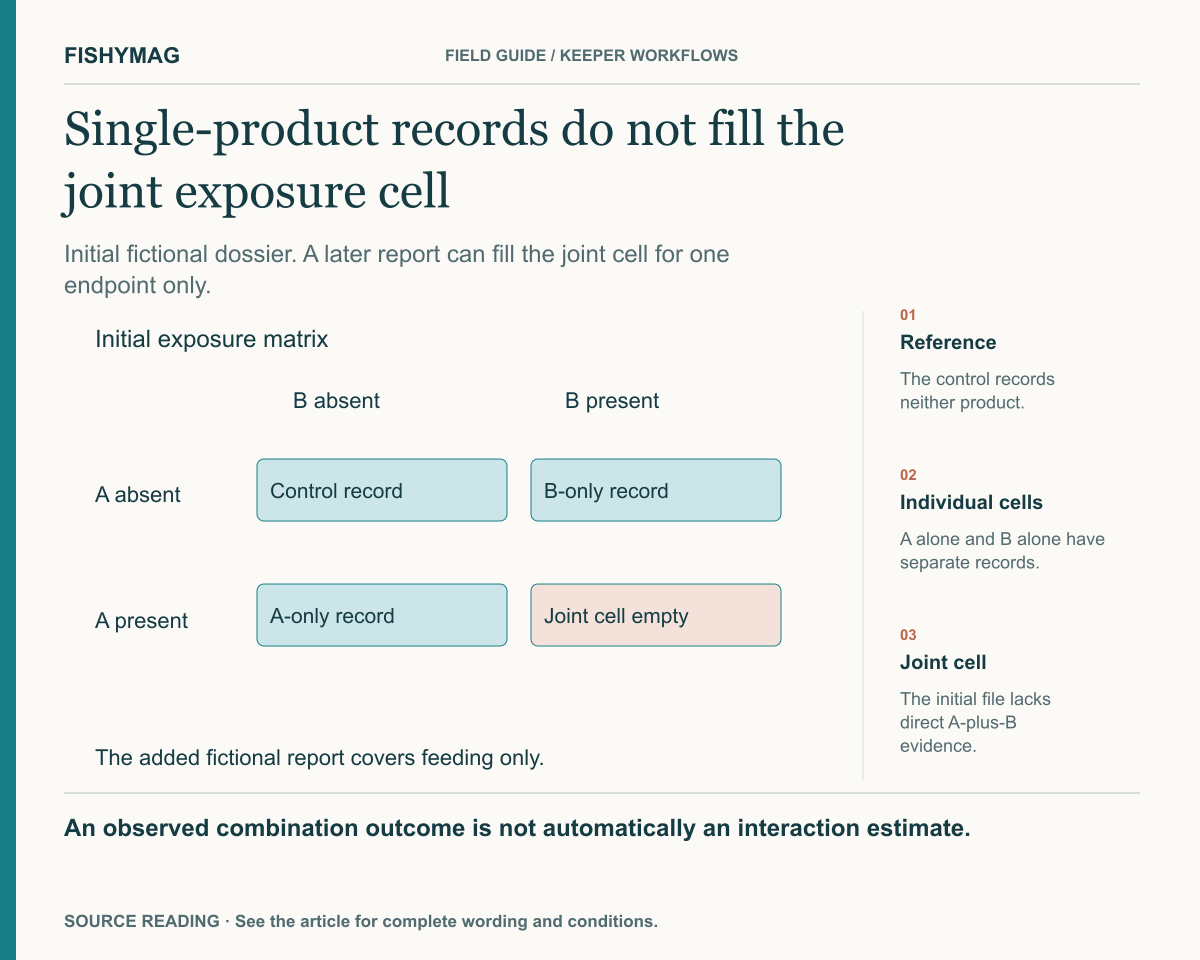
Figure data and explanation
Initial fictional dossier. A later report can fill the joint cell for one endpoint only.
- Reference
- The control records neither product.
- Individual cells
- A alone and B alone have separate records.
- Joint cell
- The initial file lacks direct A-plus-B evidence.
An observed combination outcome is not automatically an interaction estimate.
Make a cell for the question being asked
Three fictional records cover a comparison without either product, an A-only observation, and a B-only observation in freshwater. The proposed claim concerns A with B. Separate product reports cannot occupy that joint cell. EFSA’s combined-exposure guidance is a reminder to define the combination, exposure and effect separately; it is not a compatibility source for this case.
Reassess only the cell an extra report fills
In the second fictional packet an added report documents simultaneous exposure and feeding observations over its stated interval.
| Cell | Initial packet | With added joint report |
|---|---|---|
| Neither product | Reference record | Unchanged |
| A only | A observation | Unchanged |
| B only | B observation | Unchanged |
| A plus B | No direct record | Feeding recorded in the stated interval |
| Other joint outcomes | Unmeasured | Still unmeasured |
Check comparability before an interaction claim
The presence of four cells does not make them a comparable experiment. An interaction estimate also needs a defined contrast, consistent endpoints and conditions, and a suitable design. The added report improves documentation of one joint endpoint only. It supplies no administration advice or approval for combining real products.
Use your own details
Separate product evidence is not combination evidence worksheet
Download the editable text file, fill it in on your device and keep it with the relevant record. This blank worksheet records your information; it does not verify entries or approve treatment.
- Exact formulations and route
- Neither-product reference
- A-only record and outcomes
- B-only record and outcomes
- Joint exposure verification
- Comparable endpoints and observation windows
- Unmeasured effects or interaction evidence
Put it into practice
Your checklist
- Give joint exposure its own cell.
- Attach each result to the endpoint it measured.
- Separate a filled cell from a valid interaction estimate.
Sources and scope
This article distinguishes manufacturer statements from FishyMag’s own workflows and arithmetic examples. Linked formulation records retain their own evidence dates; publishing this article does not refresh those records.
- EFSA guidance on combined exposure to multiple chemicals, 2019; reviewed November 9, 2026 ↗
- OECD weight-of-evidence guidance for chemical assessment; reviewed November 9, 2026 ↗
- FishyMag evidence methodology; reviewed November 8, 2026 ↗
AI-assisted writing and development. Not hands-on product testing or veterinary review. How we publish →
FishyMag reports what manufacturers say, quoted and linked. It does not diagnose illness or recommend a treatment, and it never infers that a product is safe from the absence of a warning — where no statement exists, it says so.
Formulations change. Always read the label on the bottle in your hand, and contact the manufacturer if your tank contains anything valuable or unusual.