Keeper workflows
A new aquarium product name is not an equivalence statement
Reconstruct a documented old-to-new catalogue transition without turning a commercial replacement statement into chemical equivalence or transfer of old evidence.
By FishyMag · Published
Worked evidence example · Not a clinical review or treatment recommendation.
Quick answer
Read what the replacement statement actually confirms. In this fictional chain, a manufacturer notice establishes that N2 succeeds O1 in the catalogue. It does not say their formulations are equivalent or that O1’s evidence applies to N2. The commercial link is documented; those stronger bridges remain missing.
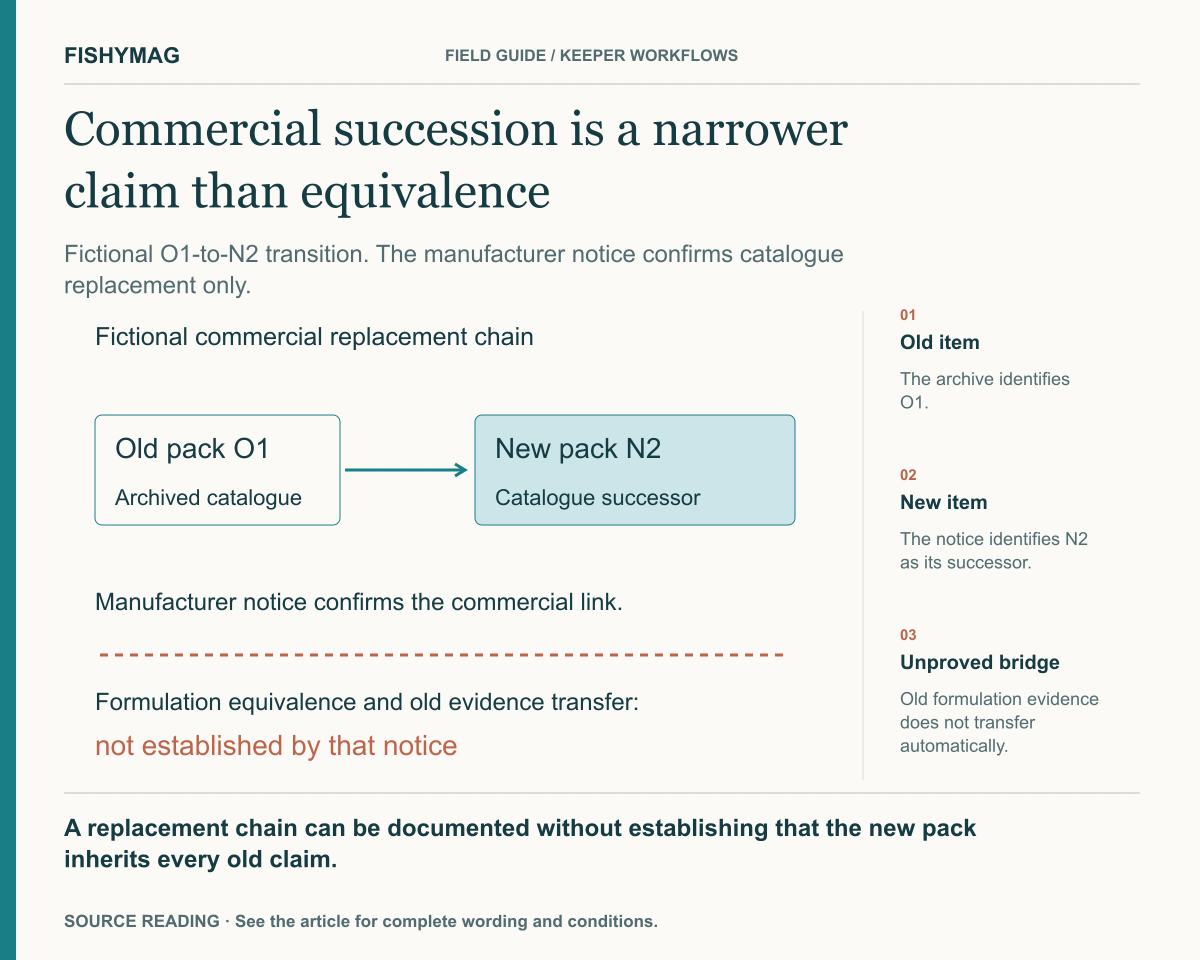
Figure data and explanation
Fictional O1-to-N2 transition. The manufacturer notice confirms catalogue replacement only.
- Old item
- The archive identifies O1.
- New item
- The notice identifies N2 as its successor.
- Unproved bridge
- Old formulation evidence does not transfer automatically.
A replacement chain can be documented without establishing that the new pack inherits every old claim.
Reconstruct the claim in three steps
The invented archive contains a catalogue entry for O1, a seller listing that calls N2 its replacement, and a manufacturer notice confirming that N2 takes O1’s place in the catalogue. No real product transition is reported here. The three sources have different roles: the archive identifies the old item, the seller explains its offer, and the notice establishes the commercial transition.
Complete the bridge-by-bridge decision
Do not combine every claim into one arrow labelled “same.” The arrow has to say what it connects and who supplied it.
| Proposed bridge | Retained source | Completed result |
|---|---|---|
| O1 existed as the archived item | Dated catalogue | Established within the teaching packet |
| Seller offers N2 instead | Seller listing | Offer documented; not equivalence proof |
| N2 succeeds O1 commercially | Manufacturer notice | Catalogue replacement established |
| O1 and N2 have equivalent formulations | No explicit statement or complete mapping | Unresolved |
| Old O1 evidence applies to received N2 revision | No applicability bridge retained | Not established |
Ask for the missing bridge explicitly
A useful request names O1 and N2, their markets and revisions, and the specific old evidence whose applicability is in question. Ask whether the manufacturer intends that evidence to cover the received N2 revision and on what documented basis. Do not substitute a shared ingredient name, an unchanged photograph or a seller’s shorthand for that answer. Retain the catalogue transition as a valid finding while leaving the stronger claims open. This also prevents a later site edit from silently attaching an old compatibility record to a new pack merely because a shopping link now redirects.
Use your own details
A new aquarium product name is not an equivalence statement worksheet
Download the editable text file, fill it in on your device and keep it with the relevant record. This blank worksheet records your information; it does not verify entries or approve treatment.
- Old item code, market and revision
- New item code, market and revision
- Archived catalogue and retrieval record
- Seller replacement claim and date
- Manufacturer transition notice and exact scope
- Explicit equivalence or evidence-transfer statement, if present
- Completed transition finding
- Question naming both items and the evidence to be bridged
Put it into practice
Your checklist
- Label a replacement arrow with the exact claim it establishes.
- Preserve the source of commercial succession.
- Require a separate bridge before transferring formulation evidence.
Sources and scope
This article distinguishes manufacturer statements from FishyMag’s own workflows and arithmetic examples. Linked formulation records retain their own evidence dates; publishing this article does not refresh those records.
- FishyMag evidence methodology; reviewed November 8, 2026 ↗
- FishyMag bottle identity worksheet; reviewed November 8, 2026 ↗
- FishyMag manufacturer question brief; reviewed November 8, 2026 ↗
AI-assisted writing and development. Not hands-on product testing or veterinary review. How we publish →
FishyMag reports what manufacturers say, quoted and linked. It does not diagnose illness or recommend a treatment, and it never infers that a product is safe from the absence of a warning — where no statement exists, it says so.
Formulations change. Always read the label on the bottle in your hand, and contact the manufacturer if your tank contains anything valuable or unusual.