Keeper workflows
One aquarium study, two publication versions
Reconcile a preprint and publication by experiment identifiers, then track substantive wording changes.
By FishyMag · Published
Original source audit · Not a clinical review or treatment recommendation.
Quick answer
The fictional preprint P and journal article J are two versions of the same documented experiment, E-17. Their titles, author order and endpoint presentation differ. A third paper shares authors but lacks enough detail to determine whether it shares the data.
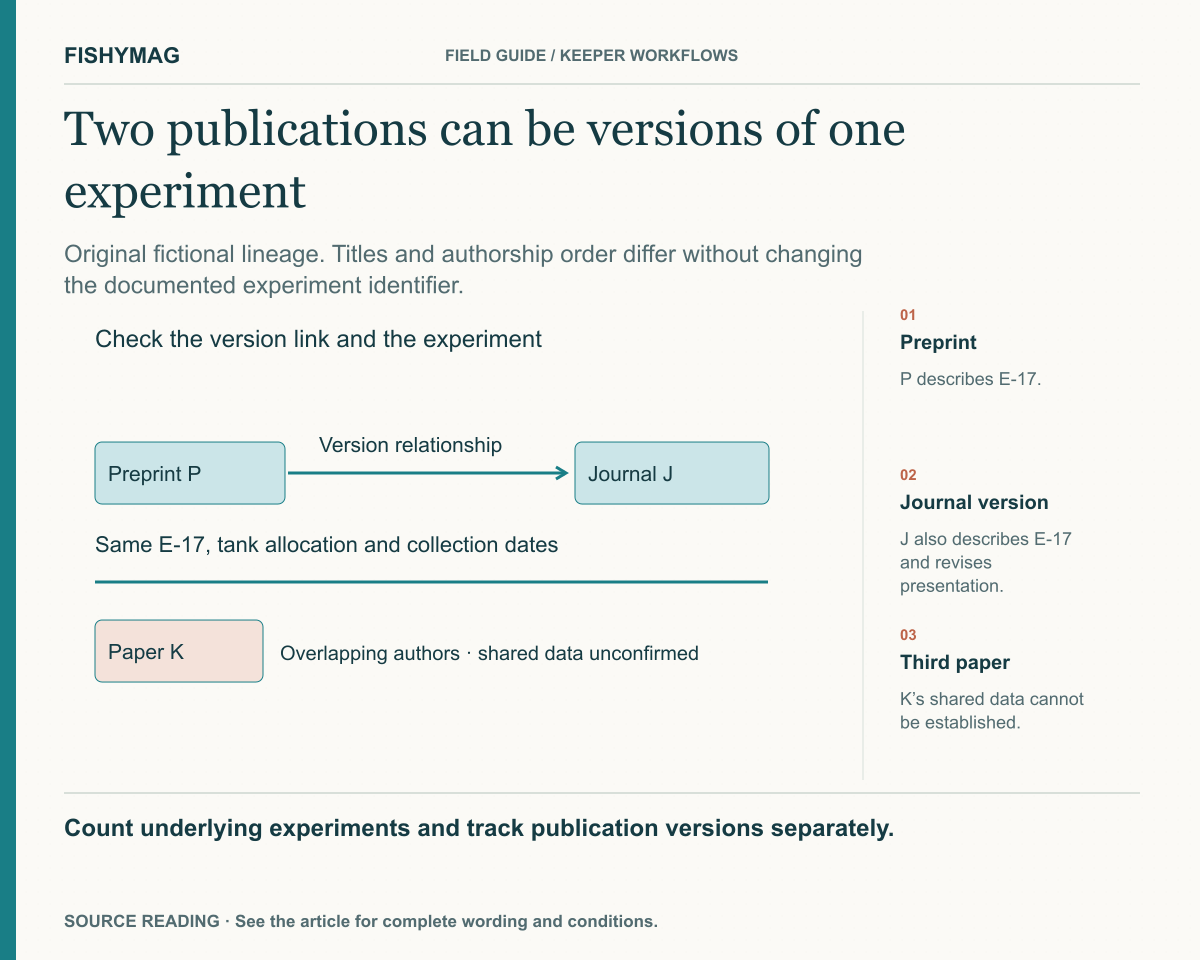
Figure data and explanation
Original fictional lineage. Titles and authorship order differ without changing the documented experiment identifier.
- Preprint
- P describes E-17.
- Journal version
- J also describes E-17 and revises presentation.
- Third paper
- K’s shared data cannot be established.
Count underlying experiments and track publication versions separately.
Match identifiers beneath the titles
The fictional preprint and journal publication both name experiment E-17, twelve allocated tanks and the same collection dates. The journal version links to the preprint. Crossref supports an explicit preprint relationship; matching details in the documents support the relationship in this worked case. Paper K shares two authors but does not supply a cohort ID or matching dates.
Compare the passages the claim depends on
Different wording does not automatically establish new data or a different experiment.
| Field | Preprint P | Journal J |
|---|---|---|
| Study and allocation | E-17, same twelve tanks | E-17, same twelve tanks |
| Title and byline | Earlier title and order | Changed title and author order |
| Feeding presentation | Narrative in results paragraph 2 | Day-four count moved to Table 3 |
| Exposure language | Timing in methods section | Timing defined in methods plus appendix |
| Paper K | Overlapping authors only | Lineage unresolved |
Cite the current passage without counting two experiments
When referring to the table, use the journal version and retain the preprint link in the record. Reassess any statement copied from the earlier text that no longer matches the current wording. This is a version audit, not an estimate of how many experiments Paper K contains.
Use your own details
One aquarium study, two publication versions worksheet
Download the editable text file, fill it in on your device and keep it with the relevant record. This blank worksheet records your information; it does not verify entries or approve treatment.
- Preprint and version-of-record identifiers
- Study, tank allocation and collection dates
- Version link from repository or publisher
- Exact changed passages and tables
- Same and missing lineage evidence
- Citation to use for current claim
- Unknown third-paper relationship
Put it into practice
Your checklist
- Match study IDs, tanks and dates.
- Track changes to passages used for claims.
- Leave a third paper’s lineage unresolved when only authors overlap.
Sources and scope
This article distinguishes manufacturer statements from FishyMag’s own workflows and arithmetic examples. Linked formulation records retain their own evidence dates; publishing this article does not refresh those records.
- Crossref relationship types; reviewed November 9, 2026 ↗
- Crossref version control, corrections and retractions; reviewed November 9, 2026 ↗
- Cochrane Handbook Chapter 5, extracting from multiple reports; reviewed November 9, 2026 ↗
AI-assisted writing and development. Not hands-on product testing or veterinary review. How we publish →
FishyMag reports what manufacturers say, quoted and linked. It does not diagnose illness or recommend a treatment, and it never infers that a product is safe from the absence of a warning — where no statement exists, it says so.
Formulations change. Always read the label on the bottle in your hand, and contact the manufacturer if your tank contains anything valuable or unusual.