Keeper workflows
What pKa can tell you about an aquarium ingredient
Calculate the modeled sulfathiazole anion fraction at three pH values and keep the study medium’s limits visible.
By FishyMag · Published
Worked formulation evidence example · Not a clinical review or treatment recommendation.
Quick answer
Using the measured apparent pKa of 7.23 in a simple acid-pair model gives about 15.7%, 50.0% and 85.5% anion at pH 6.50, 7.23 and 8.00. These are modeled values at the stated basis, not measurements of aquarium water, uptake or effects.
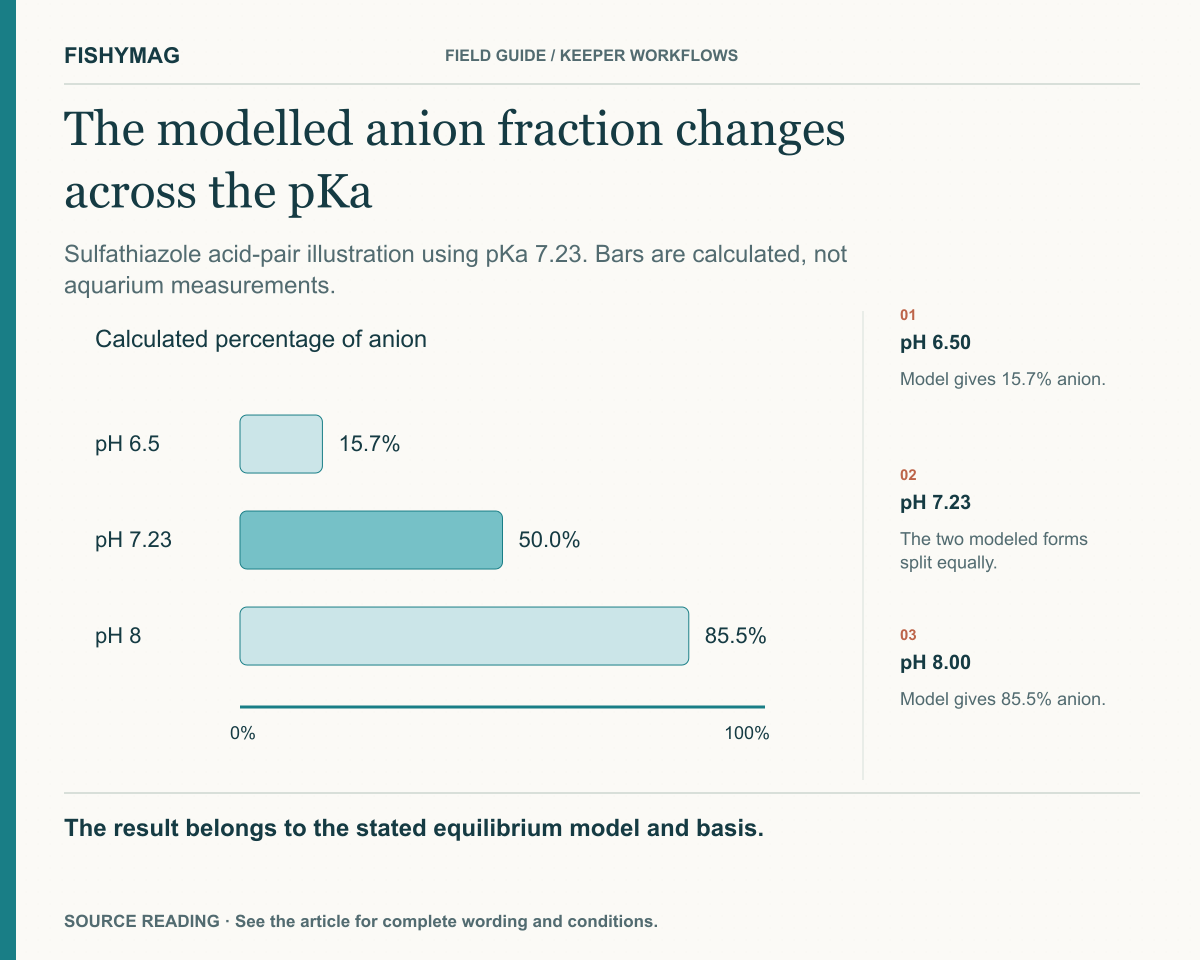
Figure data and explanation
Sulfathiazole acid-pair illustration using pKa 7.23. Bars are calculated, not aquarium measurements.
- pH 6.50
- Model gives 15.7% anion.
- pH 7.23
- The two modeled forms split equally.
- pH 8.00
- Model gives 85.5% anion.
The result belongs to the stated equilibrium model and basis.
Choose the dissociation step and match the measurement basis
A spectrophotometric study reports sulfathiazole’s acid pKa as 7.23 at 27 ± 1 °C and ionic strength 0.2. The example treats the neutral species and conjugate anion as the relevant pair near that transition, with a fixed apparent pKa and no explicitly modeled complexing or sorption. The pH values are hypothetical inputs, not a claim that the measured pKa transfers to all aquariums.
Calculate the anion fraction in the stipulated model
For the acid pair, percent anion = 100 ÷ [1 + 10 raised to (pKa minus pH)]. The difference in the exponent is dimensionless. Rounding follows the stated pKa and avoids false precision.
| Input pH | Exponent pKa minus pH | Modeled anion fraction |
|---|---|---|
| 6.50 | 0.73 | 100 ÷ (1 + 10^0.73) ≈ 15.7% |
| 7.23 | 0 | 100 ÷ 2 = 50.0% |
| 8.00 | −0.77 | 100 ÷ (1 + 10^−0.77) ≈ 85.5% |
Leave aquarium transfer and biological findings separate
A tank with different temperature, ionic composition or additional binding reactions need not match the model’s apparent pKa or chemical fractions. Seachem’s ingredient statement identifies sulfathiazole in a named product; it is not a water speciation or fate measurement. Even in the ideal case the ionisation fraction does not establish uptake, persistence or compatibility.
Use your own details
What pKa can tell you about an aquarium ingredient worksheet
Download the editable text file, fill it in on your device and keep it with the relevant record. This blank worksheet records your information; it does not verify entries or approve treatment.
- Compound and acid dissociation step
- Measured apparent pKa and source
- Temperature and ionic strength
- Fictional or measured pH values
- Model assumptions and substitutions
- Rounded calculated fractions
- Unmeasured aquarium and biological endpoints
Put it into practice
Your checklist
- Keep the measured pKa with its temperature and ionic strength.
- Name the acid-pair and other assumptions.
- Do not translate a modeled fraction into a biological or residue claim.
Sources and scope
This article distinguishes manufacturer statements from FishyMag’s own workflows and arithmetic examples. Linked formulation records retain their own evidence dates; publishing this article does not refresh those records.
- Spectrophotometric acid dissociation measurements for twelve sulfonamides; reviewed November 9, 2026 ↗
- Seachem SulfaPlex ingredient statement; reviewed November 9, 2026 ↗
- FishyMag evidence methodology; reviewed November 8, 2026 ↗
AI-assisted writing and development. Not hands-on product testing or veterinary review. How we publish →
FishyMag reports what manufacturers say, quoted and linked. It does not diagnose illness or recommend a treatment, and it never infers that a product is safe from the absence of a warning — where no statement exists, it says so.
Formulations change. Always read the label on the bottle in your hand, and contact the manufacturer if your tank contains anything valuable or unusual.