Keeper workflows
What an aquarium patent example can establish
Read the difference between a patent’s claimed scope, predicted example and reported observation without assuming validation.
By FishyMag · Published
Original source audit · Not a clinical review or treatment recommendation.
Quick answer
The fictional patent contains a broad claim, one predicted example and a second passage reporting performed work. The grant does not independently establish that either supports aquarium compatibility. The packet lacks relevant controls and raw records.
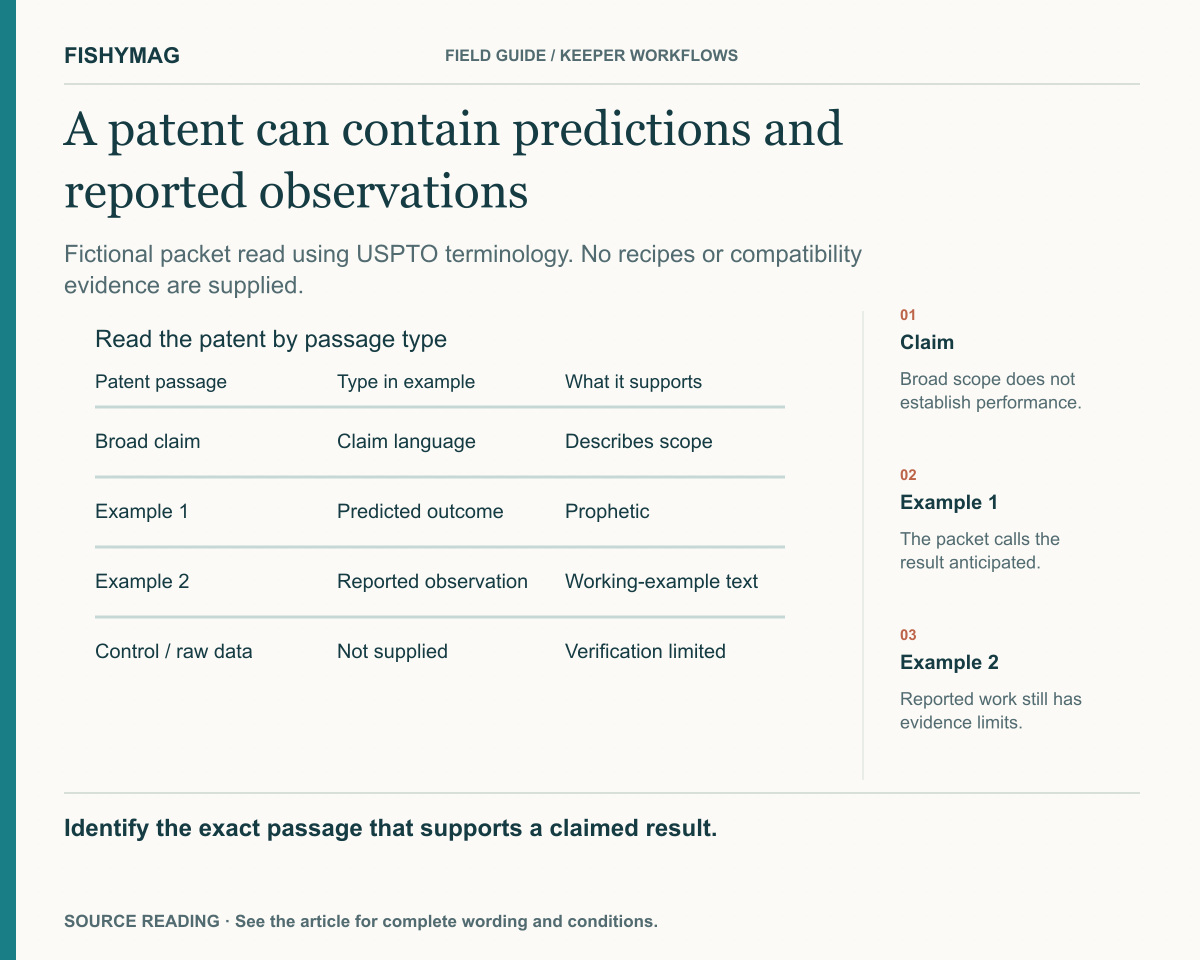
Figure data and explanation
Fictional packet read using USPTO terminology. No recipes or compatibility evidence are supplied.
- Claim
- Broad scope does not establish performance.
- Example 1
- The packet calls the result anticipated.
- Example 2
- Reported work still has evidence limits.
Identify the exact passage that supports a claimed result.
Read the patent at the passage level
The USPTO’s MPEP §2164.02 distinguishes working examples based on performed work from prophetic examples based on predictions. Our fictional aquarium-media packet includes a claim to a media arrangement. Example 1 explicitly presents an anticipated result. Example 2 says a laboratory observation was made. The invented packet gives no preparation or operating procedure.
Classify the three passages without trusting tense alone
The type follows the stated nature of the work. Tense can be a clue, but it cannot independently verify the underlying records.
| Passage | Stipulated content | Finding |
|---|---|---|
| Broad claim | Describes the claimed arrangement | Scope language, not an efficacy result |
| Example 1 | States an outcome is expected, not observed | Prophetic example in this packet |
| Example 2 | Reports an observed change | Working-example text; raw records and comparator missing |
| Aquarium compatibility | Not assessed by a cited endpoint | Unsupported by the supplied packet |
Write a cautious provenance note
State that the patent describes an invention and includes a reported observation and a separate prediction. If a later claim relies on a biological outcome, look for the specific comparative evidence that measures it. Neither the existence of a grant nor the breadth of the claim supplies that evidence.
Use your own details
What an aquarium patent example can establish worksheet
Download the editable text file, fill it in on your device and keep it with the relevant record. This blank worksheet records your information; it does not verify entries or approve treatment.
- Exact patent and version
- Claim number and wording
- Example text and whether work was reported
- Observed endpoint or predicted result
- Controls and raw record availability
- Relevant aquarium outcome not measured
- Bounded description of what the packet contains
Put it into practice
Your checklist
- Separate claims from example text.
- Distinguish reported work from predicted results.
- Check raw records and endpoint coverage before making a stronger statement.
Sources and scope
This article distinguishes manufacturer statements from FishyMag’s own workflows and arithmetic examples. Linked formulation records retain their own evidence dates; publishing this article does not refresh those records.
- USPTO MPEP §2164.02, working and prophetic examples; reviewed November 9, 2026 ↗
- OECD weight-of-evidence guidance for chemical assessment; reviewed November 9, 2026 ↗
AI-assisted writing and development. Not hands-on product testing or veterinary review. How we publish →
FishyMag reports what manufacturers say, quoted and linked. It does not diagnose illness or recommend a treatment, and it never infers that a product is safe from the absence of a warning — where no statement exists, it says so.
Formulations change. Always read the label on the bottle in your hand, and contact the manufacturer if your tank contains anything valuable or unusual.