Keeper workflows
Can a partition coefficient explain aquarium residues?
Translate a two-liquid concentration ratio into a conditional mass split without inferring residues on aquarium surfaces.
By FishyMag · Published
Worked formulation evidence example · Not a clinical review or treatment recommendation.
Quick answer
With a fictional concentration ratio of 4 and volumes of 10 mL octanol and 90 mL water, about 30.8% of the accounted mass is in octanol at equilibrium. This is a liquid-phase model. It does not estimate metronidazole on aquarium plastic, glass or sediment.
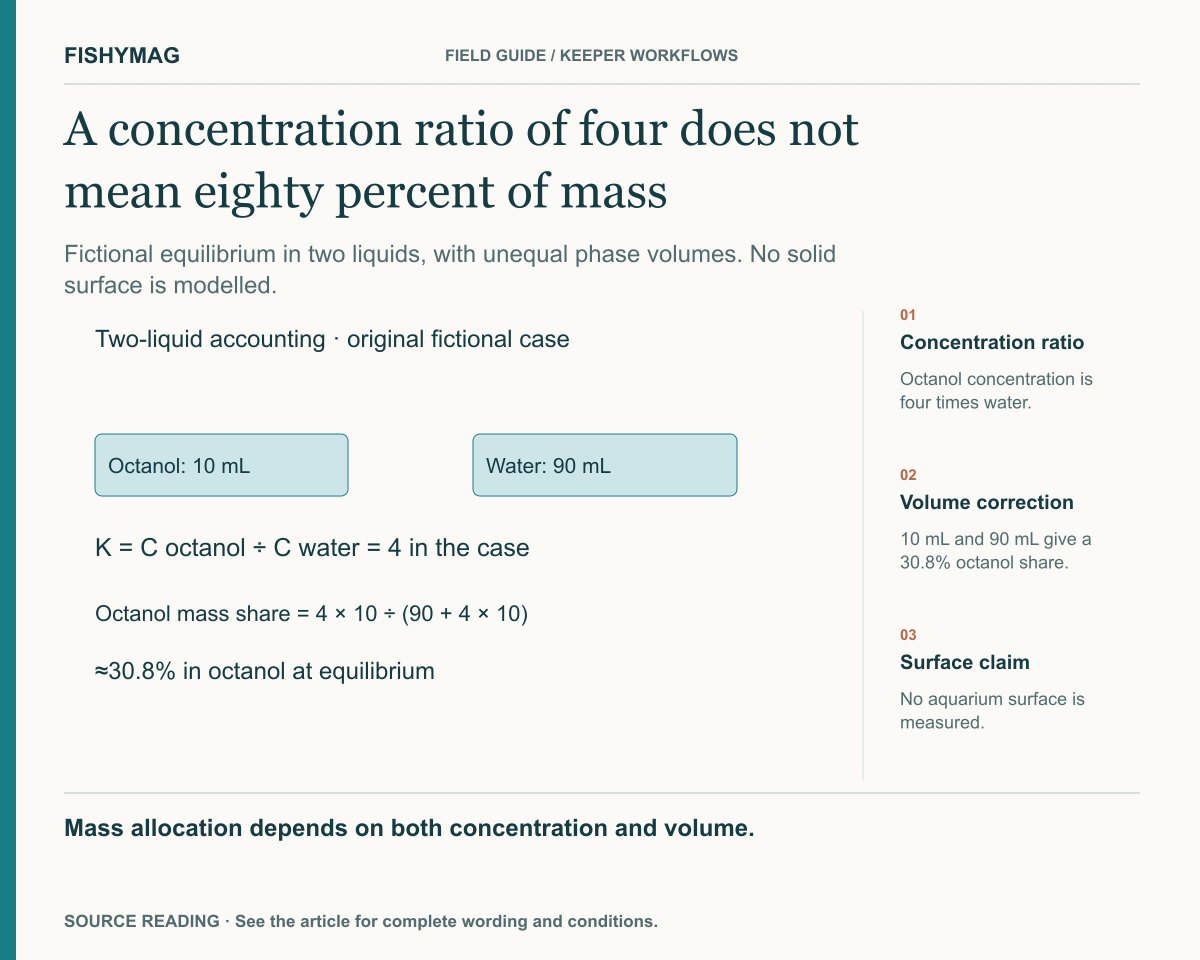
Figure data and explanation
Fictional equilibrium in two liquids, with unequal phase volumes. No solid surface is modelled.
- Concentration ratio
- Octanol concentration is four times water.
- Volume correction
- 10 mL and 90 mL give a 30.8% octanol share.
- Surface claim
- No aquarium surface is measured.
Mass allocation depends on both concentration and volume.
Read what the coefficient compares
OECD Test Guideline 107 defines an octanol/water concentration ratio at equilibrium. A published metronidazole tablet comparison used an octanol/water shake-flask experiment and reports its ratio on a base-ten log scale. It did not measure a glass wall or plastic line. The arithmetic exercise uses an invented non-log ratio of 4, not a metronidazole value from the paper.
Use volume as well as the concentration ratio
Assume a closed two-liquid model with stable phase volumes, no losses and a common mass basis. Let the water concentration be C; the octanol concentration is 4C.
| Phase | Modelled mass term | Fraction of accounted mass |
|---|---|---|
| Octanol | 4C × 10 mL | 40 ÷ 130 ≈ 30.8% |
| Water | C × 90 mL | 90 ÷ 130 ≈ 69.2% |
| Glass, plastic or sediment | No solid phase in this model | Not estimated |
Require a material-specific measurement for a surface claim
Changing the relative volumes would change the mass fractions even at the same equilibrium concentration ratio. Changing pH or chemical form can also change an apparent distribution measurement. A report that claims a named compound remains on a specific aquarium surface needs relevant material, water conditions and a suitable assay, rather than a liquid coefficient carried across by analogy.
Use your own details
Can a partition coefficient explain aquarium residues? worksheet
Download the editable text file, fill it in on your device and keep it with the relevant record. This blank worksheet records your information; it does not verify entries or approve treatment.
- Exact compound and form
- Phases and equilibrium conditions
- Concentration ratio or log definition
- Phase volumes and assumptions
- Conditional mass allocation
- Proposed surface or material
- Why the measured phases do or do not match
Put it into practice
Your checklist
- Distinguish log coefficient from the unlogged concentration ratio.
- Keep phase volumes and conditions with any calculated mass split.
- Use separate evidence for adsorption or uptake into solids.
Sources and scope
This article distinguishes manufacturer statements from FishyMag’s own workflows and arithmetic examples. Linked formulation records retain their own evidence dates; publishing this article does not refresh those records.
- OECD 107 octanol/water partition method; reviewed November 9, 2026 ↗
- Primary metronidazole tablet comparison including octanol/water partition; reviewed November 9, 2026 ↗
AI-assisted writing and development. Not hands-on product testing or veterinary review. How we publish →
FishyMag reports what manufacturers say, quoted and linked. It does not diagnose illness or recommend a treatment, and it never infers that a product is safe from the absence of a warning — where no statement exists, it says so.
Formulations change. Always read the label on the bottle in your hand, and contact the manufacturer if your tank contains anything valuable or unusual.