Keeper workflows
When aquarium research methods disagree
Reconcile conflicting exposure descriptions in a paper and its supplement, including a corrected branch.
By FishyMag · Published
Original source audit · Not a clinical review or treatment recommendation.
Quick answer
The fictional main text describes continuous exposure; the supplement describes discrete periods for the same experiment. The legends and version notes do not resolve the discrepancy. A separate example shows how an explicit correction would change the record.
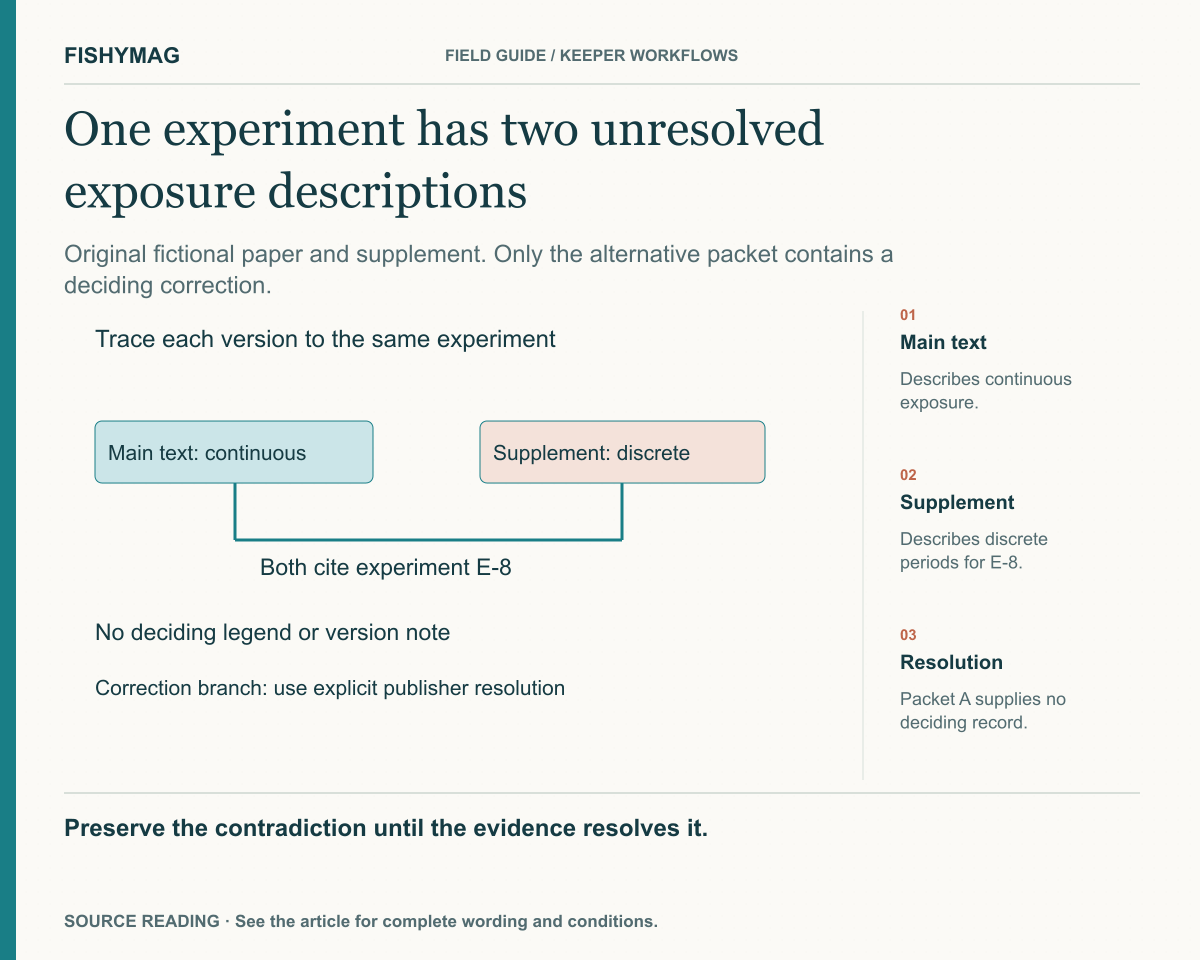
Figure data and explanation
Original fictional paper and supplement. Only the alternative packet contains a deciding correction.
- Main text
- Describes continuous exposure.
- Supplement
- Describes discrete periods for E-8.
- Resolution
- Packet A supplies no deciding record.
Preserve the contradiction until the evidence resolves it.
Confirm that the two passages describe the same experiment
Both invented documents label their study E-8 and name the same tank IDs and endpoint. The main Methods paragraph uses continuous waterborne exposure; Supplement S2 describes discrete exposure periods. These are fictional textual descriptions and not directions for exposing animals.
Complete the evidence check without guessing which version is right
An attached file can be the more detailed source without automatically superseding the main text.
| Evidence | Packet A | Packet B with explicit correction |
|---|---|---|
| Methods and S2 | Opposing descriptions for E-8 | Both retained in version history |
| Legend and version notes | Neither resolves the timeline | Correction states S2 is the accurate schedule for E-8 |
| Exposure-dependent claim | Unresolved; preserve both descriptions | Use the corrected discrete description and cite the notice |
Prepare the question that would resolve packet A
Ask which description matches the E-8 exposure record and whether a dated correction or underlying time log is available for the identified tanks. Keep the disputed interpretation out of a concise source summary until resolved. Other results still require their original conditions; a corrected timeline does not make them broadly applicable.
Use your own details
When aquarium research methods disagree worksheet
Download the editable text file, fill it in on your device and keep it with the relevant record. This blank worksheet records your information; it does not verify entries or approve treatment.
- Article and supplement version
- Experiment or tank identifiers
- Exact main and supplement passages
- Figure legend and methods references
- Correction or version history checked
- Unresolved exposure-dependent claim
- Specific author or publisher question
Put it into practice
Your checklist
- Match both passages to the exact experiment.
- Read legends and version history before choosing a branch.
- Cite an explicit correction if it resolves the discrepancy.
Sources and scope
This article distinguishes manufacturer statements from FishyMag’s own workflows and arithmetic examples. Linked formulation records retain their own evidence dates; publishing this article does not refresh those records.
- Crossref relationship types; reviewed November 9, 2026 ↗
- Crossref version control, corrections and retractions; reviewed November 9, 2026 ↗
- Percie du Sert etal., ARRIVE2.0 explanationandelaboration,2020; reviewed November 9, 2026 ↗
AI-assisted writing and development. Not hands-on product testing or veterinary review. How we publish →
FishyMag reports what manufacturers say, quoted and linked. It does not diagnose illness or recommend a treatment, and it never infers that a product is safe from the absence of a warning — where no statement exists, it says so.
Formulations change. Always read the label on the bottle in your hand, and contact the manufacturer if your tank contains anything valuable or unusual.