Keeper workflows
Two aquarium monitors, one shared point of failure
Map shared power and network dependencies in a fictional two-monitor installation without treating device count as proof of independent protection.
By FishyMag · Published
Worked arithmetic example · Not a clinical review or treatment recommendation.
Quick answer
The fictional monitors share one supply strip and route both remote notifications through one router. Either shared dependency can undermine both relevant paths in the paper model. That identifies a structural vulnerability, not a measured failure probability or proof of a fault in an actual installation.

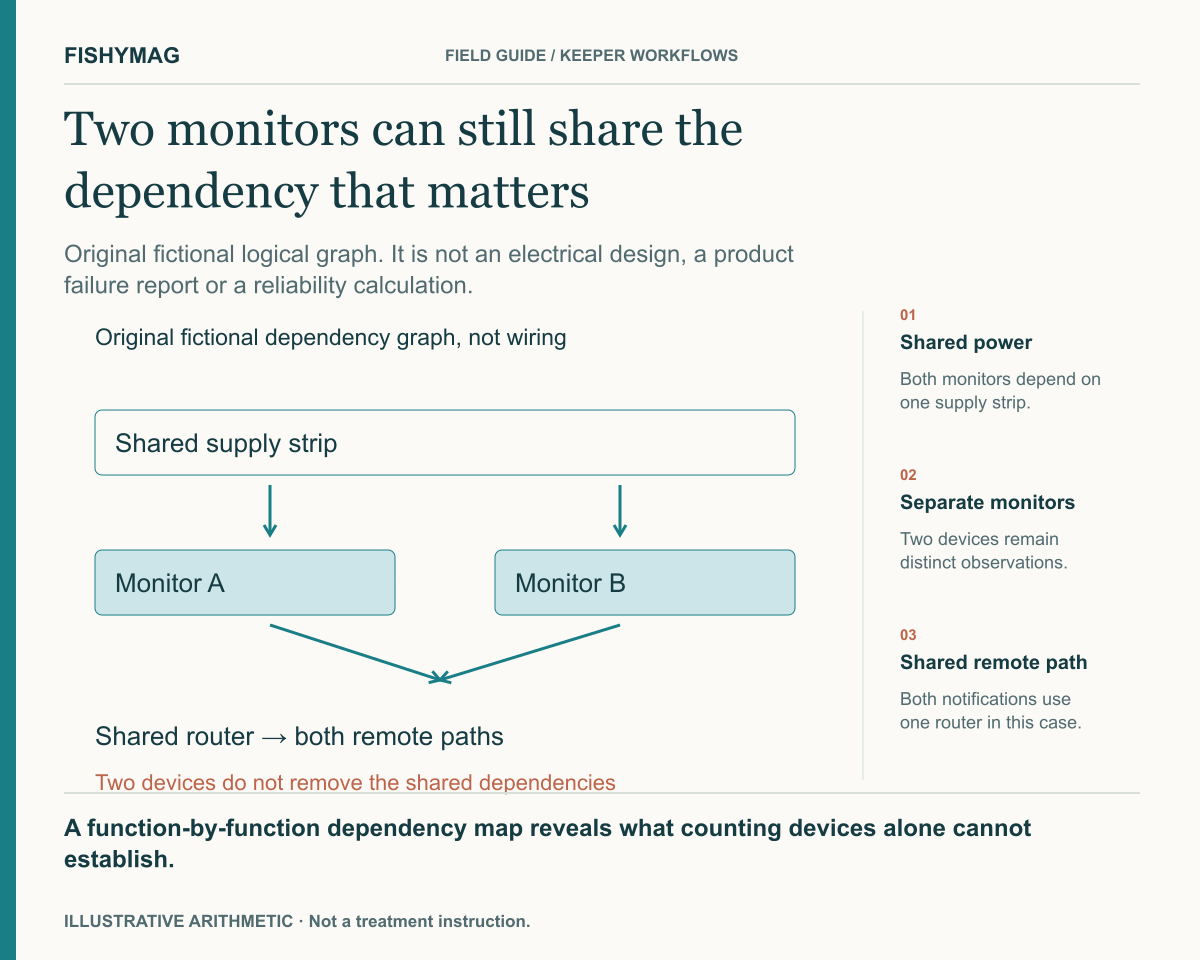
Figure data and explanation
Original fictional logical graph. It is not an electrical design, a product failure report or a reliability calculation.
- Shared power
- Both monitors depend on one supply strip.
- Separate monitors
- Two devices remain distinct observations.
- Shared remote path
- Both notifications use one router in this case.
A function-by-function dependency map reveals what counting devices alone cannot establish.
Map functions as well as device names
The case gives each monitor no alternative power source and assigns both remote paths to the same router. Those are explicit fictional assumptions, not statements about the resilience of a named product. A local sensor function and a remote notification function need separate dependency records.
Complete the shared-dependency matrix
Removing a node below is a logical paper exercise. No power supply, router or aquarium device was disconnected.
| Function in the fictional model | Supply strip required | Shared router required | Additional evidence needed |
|---|---|---|---|
| Monitor A powered sensing | Yes | Not assigned for local sensing | Actual local autonomy and other dependencies |
| Monitor B powered sensing | Yes | Not assigned for local sensing | Actual local autonomy and other dependencies |
| A remote notification | Yes for its source monitor | Yes in this model | Delivery and service behavior |
| B remote notification | Yes for its source monitor | Yes in this model | Delivery and service behavior |
| Shared strip unavailable | Both assigned monitor power paths lost | Separate question | No failure probability calculated |
| Shared router unavailable | Power need not be lost | Both assigned remote paths interrupted | Local functions not automatically declared lost |
Keep the conclusion structural
Two boxes can provide useful observations while sharing a cause that affects both. Conversely, a shared router does not prove that local control stops. Recover the actual device behavior and configuration before generalizing the paper model. The completed output identifies the common dependency and the affected function, without recommending electrical work or inventing an overall reliability percentage.
Use your own details
Two aquarium monitors, one shared point of failure worksheet
Download the editable text file, fill it in on your device and keep it with the relevant record. This blank worksheet records your information; it does not verify entries or approve treatment.
- Actual device identities and functions
- Power sources and any documented alternatives
- Shared supply or upstream dependencies
- Local-network and internet paths
- Notification delivery dependencies
- Local function autonomy evidence
- Paper-model consequence versus observed failure
- Unresolved assumptions requiring documentation
Put it into practice
Your checklist
- Map power and notification paths separately.
- Identify shared nodes before calling paths independent.
- Keep a paper vulnerability distinct from a measured failure rate.
Sources and scope
This article distinguishes manufacturer statements from FishyMag’s own workflows and arithmetic examples. Linked formulation records retain their own evidence dates; publishing this article does not refresh those records.
- HYDROS manufacturer guide: Read-Only Bluetooth mode; reviewed November 9, 2026 ↗
- Neptune Systems Energy Bar manufacturer overview; reviewed November 9, 2026 ↗
AI-assisted writing and development. Not hands-on product testing or veterinary review. How we publish →
FishyMag reports what manufacturers say, quoted and linked. It does not diagnose illness or recommend a treatment, and it never infers that a product is safe from the absence of a warning — where no statement exists, it says so.
Formulations change. Always read the label on the bottle in your hand, and contact the manufacturer if your tank contains anything valuable or unusual.