Keeper workflows
Is that aquarium reading current or just still visible?
Calculate observation and upload ages separately in a fictional aquarium dashboard packet, without assuming that a still-visible value is current.
By FishyMag · Published
Worked arithmetic example · Not a clinical review or treatment recommendation.
Quick answer
At the fictional viewing time of 10:17, the 10:02 sensor observation is 15 minutes old and the 10:03 upload is 14 minutes old. The displayed value does not establish a 10:17 measurement. Upload time, observation time and a visible connectivity indicator are different evidence.
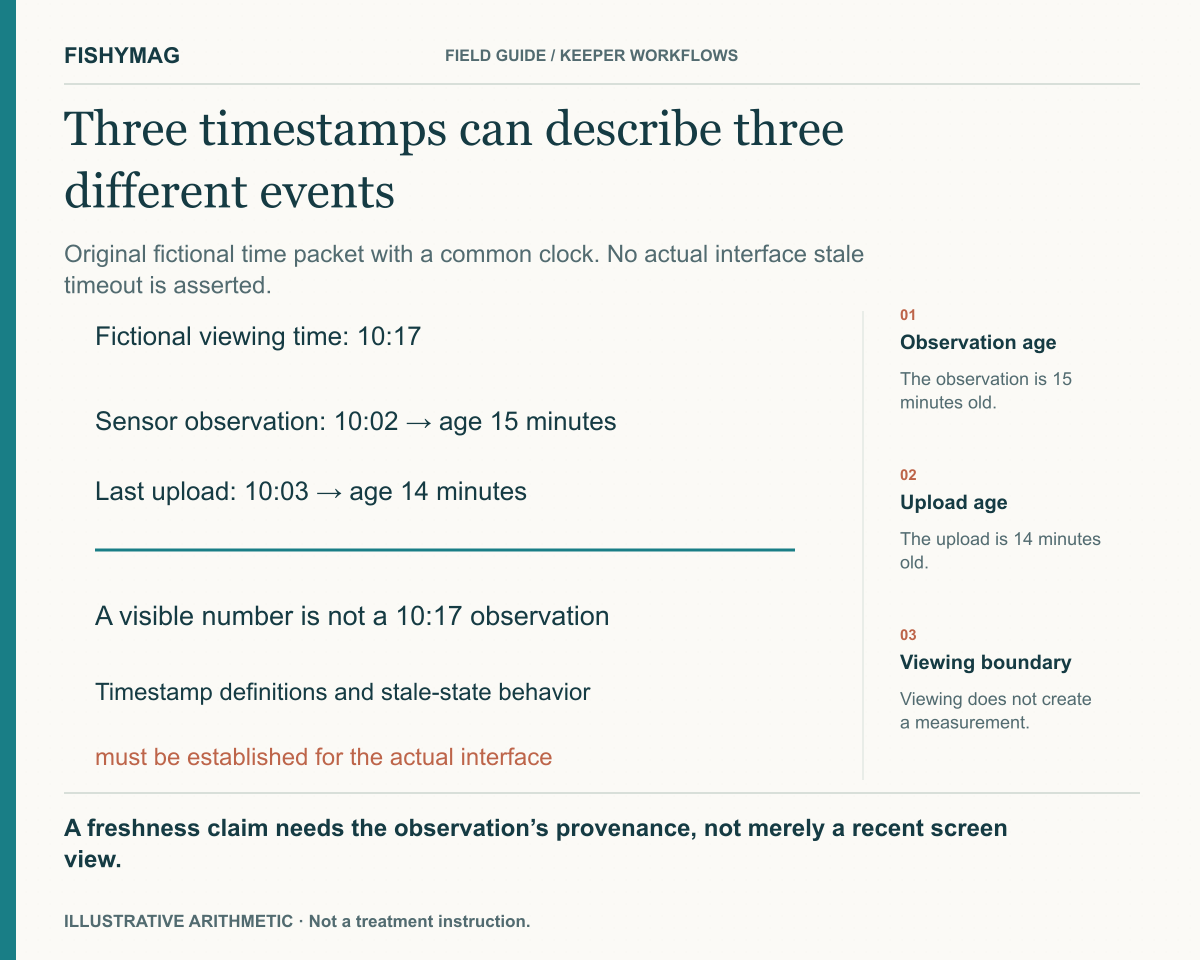
Figure data and explanation
Original fictional time packet with a common clock. No actual interface stale timeout is asserted.
- Observation age
- The observation is 15 minutes old.
- Upload age
- The upload is 14 minutes old.
- Viewing boundary
- Viewing does not create a measurement.
A freshness claim needs the observation’s provenance, not merely a recent screen view.
Identify which clock each field describes
A value can remain visible after its observation or upload. This constructed packet supplies all three times explicitly, so their ages can be calculated. A real interface may label or process timestamps differently; recover those definitions before treating a column or icon as freshness evidence.
Complete both age calculations
All times share the same clock and date in the fictional example. No time-zone conversion or device-clock correction is assumed.
| Evidence item | Time | Age at 10:17 | Meaning |
|---|---|---|---|
| Sensor observation | 10:02 | 15 minutes | Age of the reported observation |
| Last upload | 10:03 | 14 minutes | Age of that transmission event |
| Viewing | 10:17 | 0 by definition | Time of inspection, not a new sensor event |
| Visible number | Still present | Not a freshness measurement | No 10:17 observation established |
| Stale icon or color | Undocumented in the packet | No timeout inferred | Actual interface rule required |
Keep access mode separate from freshness
HYDROS documents a direct Bluetooth mode that differs from cloud access. That identifies an access-path distinction, not a universal age or stale-color rule. The reviewed packet does not supply a firmware-specific stale timeout, so none is invented. Retain observation provenance and clock consistency with any exported value instead of refreshing a screenshot and calling it a new measurement.
Use your own details
Is that aquarium reading current or just still visible? worksheet
Download the editable text file, fill it in on your device and keep it with the relevant record. This blank worksheet records your information; it does not verify entries or approve treatment.
- Observation timestamp and actual meaning
- Upload or receipt timestamp and meaning
- Viewing time and clock agreement
- Displayed value and channel identity
- Interface mode and connectivity state
- Documented stale-data indicator behavior
- Calculated ages on a common time basis
- Unsupported current-reading claim
Put it into practice
Your checklist
- Name observation, upload and viewing times separately.
- Check their clock basis before calculating age.
- Do not infer freshness from visibility or an undocumented icon.
Sources and scope
This article distinguishes manufacturer statements from FishyMag’s own workflows and arithmetic examples. Linked formulation records retain their own evidence dates; publishing this article does not refresh those records.
- HYDROS manufacturer guide: Read-Only Bluetooth mode; reviewed November 9, 2026 ↗
- GHL ProfiLux4/4e instruction manual, February2019; reviewed November 9, 2026 ↗
- Australian and New Zealand guidelines: water-quality data analysis; reviewed November 8, 2026 ↗
AI-assisted writing and development. Not hands-on product testing or veterinary review. How we publish →
FishyMag reports what manufacturers say, quoted and linked. It does not diagnose illness or recommend a treatment, and it never infers that a product is safe from the absence of a warning — where no statement exists, it says so.
Formulations change. Always read the label on the bottle in your hand, and contact the manufacturer if your tank contains anything valuable or unusual.