Keeper workflows
What does your aquarium monitor’s number represent?
Trace a temperature channel through documented averaging settings and export provenance while keeping a separate arithmetic example distinct from an undisclosed implementation.
By FishyMag · Published
Worked arithmetic example · Not a clinical review or treatment recommendation.
Quick answer
A displayed or exported temperature can be processed. The HI98194 manual documents an averaging setting from 1 to 20 and an associated initial delay. Its reviewed description does not specify every weighting or rolling-window detail. The separate 24.0, 24.0 and 25.2 °C example has an arithmetic mean of 24.4 °C; that is not a reverse-engineered meter algorithm.
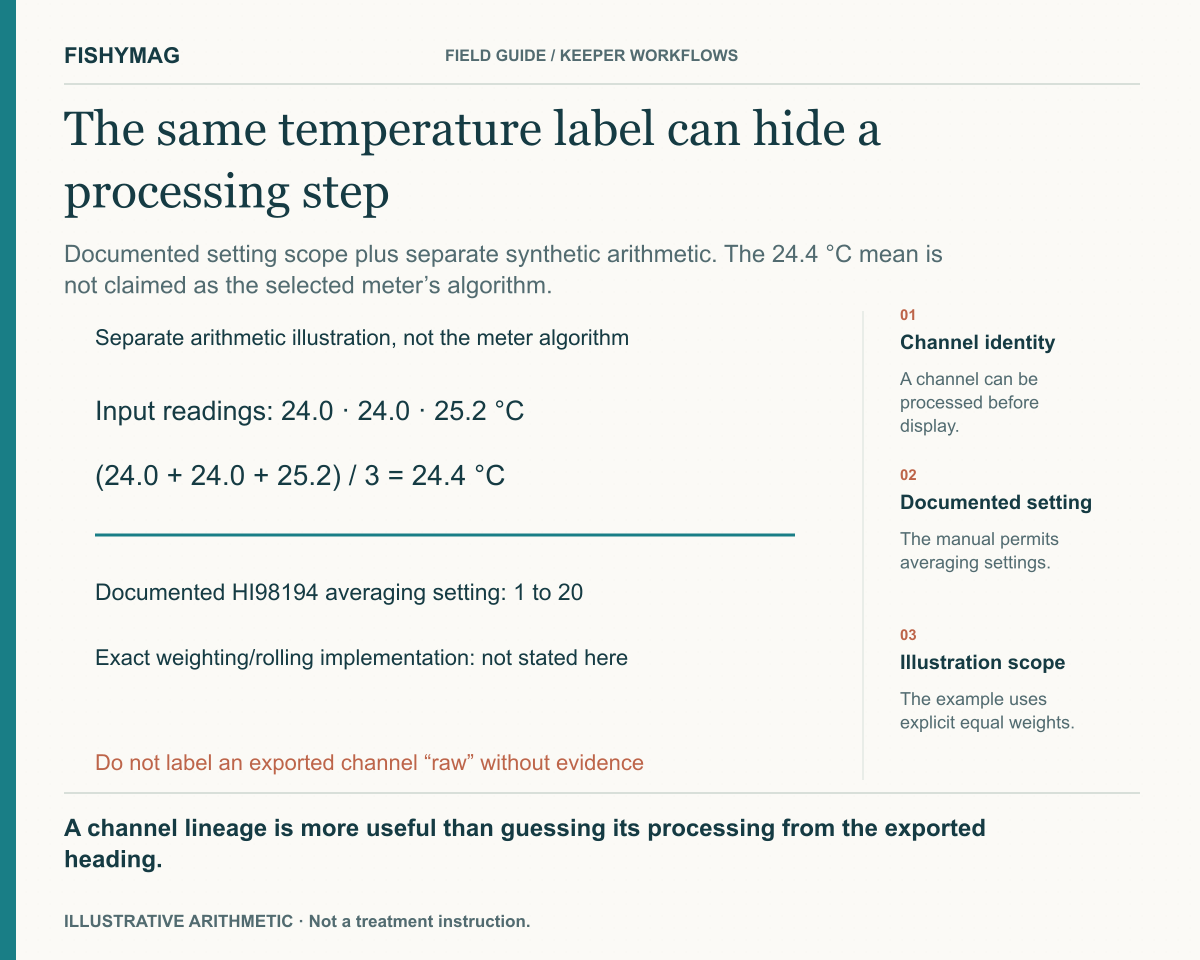
Figure data and explanation
Documented setting scope plus separate synthetic arithmetic. The 24.4 °C mean is not claimed as the selected meter’s algorithm.
- Channel identity
- A channel can be processed before display.
- Documented setting
- The manual permits averaging settings.
- Illustration scope
- The example uses explicit equal weights.
A channel lineage is more useful than guessing its processing from the exported heading.
Trace the channel instead of trusting a familiar label
The manual’s averaging option is a software filter and affects measurements. That establishes processing to investigate; it does not justify assuming the displayed number is an unfiltered instantaneous sensor observation. Retain the averaging setting and the provenance of the export used in an aquarium comparison.
Complete the lineage table
The arithmetic example below is deliberately separate from the named instrument. It shows how three inputs could yield a mean without claiming that this is the instrument’s exact weighting, overlap or export implementation.
| Lineage item | Available evidence | Completed interpretation |
|---|---|---|
| HI98194 averaging option | Manual permits 1 to 20 | A setting belongs in the measurement record |
| Exact weighting and overlap | Not fully specified in the reviewed description | Do not claim a particular moving-average algorithm |
| Exported temperature channel | Original export and settings needed | Do not call it raw solely from its column name |
| Separate synthetic inputs | 24.0, 24.0, 25.2 °C, equal weights | Arithmetic mean 24.4 °C |
| Synthetic mean versus last input | 24.4 versus 25.2 °C | Different summaries, not an instrument fault |
Preserve transformations when sharing the record
Keep the original file, channel definition, clock and relevant settings with any derived graph. If processing is undisclosed, say so. A smoothed channel may answer a different timing question from an instantaneous or maximum channel, even when all are called temperature. The finished lineage records known processing and the exact details that remain unverified.
Use your own details
What does your aquarium monitor’s number represent? worksheet
Download the editable text file, fill it in on your device and keep it with the relevant record. This blank worksheet records your information; it does not verify entries or approve treatment.
- Device, firmware and channel identity
- Measured quantity and probe location
- Averaging setting at observation time
- Documented processing and missing implementation details
- Display versus exported channel identity
- Settings history and original export
- Separate illustrative calculation if used
- Claims that cannot be made about raw observations
Put it into practice
Your checklist
- Keep the averaging setting with the channel.
- Separate illustrative arithmetic from actual implementation.
- Do not label a processed export raw without documentation.
Sources and scope
This article distinguishes manufacturer statements from FishyMag’s own workflows and arithmetic examples. Linked formulation records retain their own evidence dates; publishing this article does not refresh those records.
- GHL ProfiLux4/4e GHL Connect resource guide, June2020; reviewed November 9, 2026 ↗
- Hanna HI98194/HI98195/HI98196 instruction manual; reviewed November 9, 2026 ↗
AI-assisted writing and development. Not hands-on product testing or veterinary review. How we publish →
FishyMag reports what manufacturers say, quoted and linked. It does not diagnose illness or recommend a treatment, and it never infers that a product is safe from the absence of a warning — where no statement exists, it says so.
Formulations change. Always read the label on the bottle in your hand, and contact the manufacturer if your tank contains anything valuable or unusual.