Keeper workflows
Regenerated aquarium media: what performance was retained?
Calculate how much capacity was retained in a fictional regeneration record and identify untested outcomes.
By FishyMag · Published
Worked filtration evidence example · Not a clinical review or treatment recommendation.
Quick answer
Against the new medium’s 10 mg/g, the fictional values of 8 mg/g after one cycle and 6 mg/g after three are 80% and 60% retained capacity. These results do not establish the retained rate, physical condition or residual carryover.
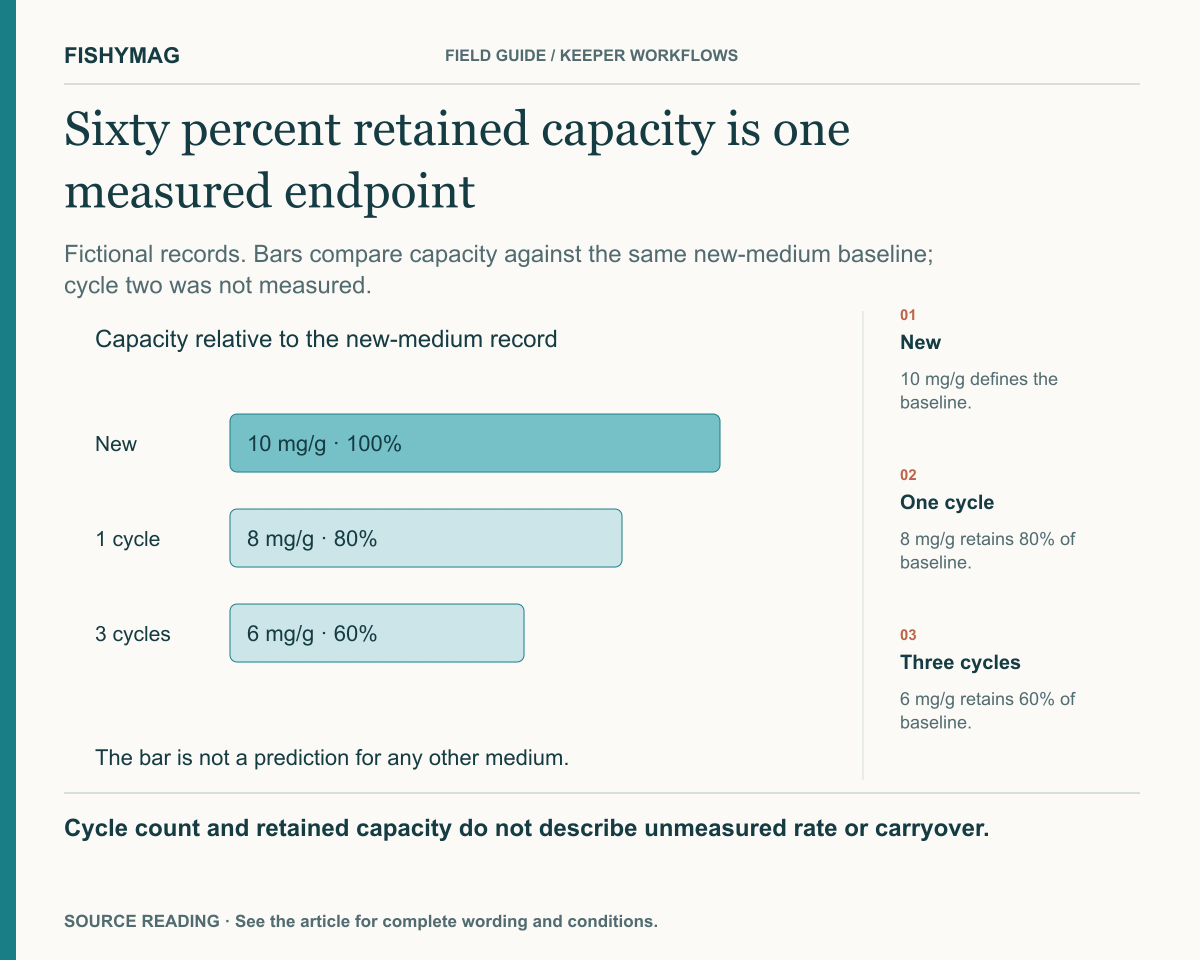
Figure data and explanation
Fictional records. Bars compare capacity against the same new-medium baseline; cycle two was not measured.
- New
- 10 mg/g defines the baseline.
- One cycle
- 8 mg/g retains 80% of baseline.
- Three cycles
- 6 mg/g retains 60% of baseline.
Cycle count and retained capacity do not describe unmeasured rate or carryover.
Separate “can be regenerated” from the performance retained
Seachem describes Purigen as a regenerable organic-scavenging medium. That statement is not the three-row dataset below. An independent published study on 1,2,4-trichlorobenzene and a different granular carbon measured recovery across three experimental cycles and reported about 48.2% under its own sequence. That result demonstrates how much a recovery figure depends on the exact test and cannot be assigned to Purigen.
Use the same starting value each time
The fictional packet uses matched target, dry-mass basis and capacity endpoint. It includes no observation at cycle two.
| Condition | Capacity | Retained against new |
|---|---|---|
| New | 10 mg/g | 100% |
| After one cycle | 8 mg/g | 8 ÷ 10 = 80% |
| After two cycles | No result | Unknown |
| After three cycles | 6 mg/g | 6 ÷ 10 = 60% |
| Rate or physical integrity | Not measured | Cannot infer from capacity |
Keep cycle history with the evidence
Do not turn the difference between one and three cycles into a predicted decline for every use. In a different report the capacity basis, target or matrix might also change. Ask separately about carryover, pressure drop, degradation and rate if those outcomes matter. No regeneration steps or replacement schedule follow from this comparison.
Use your own details
Regenerated aquarium media: what performance was retained? worksheet
Download the editable text file, fill it in on your device and keep it with the relevant record. This blank worksheet records your information; it does not verify entries or approve treatment.
- Exact medium and target
- Original capacity with units and mass basis
- Cycle numbers and repeated conditions
- Capacity after each observed cycle
- Retention against original capacity
- Rate and mechanical condition evidence
- Residual and carryover evidence
Put it into practice
Your checklist
- Compare the same target, capacity basis and test conditions.
- Keep the new-medium value as the denominator.
- Leave missing cycles and other performance outcomes unresolved.
Sources and scope
This article distinguishes manufacturer statements from FishyMag’s own workflows and arithmetic examples. Linked formulation records retain their own evidence dates; publishing this article does not refresh those records.
- Seachem Purigen manufacturer product documentation; reviewed November 9, 2026 ↗
- Three-cycle study of regenerated carbon with 1,2,4-trichlorobenzene; reviewed November 9, 2026 ↗
AI-assisted writing and development. Not hands-on product testing or veterinary review. How we publish →
FishyMag reports what manufacturers say, quoted and linked. It does not diagnose illness or recommend a treatment, and it never infers that a product is safe from the absence of a warning — where no statement exists, it says so.
Formulations change. Always read the label on the bottle in your hand, and contact the manufacturer if your tank contains anything valuable or unusual.