Keeper workflows
When an aquarium adsorbent starts passing the target
Find the first observed point that meets a declared breakthrough boundary without inventing a crossing time.
By FishyMag · Published
Worked filtration evidence example · Not a clinical review or treatment recommendation.
Quick answer
At 60 L, the fictional bed’s outlet-to-inlet ratio is 0.20, the first sampled point meeting the example boundary. It does not prove the actual crossing happened at 60 L. The three samples also do not define a replacement interval for another system.
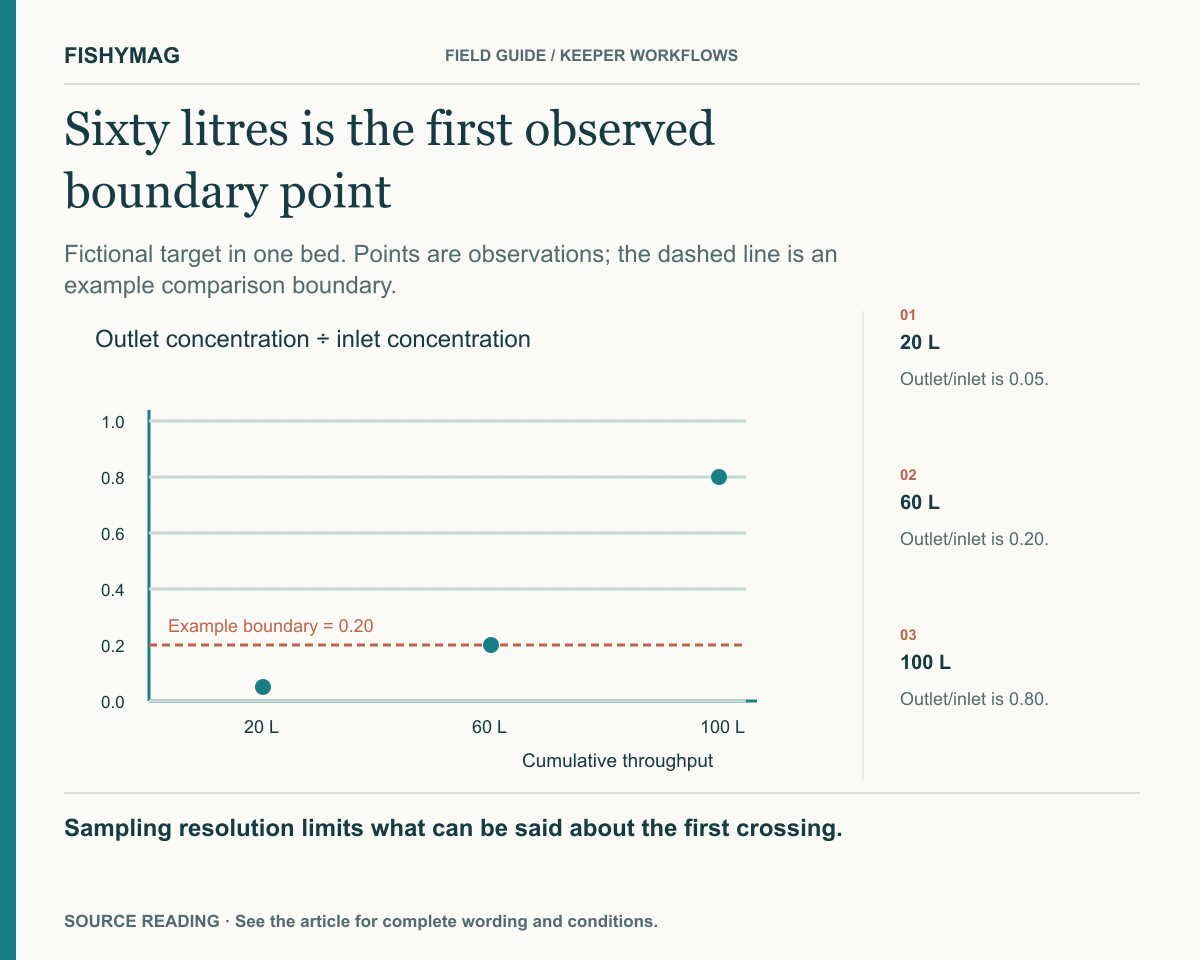
Figure data and explanation
Fictional target in one bed. Points are observations; the dashed line is an example comparison boundary.
- 20 L
- Outlet/inlet is 0.05.
- 60 L
- Outlet/inlet is 0.20.
- 100 L
- Outlet/inlet is 0.80.
Sampling resolution limits what can be said about the first crossing.
Choose a ratio and a sampling basis
This fictional dataset uses a stable 10 µg/L inlet concentration and three paired outlet results for the same target. The example boundary is C-out/C-in ≥ 0.20, solely for reading this dataset. The EPA verification protocol explains breakthrough testing. The groundwater pilot cited here shows why actual records retain media and contact time: the authors ran continuous columns with different empty-bed contact times, not just a single early observation.
Work the three points before interpreting the curve
The plot shows measured points in the invented example without joining them into a predicted trajectory.
| Cumulative volume | Outlet ÷ inlet | At least 0.20? |
|---|---|---|
| 20 L | 0.5 ÷ 10 = 0.05 | No |
| 60 L | 2 ÷ 10 = 0.20 | Yes, first observed |
| 100 L | 8 ÷ 10 = 0.80 | Yes |
Keep first observed separate from exact crossing
The records give a below-boundary observation at 20 L and an at-boundary observation at 60 L. Without additional assumptions, they do not say when the first crossing occurred, whether it stayed above, or how the ratio behaves between observations. If the inlet changes or a report says “less than,” preserve the denominator window and qualifiers before computing a ratio. Neither the boundary nor the throughputs are equipment instructions.
Use your own details
When an aquarium adsorbent starts passing the target worksheet
Download the editable text file, fill it in on your device and keep it with the relevant record. This blank worksheet records your information; it does not verify entries or approve treatment.
- Exact medium and target
- Matrix, column and flow conditions
- Cumulative throughput or bed volumes
- Matched inlet and outlet concentrations
- Qualifier and reporting limits
- Defined comparison boundary
- First observation meeting it and prior sample
Worked example files
These files contain the article’s worked example. Read its source and scope notes, and keep your own current records before opening an example in a tool.
Put it into practice
Your checklist
- Use matched pairs and a defined ratio boundary.
- Identify the first sampled point that meets it.
- Keep unsampled times and transfer to another bed unresolved.
Sources and scope
This article distinguishes manufacturer statements from FishyMag’s own workflows and arithmetic examples. Linked formulation records retain their own evidence dates; publishing this article does not refresh those records.
- EPA verification protocol for organic contaminant removal; reviewed November 9, 2026 ↗
- Pilot-scale comparison of granular activated carbon and anion exchange resins, DOI 10.1039/D2EW00080F; reviewed November 9, 2026 ↗
AI-assisted writing and development. Not hands-on product testing or veterinary review. How we publish →
FishyMag reports what manufacturers say, quoted and linked. It does not diagnose illness or recommend a treatment, and it never infers that a product is safe from the absence of a warning — where no statement exists, it says so.
Formulations change. Always read the label on the bottle in your hand, and contact the manufacturer if your tank contains anything valuable or unusual.