Keeper workflows
Average an aquarium temperature log without hiding gaps
Calculate a duration-weighted temperature mean from fictional interval means while keeping the missing quarter-hour out of the established full-window claim.
By FishyMag · Published
Worked arithmetic example · Not a clinical review or treatment recommendation.
Quick answer
The fictional observed-duration mean is 1107.5 degree-minutes divided by 45 minutes, or 24.6111 °C. The record covers 45 of 60 minutes, 75%. The missing 15 minutes prevent this from being called the full-hour mean without additional assumptions.
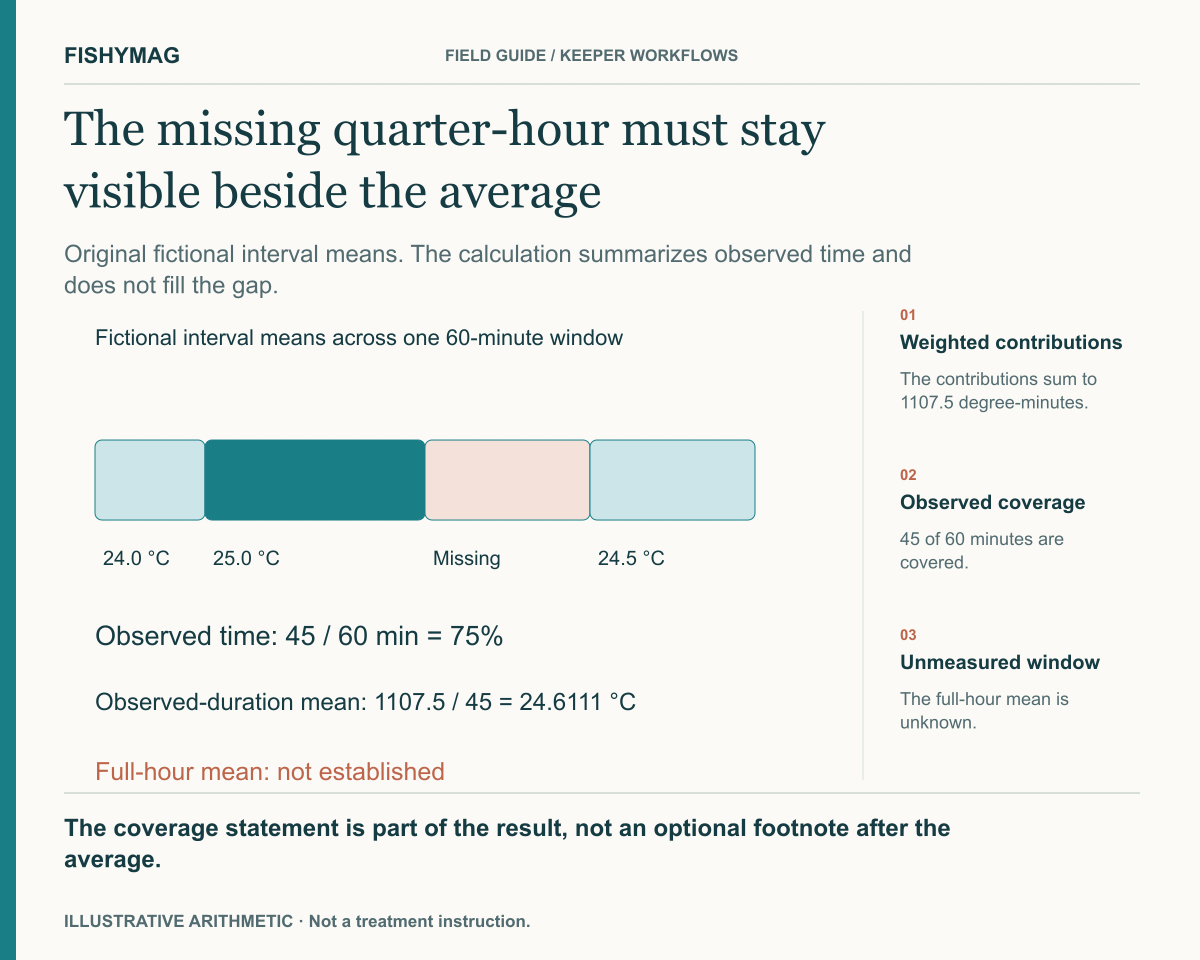
Figure data and explanation
Original fictional interval means. The calculation summarizes observed time and does not fill the gap.
- Weighted contributions
- The contributions sum to 1107.5 degree-minutes.
- Observed coverage
- 45 of 60 minutes are covered.
- Unmeasured window
- The full-hour mean is unknown.
The coverage statement is part of the result, not an optional footnote after the average.
Check that the inputs are interval means
This arithmetic stipulates interval means, not occasional point readings. Applying the same duration weights to a point export without a justified interpolation model would be a different calculation. The selected logger’s actual export definition must be established before using the worksheet with real data.
Complete the weighted account
The first ten minutes average 24.0 °C, the next twenty average 25.0 °C, fifteen minutes are missing, and the last fifteen average 24.5 °C. The missing interval contributes neither a guessed temperature nor observed duration.
| Interval record | Duration | Mean | Temperature-duration contribution |
|---|---|---|---|
| First observed interval | 10 min | 24.0 °C | 240 degree-minutes |
| Second observed interval | 20 min | 25.0 °C | 500 degree-minutes |
| Missing interval | 15 min | Unknown | Not imputed |
| Final observed interval | 15 min | 24.5 °C | 367.5 degree-minutes |
| Observed total | 45 min | 1107.5 ÷ 45 | 24.6111 °C |
| Coverage | 45 ÷ 60 × 100 | 75% | Full hour remains incomplete |
Report the missing coverage beside the mean
Do not fill the gap with zero, the nearest reading or the overall mean merely to obtain a neat hour. Those choices introduce models that need their own justification. Keep the original intervals and the coverage statement with any graph or handover summary. The finished calculation is an observed-duration mean, with no animal safety threshold or claim that the missing period resembled the observed one.
Use your own details
Average an aquarium temperature log without hiding gaps worksheet
Download the editable text file, fill it in on your device and keep it with the relevant record. This blank worksheet records your information; it does not verify entries or approve treatment.
- Exported quantity and actual interval semantics
- Start, end and duration of every interval
- Interval means versus instantaneous values
- Explicit missing interval
- Temperature-duration products
- Observed-duration mean and coverage
- Unjustified filling or weighting assumptions
- Claim made about the full window
Put it into practice
Your checklist
- Verify interval-mean semantics before weighting.
- Exclude missing time from the established observed-duration denominator.
- Report coverage with the mean.
Sources and scope
This article distinguishes manufacturer statements from FishyMag’s own workflows and arithmetic examples. Linked formulation records retain their own evidence dates; publishing this article does not refresh those records.
- GHL ProfiLux4/4e GHL Connect resource guide, June2020; reviewed November 9, 2026 ↗
- Hanna HI98194/HI98195/HI98196 instruction manual; reviewed November 9, 2026 ↗
AI-assisted writing and development. Not hands-on product testing or veterinary review. How we publish →
FishyMag reports what manufacturers say, quoted and linked. It does not diagnose illness or recommend a treatment, and it never infers that a product is safe from the absence of a warning — where no statement exists, it says so.
Formulations change. Always read the label on the bottle in your hand, and contact the manufacturer if your tank contains anything valuable or unusual.