Keeper workflows
Does aquarium lighting match the photolysis study?
Compare a 254 nm malachite green photolysis study with the documented diode groups of a reef light.
By FishyMag · Published
Worked formulation evidence example · Not a clinical review or treatment recommendation.
Quick answer
The published reactor used 254 nm UV-C. The Radion XR15 G6 Blue lists 395, 405, 415 and 430 nm diode groups among its emitters. The documented fixture groups do not match the study source and do not establish comparable in-water exposure or a residue result.
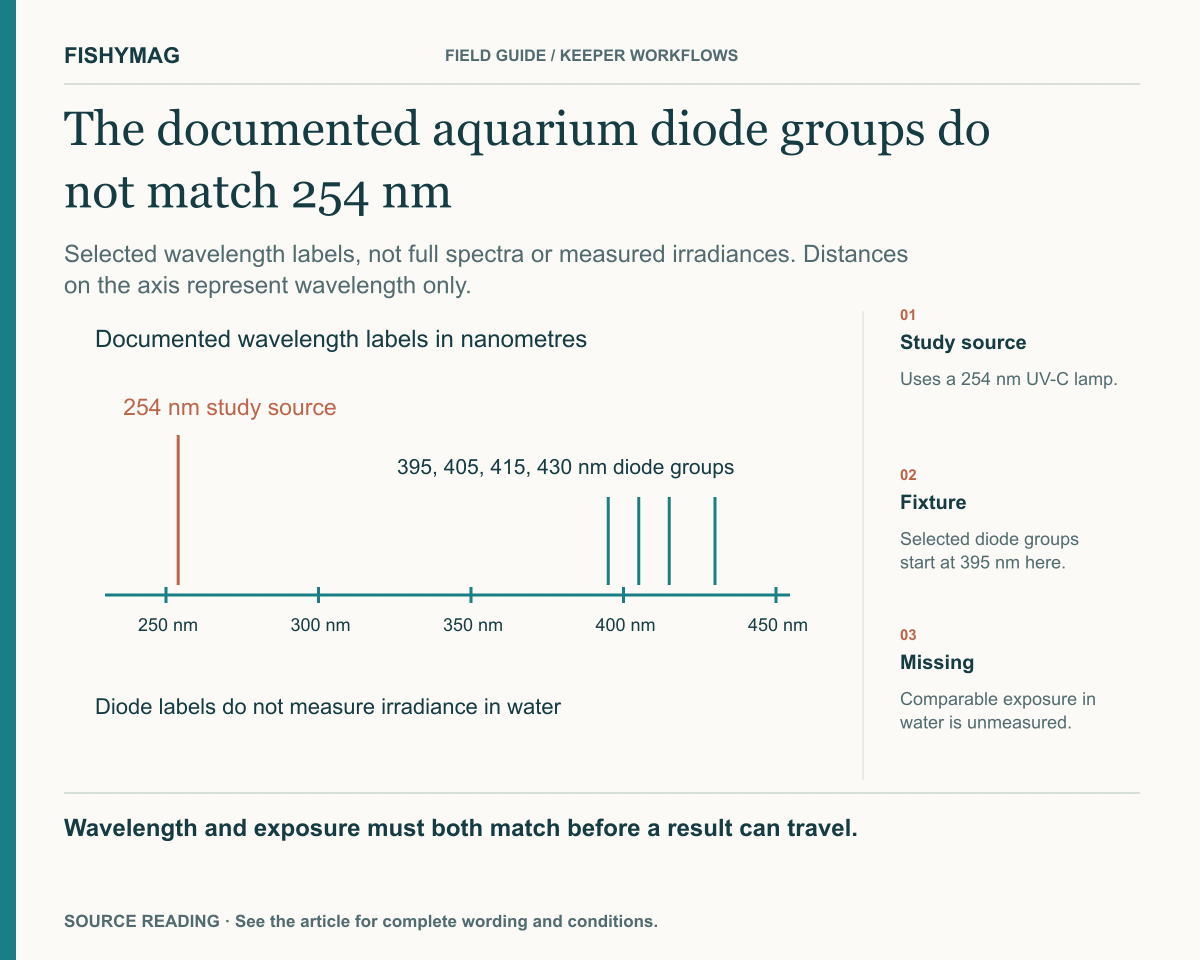
Figure data and explanation
Selected wavelength labels, not full spectra or measured irradiances. Distances on the axis represent wavelength only.
- Study source
- Uses a 254 nm UV-C lamp.
- Fixture
- Selected diode groups start at 395 nm here.
- Missing
- Comparable exposure in water is unmeasured.
Wavelength and exposure must both match before a result can travel.
Read the spectral and reactor details together
The published malachite green study used a 254 nm UV-C lamp and a stirred benchtop reactor. It compared UV-only work with separate oxidant-assisted arms. The manufacturer’s XR15 G6 Blue specification lists diode groups at 395, 405, 415 and 430 nm, among others. That list is not a spectrum measured through aquarium water and is not a complete proof of every emitted wavelength.
Finish a transfer check for the fictional reef record
The aquarium packet names the fixture and water type, but provides no comparable reactor or irradiance record.
| Check | Published study | Fictional reef record |
|---|---|---|
| Source | 254 nm UV-C | Named fixture diode groups do not match |
| Geometry | Stirred laboratory vessel | Reef display; no matched field |
| Matrix | Stated laboratory solutions | Saltwater and aquarium contents; no matched matrix |
| Other branches | UV-only separated from added-oxidant arms | No corresponding exposure evidence |
| Exposure units | Nominal lamp data and study conditions | No comparable in-water spectral irradiance or fluence |
Keep the result inside its measured setup
A duration alone cannot turn one spectrum or vessel into the other. Converting electrical watts to delivered exposure would require evidence that neither the fixture catalogue nor the fictional case supplies. Report the mismatch and the missing spectral and water evidence without advising a lighting schedule or cleanup method.
Use your own details
Does aquarium lighting match the photolysis study? worksheet
Download the editable text file, fill it in on your device and keep it with the relevant record. This blank worksheet records your information; it does not verify entries or approve treatment.
- Compound and test form
- Study wavelength and source
- Reactor geometry and matrix
- Light-only and other treatment arms
- Exact aquarium fixture and diode groups
- Measured spectral irradiance and coverage if available
- Transfer decision and missing exposure facts
Put it into practice
Your checklist
- Compare named wavelengths and measurement basis.
- Keep matrix, geometry and control arms in the comparison.
- Do not infer an aquarium exposure from a catalogue diode list.
Sources and scope
This article distinguishes manufacturer statements from FishyMag’s own workflows and arithmetic examples. Linked formulation records retain their own evidence dates; publishing this article does not refresh those records.
- Primary malachite green photodegradation study, Sections 2 and 3; reviewed November 9, 2026 ↗
- EcoTech Radion XR15 G6 Blue diode specification; reviewed November 9, 2026 ↗
- EPA UV Disinfection Guidance Manual, Chapters 3 and 5; reviewed November 9, 2026 ↗
AI-assisted writing and development. Not hands-on product testing or veterinary review. How we publish →
FishyMag reports what manufacturers say, quoted and linked. It does not diagnose illness or recommend a treatment, and it never infers that a product is safe from the absence of a warning — where no statement exists, it says so.
Formulations change. Always read the label on the bottle in your hand, and contact the manufacturer if your tank contains anything valuable or unusual.