Evidence literacy
Is the laboratory's uncertainty statement usable?
Convert a fictional expanded uncertainty to its standard value while auditing whether the laboratory packet supports a before-and-after comparison.
By FishyMag · Published
Original laboratory-report case · Not a clinical review or treatment recommendation.
Quick answer
The fictional report gives 10 µg/L with expanded uncertainty U = 2 µg/L and k = 2, so its stated combined standard uncertainty is 1 µg/L. The planned comparison is not ready because the second result’s uncertainty, applicable preparation stages and shared terms are not established.
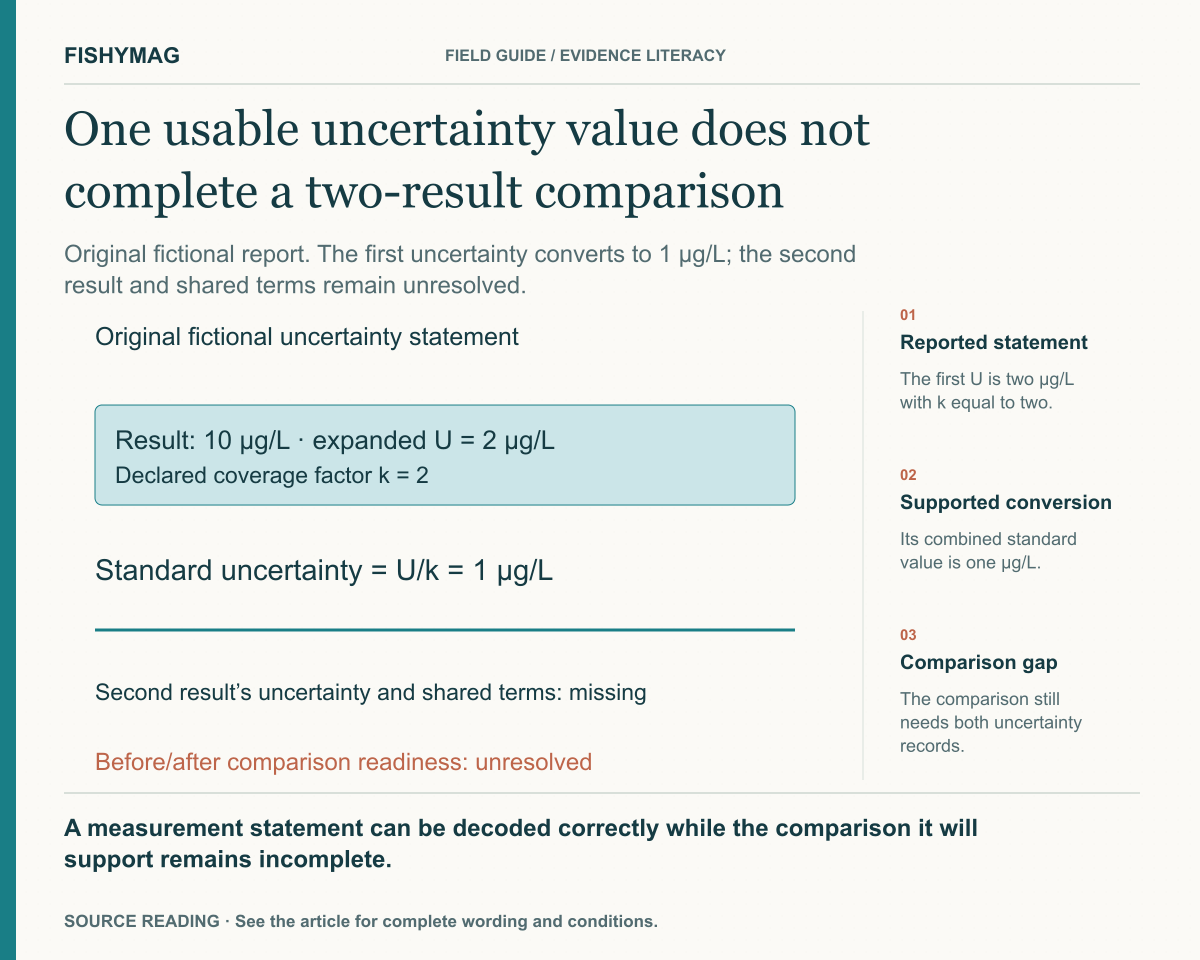
Figure data and explanation
Original fictional report. The first uncertainty converts to 1 µg/L; the second result and shared terms remain unresolved.
- Reported statement
- The first U is two µg/L with k equal to two.
- Supported conversion
- Its combined standard value is one µg/L.
- Comparison gap
- The comparison still needs both uncertainty records.
A measurement statement can be decoded correctly while the comparison it will support remains incomplete.
Decode the uncertainty statement before comparing results
The original fictional report gives a caffeine result of 10 µg/L from a stated target-specific water analysis, with expanded uncertainty U = 2 µg/L and coverage factor k = 2. NIST defines expanded uncertainty as the product of the coverage factor and combined standard uncertainty. This lets the packet’s own quantities be converted. It does not authorize assuming a coverage probability that the laboratory did not state.
Complete the conversion and evidence request
The first result’s calculation is available. The proposed second result and shared uncertainty structure are separate requirements for a defensible comparison.
| Item | Fictional record or calculation | Disposition |
|---|---|---|
| First result | 10 µg/L | Preserve the original measurand and basis |
| Expanded uncertainty | U = 2 µg/L; k = 2 | Retain the report’s stated scope |
| Combined standard uncertainty | u = U/k = 2/2 = 1 µg/L | Conversion supported |
| Coverage interpretation | No additional probability statement supplied | Do not infer a 95% claim from k alone |
| Second result’s uncertainty | Not supplied | Request its U or u, k and applicability |
| Preparation stages and shared sources | Incomplete documentation | Do not assume independent errors or identical coverage |
Make the readiness decision before doing difference arithmetic
Ask whether each uncertainty covers the actual matrix and concentration, and which preparation, sampling or analytical stages it includes. Establish whether calibration, reference material or other components are shared across the two results. Those shared terms can matter to the uncertainty of a difference. An available u for one result is useful but insufficient for calculating a complete comparison. Leave readiness unresolved rather than assigning the first result’s uncertainty to the second or adding numbers from unlike statements. The example supplies no conclusion that the aquarium changed and no threshold for biological significance.
Use your own details
Is the laboratory's uncertainty statement usable? worksheet
Download the editable text file, fill it in on your device and keep it with the relevant record. This blank worksheet records your information; it does not verify entries or approve treatment.
- Exact result and measurand
- Standard versus expanded uncertainty label
- Numerical U and declared coverage factor
- Laboratory’s stated coverage interpretation
- Applicable matrix and concentration
- Preparation, sampling and measurement stages included
- Second result’s corresponding uncertainty
- Shared terms and comparison readiness
Put it into practice
Your checklist
- Keep U, u and k distinct and preserve the stated coverage interpretation.
- Request the applicable uncertainty for both results.
- Resolve included stages and shared terms before interpreting a difference.
Sources and scope
This article distinguishes manufacturer statements from FishyMag’s own workflows and arithmetic examples. Linked formulation records retain their own evidence dates; publishing this article does not refresh those records.
- NIST TN 1297, section 6: expanded uncertainty; reviewed November 9, 2026 ↗
- NIST TN 1297, section 7: reporting uncertainty; reviewed November 9, 2026 ↗
- NIST/SEMATECH: propagation of measurement uncertainty; reviewed November 8, 2026 ↗
AI-assisted writing and development. Not hands-on product testing or veterinary review. How we publish →
FishyMag reports what manufacturers say, quoted and linked. It does not diagnose illness or recommend a treatment, and it never infers that a product is safe from the absence of a warning — where no statement exists, it says so.
Formulations change. Always read the label on the bottle in your hand, and contact the manufacturer if your tank contains anything valuable or unusual.