Evidence literacy
Read the qualifier beside your aquarium result
Translate four fictional report rows using their own legend, including an estimated value, a nondetection and an undefined flag.
By FishyMag · Published
Original laboratory-report case · Not a clinical review or treatment recommendation.
Quick answer
The fictional report supplies a 12 µg/L numerical row, a 1.5 J estimated result, a 1.0 U nondetection at its stated limit and a 3.0 K row whose code is undefined. Preserve the first three meanings as documented. Keep K unresolved and request the applicable legend before interpreting it.
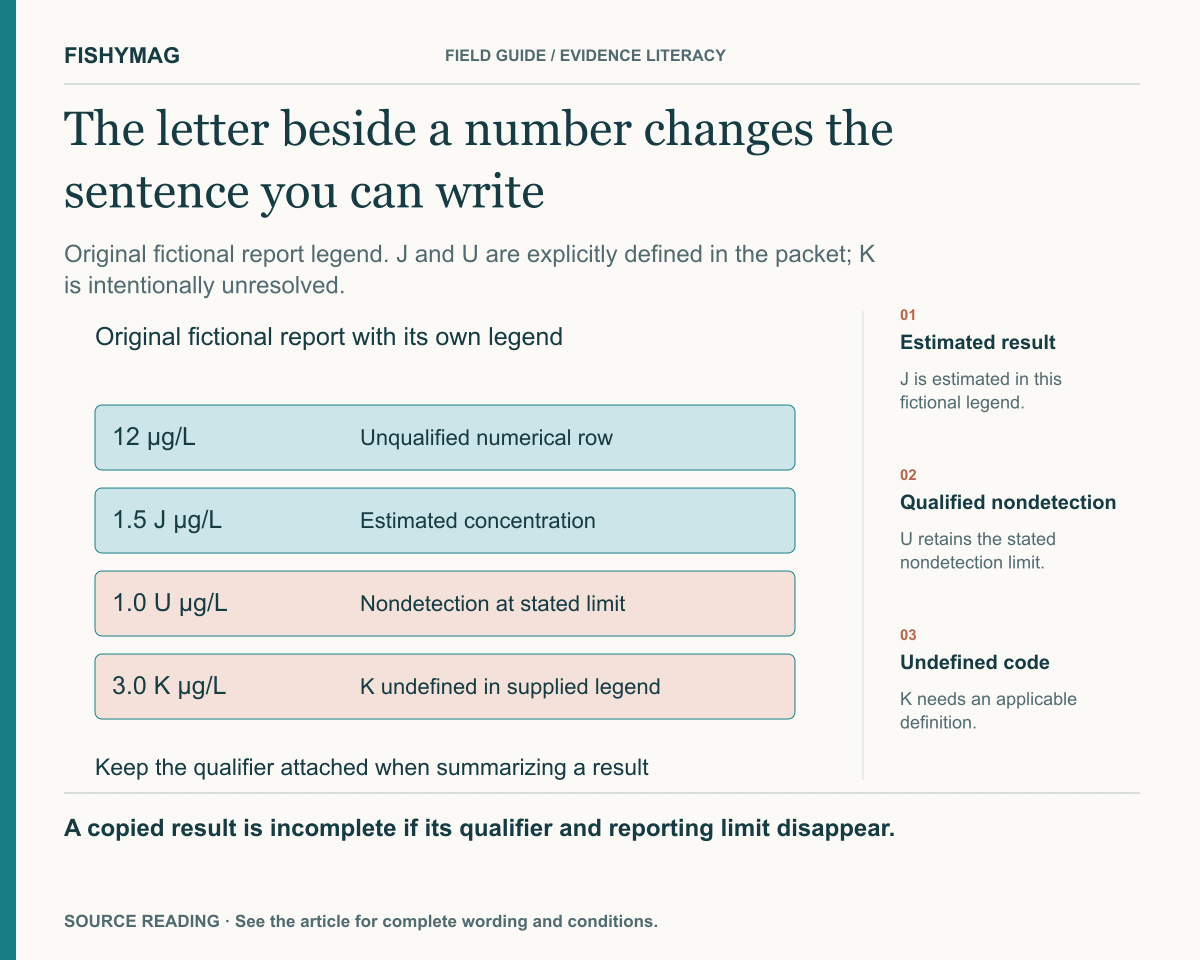
Figure data and explanation
Original fictional report legend. J and U are explicitly defined in the packet; K is intentionally unresolved.
- Estimated result
- J is estimated in this fictional legend.
- Qualified nondetection
- U retains the stated nondetection limit.
- Undefined code
- K needs an applicable definition.
A copied result is incomplete if its qualifier and reporting limit disappear.
Read the report’s own legend before decoding a letter
The EPA’s 2020 inorganic data-review guide uses J for an estimated quantity and U for a nondetection at an applicable adjusted limit. Those are meanings in that review system, not universal letters for every laboratory. This original fictional report adopts those two meanings explicitly in its attached legend and also contains a K code that its legend does not define.
Complete four report summaries
All four rows use µg/L in the teaching packet. No comparison with a biological threshold is being made, and an unqualified value is not a guarantee of perfect accuracy.
| Original row | Applicable legend evidence | Bounded summary |
|---|---|---|
| 12 µg/L | No qualifier printed | Numerical result reported as 12 µg/L |
| 1.5 J µg/L | J means estimated concentration | Approximately 1.5 µg/L as an estimated result |
| 1.0 U µg/L | U means not detected above the stated limit | Not detected at the report’s stated 1.0 µg/L limit; not zero |
| 3.0 K µg/L | No K definition in supplied legend | Preserve row and code; usability unresolved |
| Required clarification | Current report-specific K definition and review narrative | Do not guess from another laboratory’s glossary |
Carry the qualification into every downstream table
Exporting a bare number can make an estimate look definitive or turn a reported limit into a concentration. Keep separate columns for the original result, qualifier, reporting capability and interpretation. When comparing versions, preserve the applicable legend date and scope. If a code is missing from the legend, ask the performing laboratory which definition and quality-control decision apply to that specific row. Do not replace the result with zero, a guessed detection or a rejected value solely from the unfamiliar letter. This article is a completed report-reading exercise, not a review of real data or a water-clearance determination.
Use your own details
Read the qualifier beside your aquarium result worksheet
Download the editable text file, fill it in on your device and keep it with the relevant record. This blank worksheet records your information; it does not verify entries or approve treatment.
- Report version, sample and analyte identity
- Original numerical value and units
- Qualifier exactly as printed
- Applicable report legend entry
- Detection or reporting limit represented
- Allowed summary with qualifier preserved
- Undefined codes and narrative needed
- Result usability for the intended comparison
Put it into practice
Your checklist
- Keep the original row and its report-specific legend together.
- Carry estimates and nondetections into summaries with their qualifiers.
- Leave undefined flags unresolved until the performing laboratory explains them.
Sources and scope
This article distinguishes manufacturer statements from FishyMag’s own workflows and arithmetic examples. Linked formulation records retain their own evidence dates; publishing this article does not refresh those records.
AI-assisted writing and development. Not hands-on product testing or veterinary review. How we publish →
FishyMag reports what manufacturers say, quoted and linked. It does not diagnose illness or recommend a treatment, and it never infers that a product is safe from the absence of a warning — where no statement exists, it says so.
Formulations change. Always read the label on the bottle in your hand, and contact the manufacturer if your tank contains anything valuable or unusual.