Evidence literacy
A laboratory blank beside an aquarium result
Interpret an associated reagent blank using a method-specific decision branch while retaining the original aquarium result and missing MDL.
By FishyMag · Published
Original laboratory-report case · Not a clinical review or treatment recommendation.
Quick answer
Keep the fictional 3.0 µg/L sample result and its linked 0.8 µg/L blank. Subtraction gives 2.2 arithmetically, but not an authorized replacement result. For the illustrated EPA 200.8 branch, the missing applicable MDL prevents deciding which laboratory reanalysis condition applies.
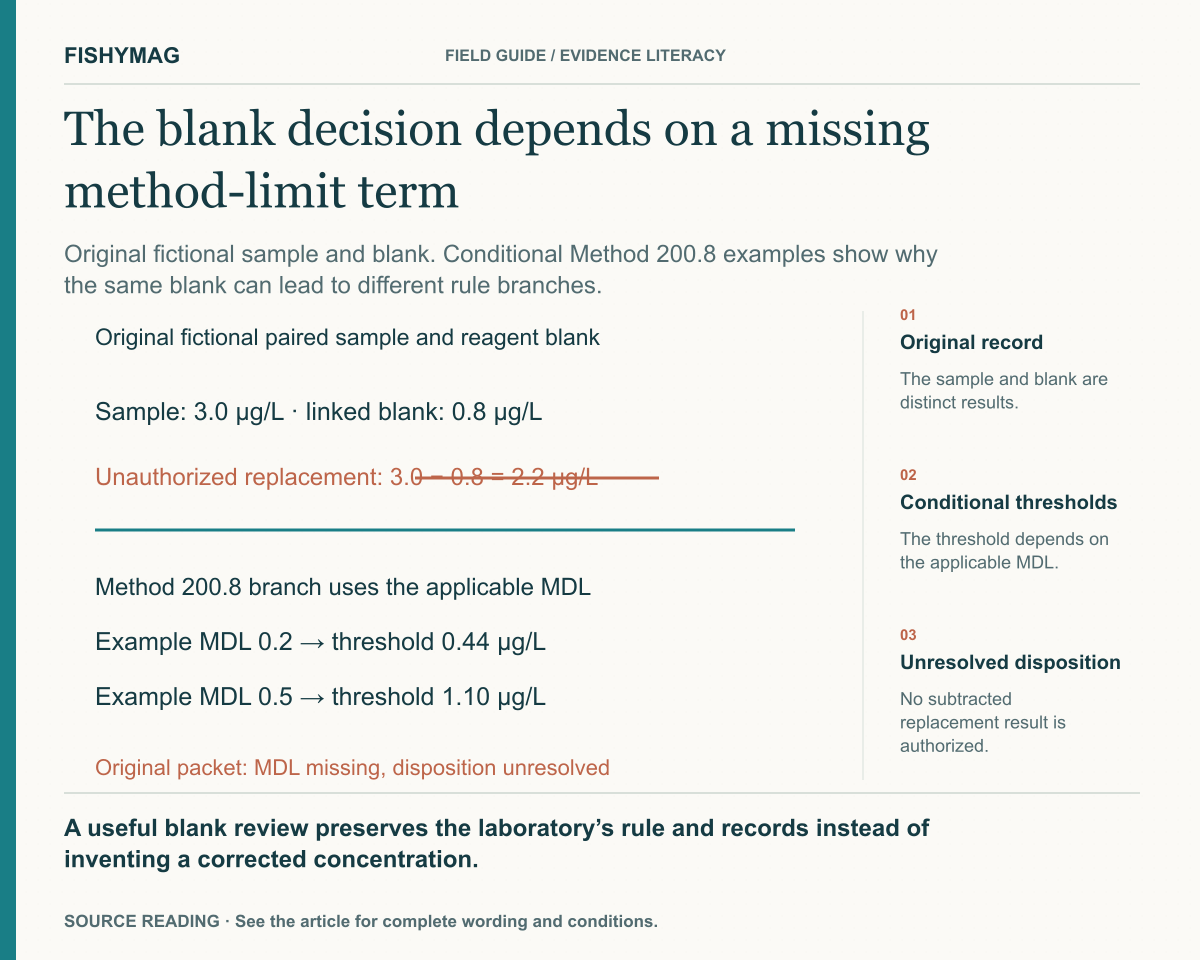
Figure data and explanation
Original fictional sample and blank. Conditional Method 200.8 examples show why the same blank can lead to different rule branches.
- Original record
- The sample and blank are distinct results.
- Conditional thresholds
- The threshold depends on the applicable MDL.
- Unresolved disposition
- No subtracted replacement result is authorized.
A useful blank review preserves the laboratory’s rule and records instead of inventing a corrected concentration.
Start with the actual associated blank and rule
This original fictional packet links a 0.8 µg/L laboratory reagent blank to a 3.0 µg/L water result for the same analyte. The applicable MDL is missing. EPA Method 200.8 revision 5.4 section 9.3.1 identifies a laboratory reanalysis condition using the greater of 10% of the sample result and 2.2 times its MDL. It also treats blanks above the MDL as a contamination concern. These conditions are not a user instruction to subtract a blank from a sample.
Complete the main packet and two conditional branches
Assume only for the two teaching branches that this exact method and blank association apply. They differ solely in the laboratory’s hypothetical applicable MDL.
| Branch | Condition calculation | Interpretation |
|---|---|---|
| Main packet | 10% of 3.0 = 0.30 µg/L; 2.2 × MDL unknown | Full method condition cannot be assessed |
| Alternative MDL 0.2 | Greater of 0.30 and 2.2 × 0.2 = 0.44 | 0.8 meets the illustrated reanalysis condition |
| Alternative MDL 0.5 | Greater of 0.30 and 2.2 × 0.5 = 1.10 | 0.8 is below that condition; still above the hypothetical MDL |
| Tempting subtraction | 3.0 − 0.8 = 2.2 µg/L | Arithmetic only; do not issue this replacement result |
| Record disposition | Retain 3.0 and the separate 0.8 blank | Request formal batch assessment |
Let the performing laboratory resolve the report
The second branch does not turn a below-trigger blank into a universal pass: the method’s contamination concern and any other applicable batch criteria still matter. Ask the laboratory to confirm the blank association, applicable MDL, quality-control rule and disposition of the original row. If it issues an amended result, preserve both versions and the reason. This is a review of the evidence needed to interpret a laboratory document, not a procedure for performing sample preparation, authorizing self-correction or declaring the water safe.
Use your own details
A laboratory blank beside an aquarium result worksheet
Download the editable text file, fill it in on your device and keep it with the relevant record. This blank worksheet records your information; it does not verify entries or approve treatment.
- Sample result, analyte, unit and qualifier
- Associated blank identity and type
- Preparation batch and matrix linkage
- Applicable method revision and rule
- Laboratory-specific applicable MDL
- Computed condition with both terms visible
- Performing laboratory’s batch disposition
- Original versus formally amended report
Put it into practice
Your checklist
- Verify that the blank belongs to the sample’s preparation batch.
- Recover both terms of the applicable method condition before interpreting it.
- Keep the original result until the laboratory formally resolves the batch.
Sources and scope
This article distinguishes manufacturer statements from FishyMag’s own workflows and arithmetic examples. Linked formulation records retain their own evidence dates; publishing this article does not refresh those records.
AI-assisted writing and development. Not hands-on product testing or veterinary review. How we publish →
FishyMag reports what manufacturers say, quoted and linked. It does not diagnose illness or recommend a treatment, and it never infers that a product is safe from the absence of a warning — where no statement exists, it says so.
Formulations change. Always read the label on the bottle in your hand, and contact the manufacturer if your tank contains anything valuable or unusual.