Evidence literacy
An aquarium result above the laboratory's range
Preserve a fictional above-range laboratory estimate and request the evidence needed to replace it with a supported report.
By FishyMag · Published
Original laboratory-report case · Not a clinical review or treatment recommendation.
Quick answer
The fictional report shows 140 µg/L with an estimated qualifier, while the applicable validated range ends at 100 µg/L. Keep 140 with its qualifier. Do not clip it to 100 or present it as validated. Ask whether the performing laboratory can issue an authorized in-range reanalysis with the applicable revised reporting limits.
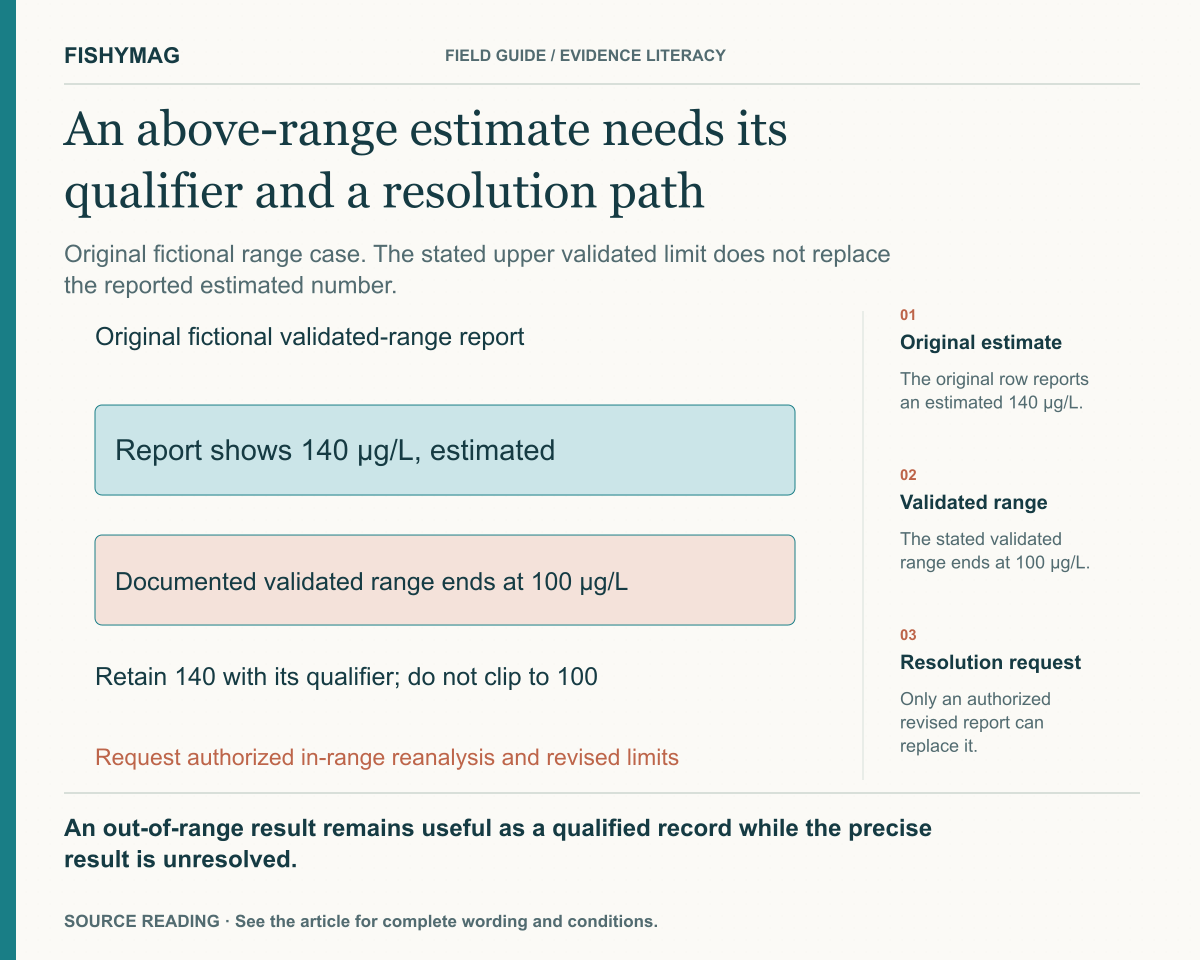
Figure data and explanation
Original fictional range case. The stated upper validated limit does not replace the reported estimated number.
- Original estimate
- The original row reports an estimated 140 µg/L.
- Validated range
- The stated validated range ends at 100 µg/L.
- Resolution request
- Only an authorized revised report can replace it.
An out-of-range result remains useful as a qualified record while the precise result is unresolved.
Compare the result and range on the same basis
The original fictional report explicitly puts its estimated 140 µg/L result and upper validated limit of 100 µg/L on the same stated sample basis. A real packet may instead give a range for an analytical aliquot, so its relationship to the reported water result must be verified. EPA Method 200.8 discusses an analyte-specific working range. It does not make this fictional numerical range a universal limit for aquarium laboratories.
Complete the provisional report entry
The above-range estimate is preserved exactly as reported. Neither truncation nor replacing it with a firm threshold statement is an authorized interpretation in this packet.
| Field | Fictional evidence | Disposition |
|---|---|---|
| Original value | 140 µg/L, estimated | Retain number and qualifier |
| Applicable upper validated limit | 100 µg/L on the same stated basis | Reported estimate lies above the validated range |
| Clipped result of 100 µg/L | Not reported by the laboratory | Do not substitute |
| Validated exact value of 140 µg/L | Not supported by the range record | Do not remove the qualifier |
| Reanalysis option | Not yet authorized or supplied | Request laboratory’s applicable in-range approach |
| Replacement report | No revised result or limit supplied | Provisional interpretation remains |
Request the replacement evidence rather than repairing the number yourself
Ask whether the laboratory can reanalyse the retained sample or requires a new one, and how any changed analytical preparation affects the reported basis, limits and qualifications. Request the formal revised report linked to the original. The provisional wording can be concise: “140 µg/L estimated, above the stated validated range; a supported quantitative replacement is pending.” It does not establish a precise true concentration or a biological boundary. This article gives no dilution or sample-preparation procedure and makes no purchasing or treatment recommendation.
Use your own details
An aquarium result above the laboratory's range worksheet
Download the editable text file, fill it in on your device and keep it with the relevant record. This blank worksheet records your information; it does not verify entries or approve treatment.
- Report identity, version and original result
- Analyte, fraction and analytical basis
- Estimated or over-range qualifier as printed
- Applicable upper validated limit
- Whether range refers to original sample or analytical aliquot
- Authorized reanalysis or qualified reporting option
- Revised limit and sample-basis conversion record
- Formal replacement or unresolved provisional summary
Put it into practice
Your checklist
- Check that the result and range use the same basis.
- Retain the estimate and qualifier without clipping.
- Replace the row only with a traceable laboratory-issued revision.
Sources and scope
This article distinguishes manufacturer statements from FishyMag’s own workflows and arithmetic examples. Linked formulation records retain their own evidence dates; publishing this article does not refresh those records.
- US EPA Method 200.8 revision 5.4 (1994); reviewed November 9, 2026 ↗
- NATA: interpreting accredited test reports; reviewed November 9, 2026 ↗
AI-assisted writing and development. Not hands-on product testing or veterinary review. How we publish →
FishyMag reports what manufacturers say, quoted and linked. It does not diagnose illness or recommend a treatment, and it never infers that a product is safe from the absence of a warning — where no statement exists, it says so.
Formulations change. Always read the label on the bottle in your hand, and contact the manufacturer if your tank contains anything valuable or unusual.