Evidence literacy
Which aquarium result does the matrix spike qualify?
Calculate a fictional copper matrix-spike recovery and trace exactly which sample it represents before interpreting a second sample.
By FishyMag · Published
Original laboratory-report case · Not a clinical review or treatment recommendation.
Quick answer
The fictional spike explicitly associated with sample A gives (12 − 4)/10 × 100 = 80% recovery. That is inside EPA Method 200.8’s stated LFM range for this illustrative applicable case. No evidence links that spike to sample B’s different matrix, so B’s matrix status remains unresolved.
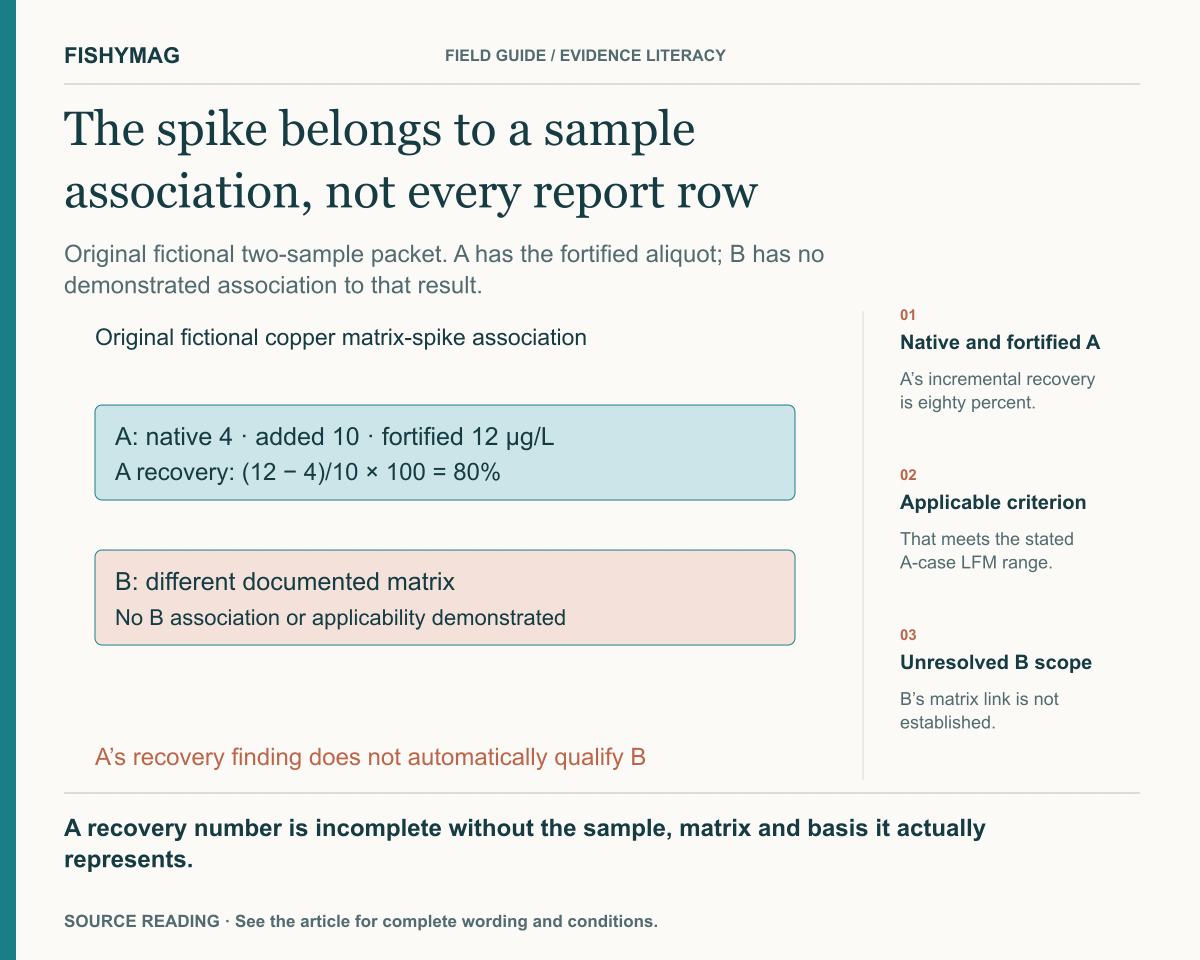
Figure data and explanation
Original fictional two-sample packet. A has the fortified aliquot; B has no demonstrated association to that result.
- Native and fortified A
- A’s incremental recovery is eighty percent.
- Applicable criterion
- That meets the stated A-case LFM range.
- Unresolved B scope
- B’s matrix link is not established.
A recovery number is incomplete without the sample, matrix and basis it actually represents.
Trace the spike to the source sample
In the original fictional report, sample A is freshwater and sample B has a separately documented saline matrix. The laboratory explicitly links its fortified aliquot to A, not B. For this teaching calculation, EPA Method 200.8 is stipulated applicable to A and all concentrations share the documented final analytical basis. This example does not infer that the method applies unchanged to the saline sample.
Complete both the arithmetic and the association map
EPA 200.8 section 9.4 uses the increment above the native concentration and gives a designated 70 to 130% LFM range. The supplied addition is 10 µg/L versus native 4, so the method’s exception for an addition below 30% of native concentration is not invoked in this case.
| Record | Fictional value or link | Completed finding |
|---|---|---|
| A native | 4 µg Cu/L | Background retained |
| A fortified | 12 µg Cu/L | Same analytical basis stipulated |
| Added equivalent | 10 µg Cu/L | Addition denominator for A |
| A recovery | (12 − 4)/10 × 100 = 80% | Inside stated 70 to 130% criterion for A |
| B association | Different matrix; no applicable link or validation supplied | B matrix performance unresolved |
| Native concentration correction | No authorized corrected result supplied | Do not divide the native value by 0.80 |
Apply the finding only where the association supports it
An acceptable A recovery is useful evidence for its documented analytical context. It does not certify B, clear all analytes or demonstrate accuracy for every concentration. A representative spike can inform other samples if the method and laboratory document why the same matrix scope applies. This packet does not. Ask which sample group and preparation batch the spike represents and how the laboratory assessed B. Leave B unresolved rather than calling it failed or inventing a recovery correction. No spike preparation procedure or dosing instruction is provided.
Use your own details
Which aquarium result does the matrix spike qualify? worksheet
Download the editable text file, fill it in on your device and keep it with the relevant record. This blank worksheet records your information; it does not verify entries or approve treatment.
- Native sample ID and matrix
- Fortified aliquot ID and explicit association
- Native result on comparable basis
- Added analyte equivalent on final analytical basis
- Fortified result and reporting unit
- Applicable recovery range and conditions
- Other samples and documented association
- Bounded scope of recovery finding
Put it into practice
Your checklist
- Identify the native sample behind the fortified aliquot.
- Check the method range and calculation basis before interpreting recovery.
- Do not extend the finding to a different matrix without documented association.
Sources and scope
This article distinguishes manufacturer statements from FishyMag’s own workflows and arithmetic examples. Linked formulation records retain their own evidence dates; publishing this article does not refresh those records.
- US EPA Method 200.8 revision 5.4 (1994); reviewed November 9, 2026 ↗
- EPA National Functional Guidelines for Inorganic Superfund Methods Data Review, November 2020; reviewed November 9, 2026 ↗
AI-assisted writing and development. Not hands-on product testing or veterinary review. How we publish →
FishyMag reports what manufacturers say, quoted and linked. It does not diagnose illness or recommend a treatment, and it never infers that a product is safe from the absence of a warning — where no statement exists, it says so.
Formulations change. Always read the label on the bottle in your hand, and contact the manufacturer if your tank contains anything valuable or unusual.