Evidence literacy
Laboratory duplicates near the reporting limit
Read two fictional laboratory duplicates near their quantitation limit, compare absolute and relative summaries and preserve a censored branch.
By FishyMag · Published
Original laboratory-report case · Not a clinical review or treatment recommendation.
Quick answer
The fictional quantified duplicates differ by 0.4 µg/L, or 30.8% relative to their mean. The packet’s stated low-range criterion uses absolute difference, so 0.4 is within its 1.0 µg/L criterion. A separate pair containing <1.0 has no exact RPD without a supported censored-result procedure.
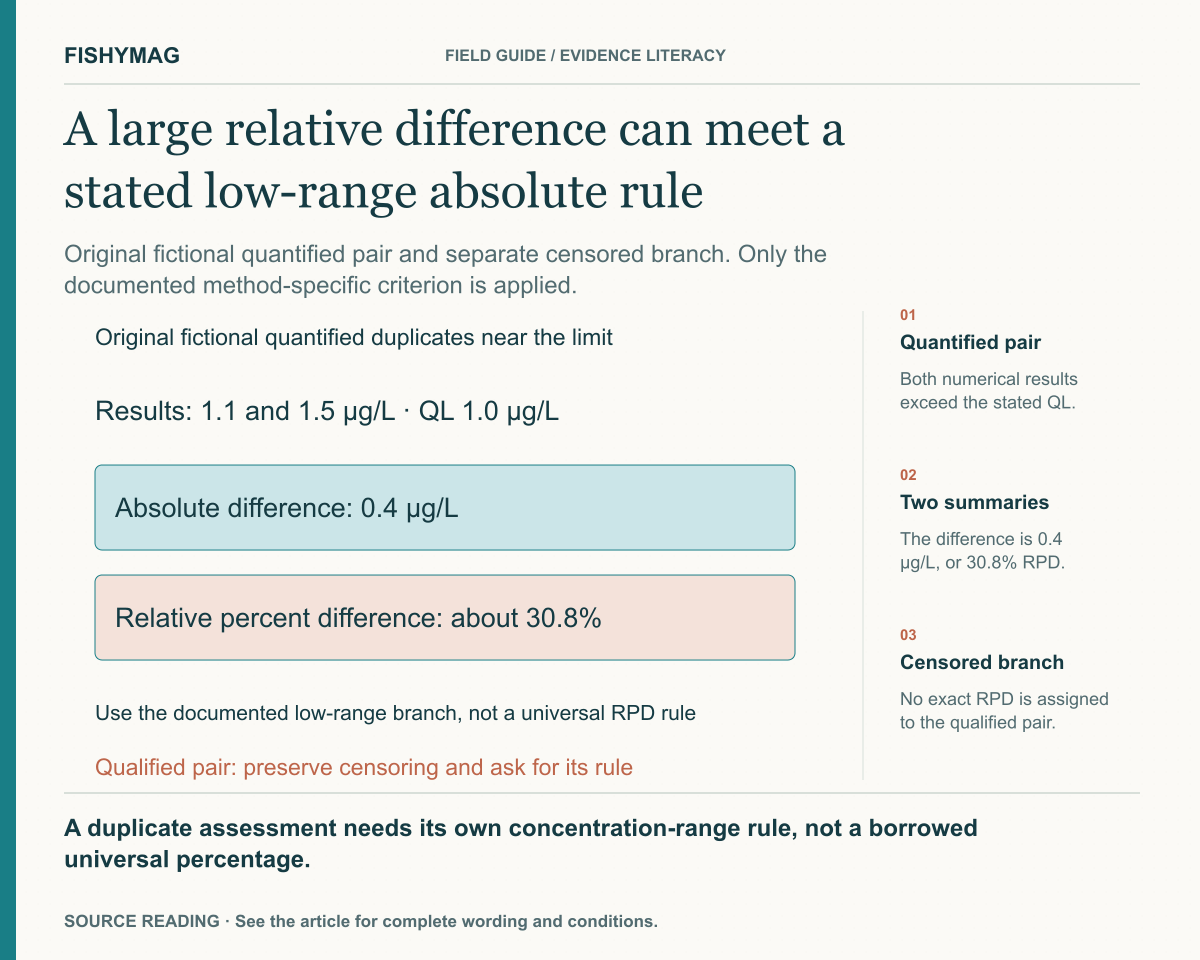
Figure data and explanation
Original fictional quantified pair and separate censored branch. Only the documented method-specific criterion is applied.
- Quantified pair
- Both numerical results exceed the stated QL.
- Two summaries
- The difference is 0.4 µg/L, or 30.8% RPD.
- Censored branch
- No exact RPD is assigned to the qualified pair.
A duplicate assessment needs its own concentration-range rule, not a borrowed universal percentage.
Check which duplicate rule applies near the limit
The original fictional quantified pair is 1.1 and 1.5 µg/L, with quantitation limit 1.0 µg/L. The fictional lab adopts the low-range absolute-difference rule for this quantified pair, as illustrated by EPA’s 2020 inorganic data-review guide, ICP-MS Table 7. That source separates its statement-of-work cases below five times QL from its higher-range RPD cases. It is not a universal rule for every aquarium laboratory.
Calculate both summaries and apply the correct branch
The same pair can look large on a relative scale while its absolute difference remains within the stated low-range criterion.
| Check | Calculation or record | Finding |
|---|---|---|
| Absolute difference | 1.5 − 1.1 = 0.4 µg/L | Retains the original concentration unit |
| Mean of quantified pair | (1.1 + 1.5)/2 = 1.3 µg/L | RPD denominator |
| RPD | 0.4/1.3 × 100 ≈ 30.8% | Descriptive relative summary |
| Low-range branch | Both below 5 × 1.0; 0.4 ≤ 1.0 | No qualification from this duplicate check under the stated rule |
| Separate censored pair | <1.0 and 1.5 µg/L | Exact RPD not computed; retain <1.0 |
| Censored-pair rule | Not supplied for the fictional second packet | Ask for its applicable interpretation |
Keep the check result narrower than a batch pass
Do not apply a higher-range 20% RPD number to this low-range case merely because 30.8 looks large. Conversely, meeting the stipulated duplicate criterion does not prove accuracy or every quality-control result acceptable. In the separate censored branch, do not substitute zero or the limit by habit. A project-specific procedure may define a qualified comparison, but its basis must be documented. Preserve the original rows, limits, calculation and named rule beside the result. This guide concerns duplicate analyses of the same sample, not variation between independently collected water samples.
Use your own details
Laboratory duplicates near the reporting limit worksheet
Download the editable text file, fill it in on your device and keep it with the relevant record. This blank worksheet records your information; it does not verify entries or approve treatment.
- Same-sample duplicate identities
- Method, matrix and common analytical basis
- Both original results and qualifiers
- Applicable QL and lab criterion by range
- Absolute difference with unit
- RPD using the average of quantified results
- Censored-pair handling rule if supplied
- Specific check result versus overall batch validity
Put it into practice
Your checklist
- Identify the duplicate level and applicable concentration branch.
- Report absolute and relative summaries with their proper units.
- Retain the original censoring when a quantified comparison is not justified.
Sources and scope
This article distinguishes manufacturer statements from FishyMag’s own workflows and arithmetic examples. Linked formulation records retain their own evidence dates; publishing this article does not refresh those records.
AI-assisted writing and development. Not hands-on product testing or veterinary review. How we publish →
FishyMag reports what manufacturers say, quoted and linked. It does not diagnose illness or recommend a treatment, and it never infers that a product is safe from the absence of a warning — where no statement exists, it says so.
Formulations change. Always read the label on the bottle in your hand, and contact the manufacturer if your tank contains anything valuable or unusual.