Evidence literacy
Which laboratory limit answers your aquarium question?
Compare two fictional laboratory offers for the same water measurement without ranking a detection limit against a numerical reporting limit.
By FishyMag · Published
Original laboratory-report case · Not a clinical review or treatment recommendation.
Quick answer
For the fictional requirement of numerical reporting at 2 µg/L, a 0.2 µg/L detection limit alone does not answer the question. Quote B explicitly offers numerical reporting from 1 µg/L for the same matrix and fraction. It documents the requested capability; quote A remains unresolved, not necessarily inferior.
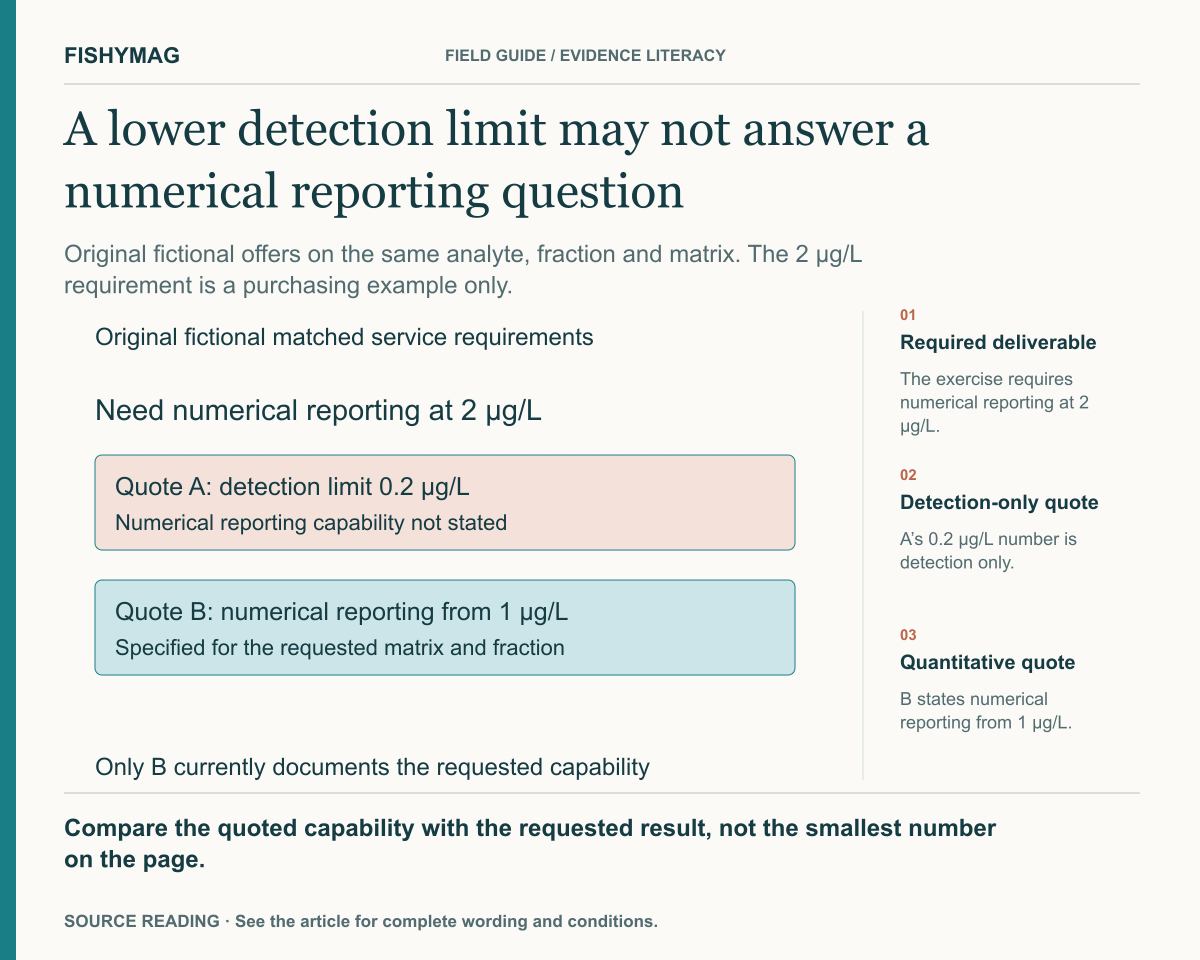
Figure data and explanation
Original fictional offers on the same analyte, fraction and matrix. The 2 µg/L requirement is a purchasing example only.
- Required deliverable
- The exercise requires numerical reporting at 2 µg/L.
- Detection-only quote
- A’s 0.2 µg/L number is detection only.
- Quantitative quote
- B states numerical reporting from 1 µg/L.
Compare the quoted capability with the requested result, not the smallest number on the page.
Identify the limit the decision actually needs
The original fictional buyer wants a number at 2 µg/L for one specified analyte, operational fraction and aquarium-water matrix. This is a procurement condition for the example. It is not a biological threshold. EPA Method 200.8 distinguishes instrumental and method detection information and notes that achievable limits depend on matrix and operating conditions. A quote’s label needs its own definition and applicable sample basis.
Compare the two offers on the same question
The fictional offers concern the same analyte and matrix. Only one states a quantitative reporting capability. The smaller printed number does not automatically win the comparison.
| Quote line | Supplied information | Can it demonstrate numerical reporting at 2 µg/L? |
|---|---|---|
| A | Detection limit 0.2 µg/L only | Unresolved; no stated numerical reporting capability |
| B | Numerical reporting from 1 µg/L for the specified fraction and matrix | Yes as quoted, subject to the stated conditions |
| Instrument-only limit | Not accepted as a sample reporting limit without a supported link | Do not substitute |
| Applicable sample dilution or matrix interference | Could alter reporting conditions; not stipulated in the quotes | Ask how sample-specific limits will be reported |
| Procurement conclusion | B currently documents the requested capability | A may still meet it if clarified |
Request the missing definition instead of replacing it with a generic LOQ
Ask quote A for the actual quantitative reporting level, when it applies to the requested fraction and matrix, and how low or qualified results would be written. Ask both laboratories what can change the final sample-specific limit. Terms such as detection limit, quantitation limit and reporting limit are not interchangeable without the provider’s definitions. Keep the chosen comparison focused on the requested deliverable rather than assuming B is more accurate in every respect. Neither quotation demonstrates absence of the analyte, a real-world service guarantee or safe water.
Use your own details
Which laboratory limit answers your aquarium question? worksheet
Download the editable text file, fill it in on your device and keep it with the relevant record. This blank worksheet records your information; it does not verify entries or approve treatment.
- Exact analyte, fraction and matrix
- Required numerical reporting capability
- Definitions used by each laboratory
- Detection limit and its basis
- Quantitative or reporting limit and its basis
- Sample-specific effects of preparation or dilution
- Current quote answerability by service
- Clarification required without a price or safety ranking
Put it into practice
Your checklist
- Define the needed reporting capability before comparing offers.
- Do not rank unlike limits by their printed numbers alone.
- Leave an incomplete quote unresolved and ask for the exact missing definition.
Sources and scope
This article distinguishes manufacturer statements from FishyMag’s own workflows and arithmetic examples. Linked formulation records retain their own evidence dates; publishing this article does not refresh those records.
- US EPA Method 200.8 revision 5.4 (1994); reviewed November 9, 2026 ↗
- Australian and New Zealand water-quality guidelines: laboratory analysis; reviewed November 8, 2026 ↗
AI-assisted writing and development. Not hands-on product testing or veterinary review. How we publish →
FishyMag reports what manufacturers say, quoted and linked. It does not diagnose illness or recommend a treatment, and it never infers that a product is safe from the absence of a warning — where no statement exists, it says so.
Formulations change. Always read the label on the bottle in your hand, and contact the manufacturer if your tank contains anything valuable or unusual.