Evidence literacy
A passing laboratory control is not your aquarium matrix
Interpret a passing laboratory control sample without treating it as validation of an unrepresented aquarium matrix.
By FishyMag · Published
Original laboratory-report case · Not a clinical review or treatment recommendation.
Quick answer
The fictional laboratory marks its control sample acceptable. That supports the reported control performance for that batch and analyte. No sample-associated matrix evidence is supplied, so the control alone does not establish that the aquarium sample had comparable recovery or that its matrix effects were resolved.

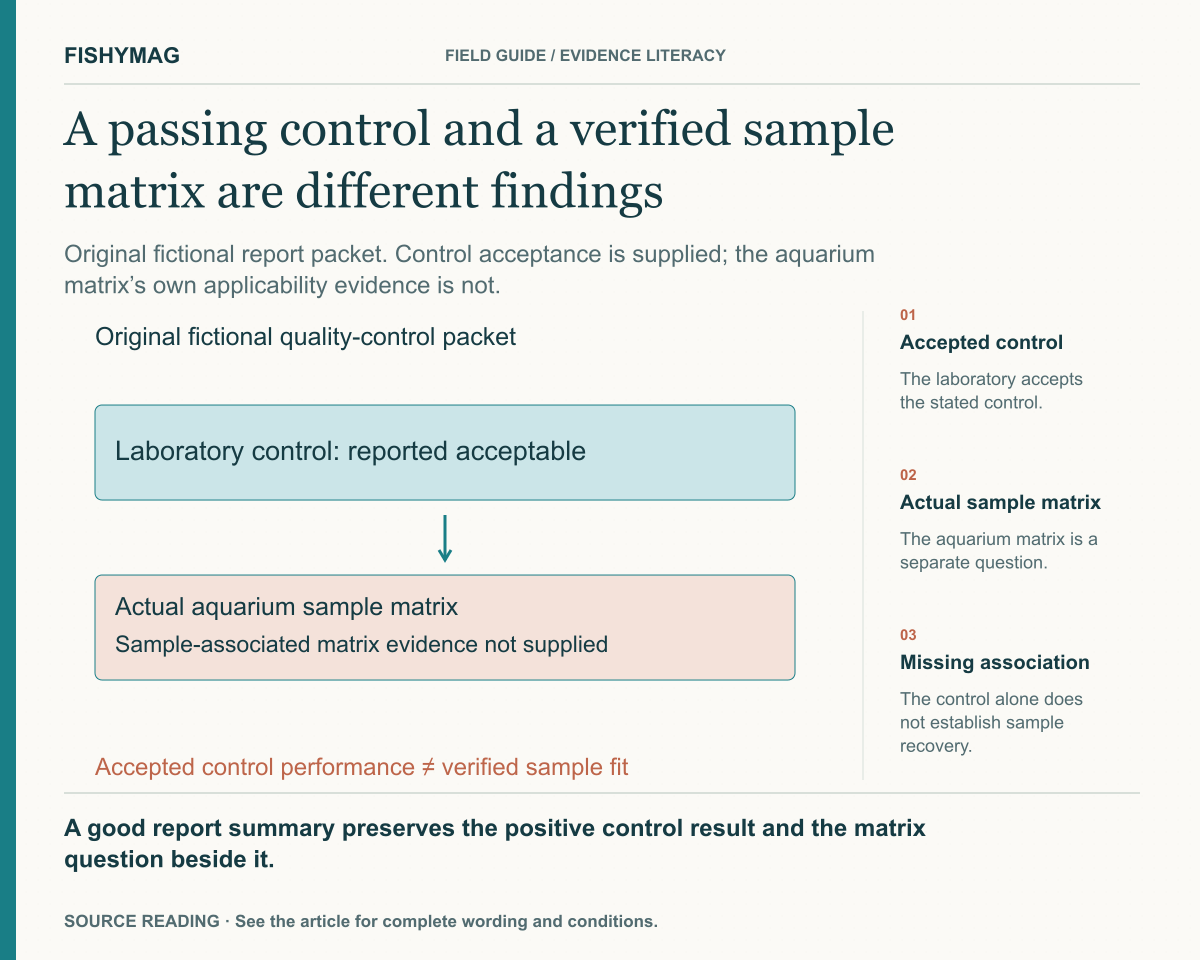
Figure data and explanation
Original fictional report packet. Control acceptance is supplied; the aquarium matrix’s own applicability evidence is not.
- Accepted control
- The laboratory accepts the stated control.
- Actual sample matrix
- The aquarium matrix is a separate question.
- Missing association
- The control alone does not establish sample recovery.
A good report summary preserves the positive control result and the matrix question beside it.
Name which material passed the control
This original fictional packet marks a laboratory control sample acceptable for the stated analyte and preparation batch. The actual aquarium sample has a separately described matrix, but the packet supplies no associated matrix spike or equivalent applicability evidence. EPA’s inorganic data-review guidance treats laboratory control and sample-matrix review as distinct checks. The case does not invent a recovery number or a universal laboratory acceptance cutoff.
Complete the evidence coverage table
The absence of a matrix-specific attachment is a documentation gap. It does not show that the laboratory never assessed the matrix, and the acceptable control cannot fill that gap by itself.
| Question | Fictional evidence | Bounded conclusion |
|---|---|---|
| Did the laboratory accept its control? | Control row explicitly marked acceptable | Accepted as stated for that control |
| Which analytical work does that support? | Named analyte and preparation batch | Control performance in that documented scope |
| Did the actual aquarium matrix show comparable recovery? | No sample-associated evidence supplied | Not established by the control alone |
| Has an interference been demonstrated? | No case-specific evidence | Do not infer a failed sample from the gap |
| What would help resolve it? | Applicable matrix validation, associated QC and report narrative | Request the performing laboratory’s basis |
Keep a useful positive finding without extending it
A sound summary is: “The reported control passed; applicability to the aquarium sample matrix is not established by that control alone.” An applicable validation or representative matrix control may answer more when its scope and association are documented. Do not insist that every service must have a bespoke spike for every individual sample without checking its actual policy. Likewise, do not mark every sample result acceptable simply because one control was in range. The completed finding identifies what is supported, what is missing and what record could resolve the gap, without declaring a real sample valid, invalid or safe.
Use your own details
A passing laboratory control is not your aquarium matrix worksheet
Download the editable text file, fill it in on your device and keep it with the relevant record. This blank worksheet records your information; it does not verify entries or approve treatment.
- Laboratory control sample identity and batch
- Target analyte and preparation represented
- Laboratory’s stated control acceptance
- Actual aquarium sample and matrix
- Sample-associated matrix evidence supplied
- Applicability of shared controls or validation
- Unresolved interference, recovery and reporting issues
- Bounded report summary
Put it into practice
Your checklist
- Record the exact control and the batch it represents.
- Keep control performance separate from sample-matrix evidence.
- Request the applicable matrix basis instead of assuming either success or failure.
Sources and scope
This article distinguishes manufacturer statements from FishyMag’s own workflows and arithmetic examples. Linked formulation records retain their own evidence dates; publishing this article does not refresh those records.
- EPA National Functional Guidelines for Inorganic Superfund Methods Data Review, November 2020; reviewed November 9, 2026 ↗
- US EPA Method 200.8 revision 5.4 (1994); reviewed November 9, 2026 ↗
AI-assisted writing and development. Not hands-on product testing or veterinary review. How we publish →
FishyMag reports what manufacturers say, quoted and linked. It does not diagnose illness or recommend a treatment, and it never infers that a product is safe from the absence of a warning — where no statement exists, it says so.
Formulations change. Always read the label on the bottle in your hand, and contact the manufacturer if your tank contains anything valuable or unusual.