Keeper workflows
Is that aquarium actually isolated?
Audit a claimed aquarium isolation boundary against a return, equaliser and emergency overflow.
By FishyMag · Published
Worked hydraulic example · Not a clinical review or treatment recommendation.
Quick answer
The auxiliary tank in this example is still hydraulically connected. The main return is recorded closed, but the equaliser is open. The overflow is a separate unresolved path. None of these records tells you how quickly water exchanges.
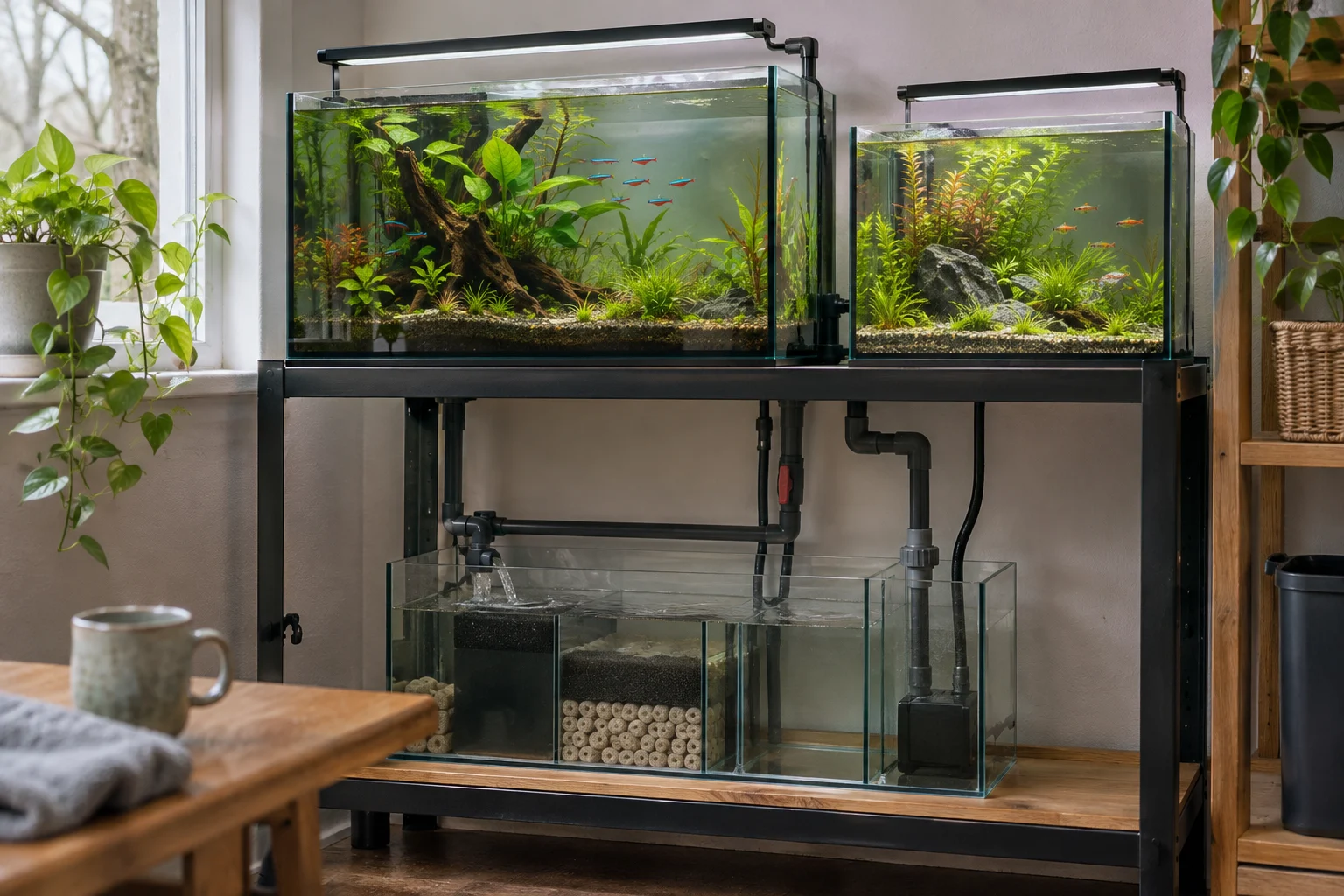
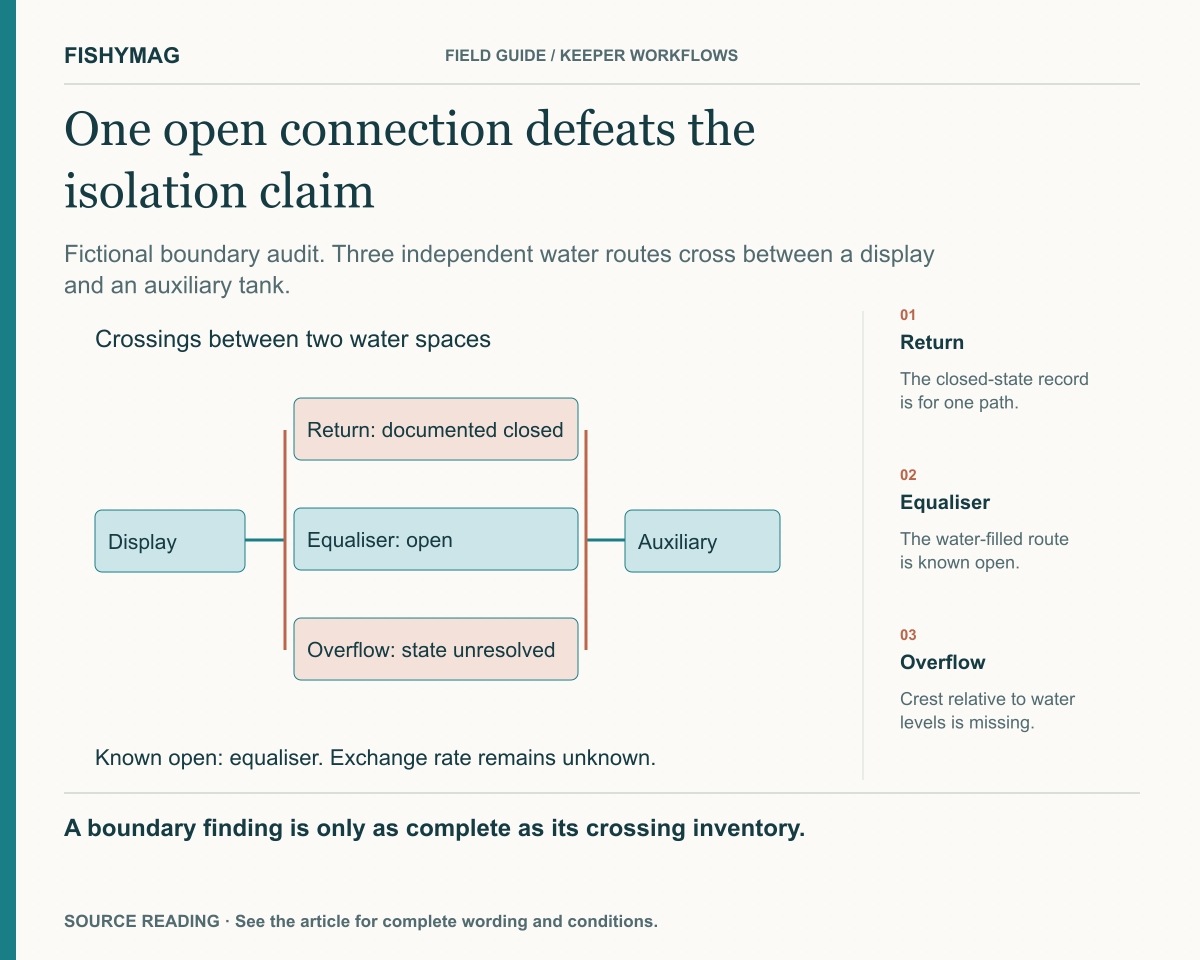
Figure data and explanation
Fictional boundary audit. Three independent water routes cross between a display and an auxiliary tank.
- Return
- The closed-state record is for one path.
- Equaliser
- The water-filled route is known open.
- Overflow
- Crest relative to water levels is missing.
A boundary finding is only as complete as its crossing inventory.
Draw the boundary through the pipes
In the fictional fish room the display and auxiliary tank share three documented crossings. A return carries pumped water, a low equaliser joins the water spaces, and a high overflow can route water when its crest is reached. The record says the return valve is closed; the equaliser is water-filled and open; the overflow crest and water levels were never recorded together. EPA’s EPANET manual illustrates why a network depends on available links, and Red Sea documents a separate overflow route in a real system. The teaching layout is neither of those installations.
Read each crossing on its own evidence
A closed-state entry describes what was recorded about that route. A documented open connection elsewhere defeats the claim before the overflow question is resolved.
| Crossing | Record | Boundary finding |
|---|---|---|
| Main return | Valve recorded closed | No intended return through that route; seat leakage unmeasured |
| Low equaliser | Water-filled connection, no closed valve | Known open path |
| High overflow | Crest exists; relative levels missing | Conditional route; current status unresolved |
Write the conclusion so it can be checked
Record “auxiliary tank remains connected through the equaliser at the recorded configuration.” Leave the overflow on the map and ask for its crest elevation and operating-level record. A level pair showing the crest dry would narrow the finding to that time; it would not remove the pipe from a different operating state. Do not convert a configuration sketch into exchange speed, concentration, or a treatment compatibility finding.
Use your own details
Is that aquarium actually isolated? worksheet
Download the editable text file, fill it in on your device and keep it with the relevant record. This blank worksheet records your information; it does not verify entries or approve treatment.
- Compartment and proposed boundary
- Configuration and timestamp
- Return path and evidence
- Equaliser path and evidence
- Overflow crest and recorded water levels
- Unseen or undocumented links
- Known open path and unresolved assumptions
Put it into practice
Your checklist
- Trace each line through the proposed boundary.
- Keep one row per crossing, including emergency paths.
- Separate the known open path from the unresolved path.
Sources and scope
This article distinguishes manufacturer statements from FishyMag’s own workflows and arithmetic examples. Linked formulation records retain their own evidence dates; publishing this article does not refresh those records.
- US EPA EPANET 2.2 manual, network components and hydraulic equations; reviewed November 9, 2026 ↗
- Red Sea REEFER series manual v19A, water management system; reviewed November 9, 2026 ↗
AI-assisted writing and development. Not hands-on product testing or veterinary review. How we publish →
FishyMag reports what manufacturers say, quoted and linked. It does not diagnose illness or recommend a treatment, and it never infers that a product is safe from the absence of a warning — where no statement exists, it says so.
Formulations change. Always read the label on the bottle in your hand, and contact the manufacturer if your tank contains anything valuable or unusual.