Keeper workflows
What an aquarium ingredient percentage actually measures
Reconcile raw ingredient purity, finished formulation content and active-equivalent reporting without inventing a product assay.
By FishyMag · Published
Worked formulation evidence example · Not a clinical review or treatment recommendation.
Quick answer
A fictional blend containing 69% by mass of a raw ingredient assayed at 98% on the matching basis would contain 67.62% by mass in the stated model. Seachem’s SulfaPlex ingredient statement does not establish those premises or an adjusted product assay.
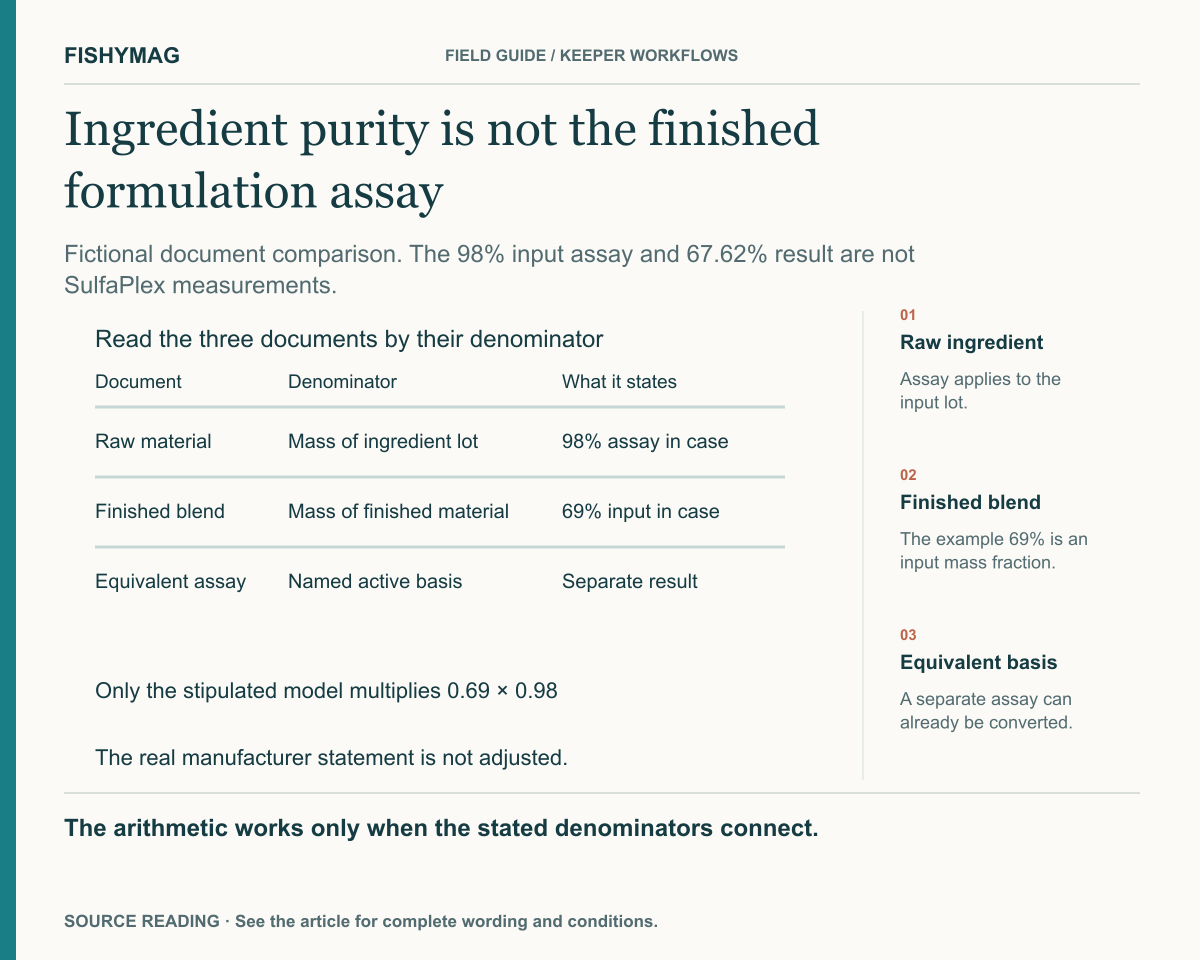
Figure data and explanation
Fictional document comparison. The 98% input assay and 67.62% result are not SulfaPlex measurements.
- Raw ingredient
- Assay applies to the input lot.
- Finished blend
- The example 69% is an input mass fraction.
- Equivalent basis
- A separate assay can already be converted.
The arithmetic works only when the stated denominators connect.
Three percentages can refer to three different denominators
Seachem lists SulfaPlex as 69% sulfathiazole and 31% excipients. The page does not publish a 98% raw ingredient assay or say the reported sulfathiazole percentage should be adjusted. The separate example here assigns one fictional percentage to a raw-material lot and one to its physical input mass in a finished blend.
Multiply only if the two denominators join
The model assumes a simple mass fraction, matching assay basis and no other contribution or loss. It is not an interpretation of the real product statement.
| Document type | Fictional entry | Meaning |
|---|---|---|
| Raw ingredient purity | 98% of input lot mass | The input material’s stated chemical assay |
| Finished blend input | 69% of total blend mass | Fraction physically supplied by that raw material |
| Conditional model | 0.69 × 0.98 = 0.6762 | 67.62% by mass under the declared premises |
| Finished active-equivalent report | Stated on a named moiety basis | Read as reported; may already incorporate adjustment |
Read the product statement as it stands
If 69% already means measured sulfathiazole in the finished blend, multiplying by an ingredient purity again would count it twice. If an assay is reported on a salt-free or dry basis, a matching basis is needed before comparison. Ask for the exact document definitions rather than attaching the fictional 67.62% to SulfaPlex.
Use your own details
What an aquarium ingredient percentage actually measures worksheet
Download the editable text file, fill it in on your device and keep it with the relevant record. This blank worksheet records your information; it does not verify entries or approve treatment.
- Exact product statement and source
- Raw ingredient lot and assay basis
- Finished blend denominator and meaning
- Moiety or salt basis of equivalent assay
- Whether reported content already includes purity
- Conditional arithmetic and assumption checks
- What remains unverified about the real product
Put it into practice
Your checklist
- Record the denominator of each percentage.
- Confirm the finished figure is an input fraction before multiplying.
- Do not assign hypothetical assay values to the marketed product.
Sources and scope
This article distinguishes manufacturer statements from FishyMag’s own workflows and arithmetic examples. Linked formulation records retain their own evidence dates; publishing this article does not refresh those records.
- Seachem SulfaPlex ingredient statement; reviewed November 9, 2026 ↗
- DailyMed doxycycline hyclate capsule label, description; reviewed November 9, 2026 ↗
- FishyMag evidence methodology; reviewed November 8, 2026 ↗
AI-assisted writing and development. Not hands-on product testing or veterinary review. How we publish →
FishyMag reports what manufacturers say, quoted and linked. It does not diagnose illness or recommend a treatment, and it never infers that a product is safe from the absence of a warning — where no statement exists, it says so.
Formulations change. Always read the label on the bottle in your hand, and contact the manufacturer if your tank contains anything valuable or unusual.