Keeper workflows
Rebuild an aquarium incident timeline without inventing exact times
Use bounded timestamps and retained evidence to reconstruct an aquarium record. A worked case shows which event order is known and which remains open.
By FishyMag · Published
FishyMag editorial workflow · Not a clinical review or treatment recommendation.
Quick answer
Keep exact timestamps, time intervals and recollections in separate fields. Order events only when the evidence supports it. If one event could have happened anywhere within an interval that overlaps another event, retain the uncertainty instead of choosing the more convenient sequence.
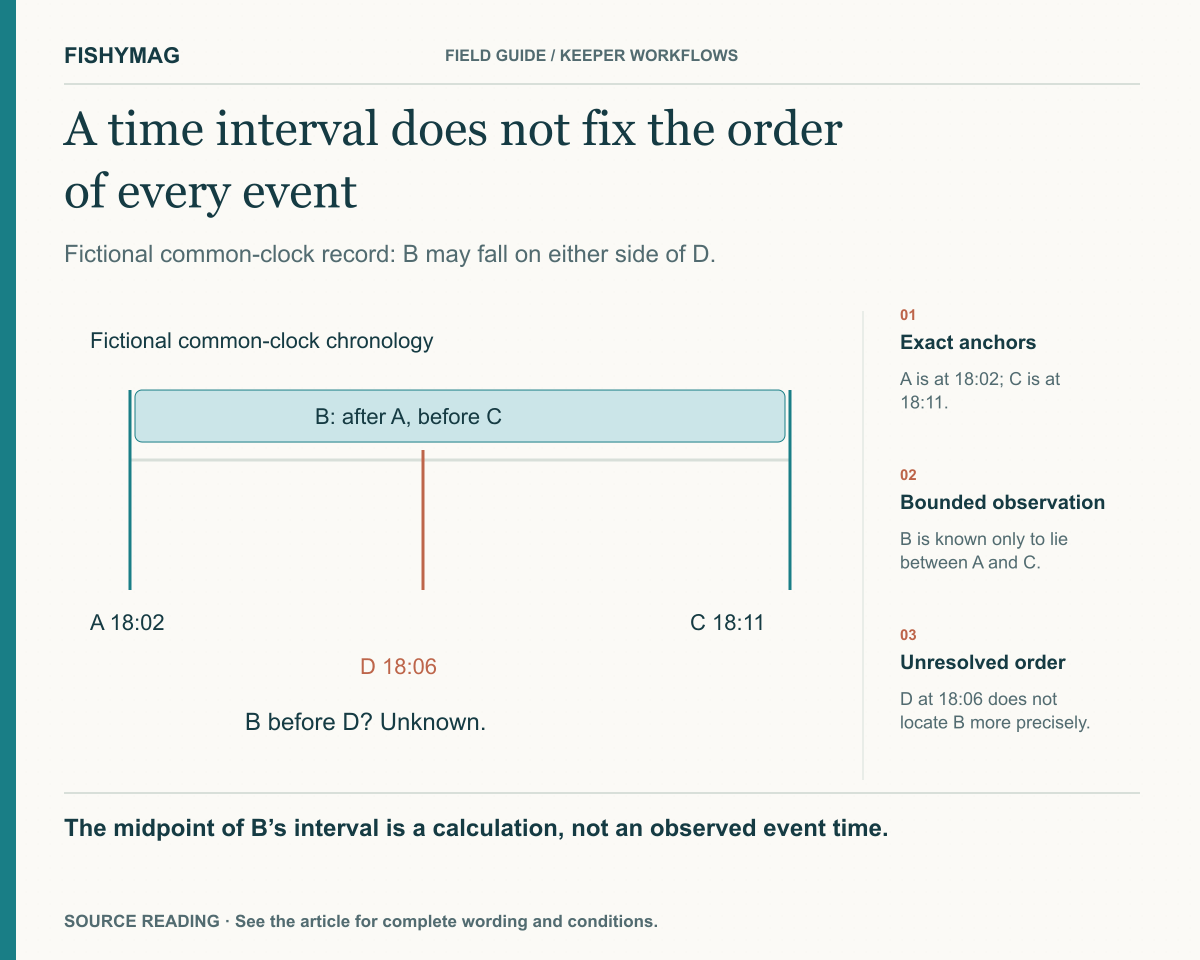
Figure data and explanation
Fictional common-clock record: B may fall on either side of D.
- Exact anchors
- A is at 18:02; C is at 18:11.
- Bounded observation
- B is known only to lie between A and C.
- Unresolved order
- D at 18:06 does not locate B more precisely.
The midpoint of B’s interval is a calculation, not an observed event time.
Preserve the source of each time
A camera timestamp, a controller entry and a later recollection are different evidence. Record the original time string and time zone before converting it. If device clocks have not been compared, flag that gap. This worked example assumes the listed records already share the same clock basis; it does not provide a clock correction for actual equipment. Reconstructing when something happened also does not establish why it happened.
Worked case: a bounded observation
The aquarium, identifiers and events below are fictional. A keeper knows when a display was photographed but recalls an equipment observation only between two other documented events. The table preserves that interval rather than manufacturing a midpoint.
| Event | Retained evidence | Time on the declared common clock |
|---|---|---|
| A: first aquarium photograph | Image A with retained timestamp | 18:02 exact in this example |
| B: unusual display noticed | Keeper note: after A, before C | Between 18:02 and 18:11 |
| C: second aquarium photograph | Image C with retained timestamp | 18:11 exact in this example |
| D: support note created | File creation record retained separately | 18:06 exact in this example |
Write the order that the evidence actually supports
A precedes B, and B precedes C, because the keeper’s bounded statement explicitly places it there. D occurs between the two photographs. However, B may be before or after D. Writing B at 18:06:30, the midpoint of its interval, would add information that the evidence does not contain. File creation time for D identifies creation of the support note in this case; it is not silently substituted for the time of an aquarium event.
| Comparison | Supported result | Reason |
|---|---|---|
| A versus B | A before B | Explicit lower bound |
| B versus C | B before C | Explicit upper bound |
| A versus D versus C | A before D before C | Declared exact timestamps |
| B versus D | Order unresolved | B interval spans D |
| B versus proposed midpoint | Midpoint not observed | No supporting timestamp exists |
Issue a chronology with visible uncertainty
A useful closing note is: “B was noticed after image A and before image C. Its order relative to support note D is unresolved.” Keep the source files and the keeper’s exact wording with that summary. A later clarification can narrow the interval, but retain the earlier version and the basis for the change. Do not infer equipment failure, chemical exposure or a biological cause from this chronology alone.
Use your own details
Rebuild an aquarium incident timeline without inventing exact times worksheet
Download the editable text file, fill it in on your device and keep it with the relevant record. This blank worksheet records your information; it does not verify entries or approve treatment.
- System and incident reference
- Event IDs and descriptions
- Original timestamp strings and zones
- Clock-comparison evidence or gap
- Earliest and latest supported time
- Source supporting each bound
- Supported event-order relationships
- Unresolved ordering and later clarification
Put it into practice
Your checklist
- Retain the original source and clock basis for every time.
- Keep a bounded interval when an exact instant is unsupported.
- Report unresolved order separately from any causal question.
Sources and scope
This article distinguishes manufacturer statements from FishyMag’s own workflows and arithmetic examples. Linked formulation records retain their own evidence dates; publishing this article does not refresh those records.
- FishyMag evidence methodology; reviewed November 8, 2026 ↗
- FishyMag local treatment log; reviewed November 8, 2026 ↗
- FishyMag keeper handover and editable backup; reviewed November 8, 2026 ↗
AI-assisted writing and development. Not hands-on product testing or veterinary review. How we publish →
FishyMag reports what manufacturers say, quoted and linked. It does not diagnose illness or recommend a treatment, and it never infers that a product is safe from the absence of a warning — where no statement exists, it says so.
Formulations change. Always read the label on the bottle in your hand, and contact the manufacturer if your tank contains anything valuable or unusual.